Showing posts with label Falmouth300. Show all posts

Monday, April 16, 2018

The Portland-Lewiston Interurban No. 14, Narcissus - West Falmouth, Maine

The Narcissus (left) and the Gladiolus at the West Falmouth substation
May 19, 1916. The PLI ended service on June 29, 1933.
The Narcissus is the only surviving high-speed, luxury interurban coach
from the PLI. The Narcissus is currently under restoration at
Seashore Trolley Museum in Kennebunkport, ME.
Image from DGC/ORC slide.

This post is a companion to the slide presentation program done by Phil Morse as a guest speaker for the Falmouth Memorial Library and Falmouth300 (the presentation includes Donald Curry presenting on the restoration of the Narcissus currently underway at Seashore Trolley Museum) and was made at the West Falmouth Baptist Church on Tuesday, April 17, 2018, at 6:30 p.m. The images and text are from various sources, including some that belong to Phil Morse. Other sources will be noted. Much of the text and many of the images were drawn from various books released by O. R. Cummings. O. R. wrote more than fifty books on electric railway systems throughout New England. O. R. passed away early in 2013. He was a member/volunteer at the New England Electric Railway Historical Society (Seashore Trolley Museum) starting in 1947, serving as its historian for many, many years. O. R. was a personal friend and is dearly missed.

 A great turnout! Donald Curry from the Seashore Trolley Museum in
Kennebunkport, ME, discusses the Narcissus 
restoration with the assembled guests attending the
Falmouth300 & Falmouth Memorial Library
April 17, 2018, presentation on the Portland-Lewiston
Interurban. PWM

The Narcissus /PLI display with items for sale to
benefit the Narcissus project at the presentation, 
Tuesday, April 17, 2018. PWM

This material is not intended as a comprehensive history of the Portland-Lewiston Interurban or the railway systems that served the greater Falmouth area. Instead, it was tailored for the Falmouth audience attending the public presentation at the West Falmouth Baptist Church on April 17, 2018. Its intent was to show a glimpse of how the Portland-Lewiston Interurban and its employees were important to the communities they served in the early 1900s and to let them know that one of these majestic PLI interurbans, the Narcissus, was saved and is currently being restored at Seashore Trolley Museum.

The Portland-Lewiston Interurban 1910-1933

The Portland-Lewiston Interurban (PLI) operated in West Falmouth from 1914 until 1933 and carried a total of 7.3 million passengers traveling between Portland and Lewiston. Serving the communities of Lewiston, Auburn, New Gloucester, Gray, West Cumberland, West Falmouth, and Portland. Operating over some 30 miles of well-ballasted private right-of-way and trackage rights into both Portland and Lewiston. The PLI was special, a jewel that was cherished by its employees and patrons alike.

First, we will briefly visit the early years of the electric railway service in Falmouth. The Portland & Yarmouth Electric Railway was awarded its charter on November 21, 1894. In 1895, the company obtained locations in Portland, Deering, Falmouth, Cumberland, & Yarmouth. A change in ownership occurred early in 1897, followed by controversies that led to legal action. Finally, in August of 1897, the construction of the line started. The rebuilding of Tukey's Bridge delayed the completion of the railway for a year. Service from Portland to the Cumberland/Yarmouth town line was opened on August 1, 1898. The balance of the line to the Grand Trunk Railroad depot at Yarmouth was completed on August 18, 1898.

No. 3, an 1897 combination car. Express (light freight) and
passengers were both carried. O. R. Cummings
"Portland Railroad, January 1957.

Martin's Point Bridge between Portland and Falmouth.
From the NEERHS 2015 book, "The Illustrated Atlas of
Maine's Street & Electric Railways 1863-1946."

     A half-hour schedule between Portland and Yarmouth was in effect, the nearly thirteen-mile route having a one-hour running time. The Portland Railroad took stock control of the Portland & Yarmouth line on December 11, 1900.

     The route of the Yarmouth line, Monument Square via Elm and Oxford Streets to Washington Avenue; Washington Avenue to Veranda Street; Veranda Street to Martin's Point Bridge; Route One through Falmouth and Cumberland Foresides to Yarmouth; Pleasant and Main Streets to Grand Trunk Depot in Yarmouth. 12.44 miles. Services on the Yarmouth line, outward from the Marine Hospital, were abandoned on June 29, 1933. The same-day service ended for the Portland-Lewiston Interurban.

From the NEERHS 2015 book, "The Illustrated Atlas of
Maine's Street & Electric Railways 1863-1946."

From O. R. Cummings' 1957 book,
"Part 1 - Portland Railroad."

Falmouth had Maine's only electric fountain at Underwood Spring Park.
The Portland & Yarmouth Electric Railway opened the park in the summer
of 1899.

Built upon an underground spring that gushed forth a quarter of a million
gallons of healthy water every 24 hours. Day-trippers from Portland
could depart Monument Square every 30 minutes, every 15 minutes during
peak times. 20 cents round trip. Every evening between 8 and 9 p.m.,
an engineer would operate the electric fountain, manipulating its
controls to create a shifting rainbow of color in the water. The casino and
theater burned down in 1907 and were never rebuilt.  Text and images from
2012 NEERHS book, "The Trolley Parks of Maine."

Trolley car No. 253 was built in 1912. Here at Skillins Corner
in Falmouth Foreside. The crew is "cutting the high centers" of the snow.
From the NEERHS 2015 book, "The Illustrated Atlas of
 Maine's Street & Electric Railways 1863-1946."
~~~~~~~~~~~~~~~
We continue the restoration work on the 1912 Narcissus, the only surviving high-speed, luxury interurban coach of the Portland-Lewiston Interurban. 

Click Here: Narcissus Restoration-Related Posts

Being more than a century old, the stately "Elegant Ride," Narcissus, is a gem.  This shimmering precious stone of Maine transportation history is brilliantly resplendent as it emanates so many elements of history, including time, places, people, and events, that it was coupled to, that when just a smattering of its seemingly innumerable stories are shared, the contents first captivate, fascinate, then generate interest to learn more 🙋. The majestic Narcissus is listed in the National Register of Historic Places.

Please consider joining the epic journey to complete the Narcissus Project by making a donation today!

Click Here: Donation Options

The restoration of this majestic icon of Maine's electric railway history is but one in a series of captivating stories containing an abundance of incredible coalition narratives.

Click Here: History-Related Posts - Narcissus and Portland-Lewiston Interurban

     The Narcissus is featured in the national Gold Award-winning novel, Teddy Roosevelt, Millie, and the Elegant Ride. The "Elegant Ride" is the Narcissus. Theodore Roosevelt was a passenger on the Narcissus on August 18, 1914, between Lewiston and Portland, Maine, while campaigning for the Progressive Party candidates.

Click Here: Bookstores and Businesses promoting the Narcissus Project

Independent book publisher, Phil Morse, holding
Gold Book Award Winner plaque for
 Middle Reader category for The Eric
Hoffer Book Award. Congratulations to
award-winning Maine author,
Jean M. Flahive

Tuesday, January 23, 2018

$40,000 Donation From 20th Century Electric Railway Foundation For the Narcissus

Narcissus Project manager, Phil Morse, is holding the $40,000 check
from the 20th Century Electric Railway Foundation, with
lead restoration technician, Donald Curry, to the right and
1912  Narcissus in the background. The photo was taken
in the Seashore Trolley Museum's Donald G. Curry Town House
Restoration Shop in Kennebunkport, Maine
January 23, 2018. PWM

"The 20th Century Electric Railway Foundation is proud to be able to match this very important project and looks forward to assisting with other grants in the future. The Narcissus Project has been a special project to Art Jones and Joe Brogan for a long time, and they are thrilled that they are seeing real progress."
Sheila Cook
Secretary
20th Century Electric Railway Foundation

The 20th Century Electric Railway Foundation in La Canada, CA, first provided a matching grant opportunity to benefit the Narcissus in the fall of 2014. We had 90 days to raise the initial $10,000. Once raised, donations would be matched dollar-for-dollar, up to the full $10K. We were successful that fall in raising the full $10K in ninety days. The largest portion was donated by individuals who were either staff members or alumni from my employer in Saco, Maine, Thornton Academy.

In the months following the successful matching grant campaign, I would occasionally send project progress updates to the secretary of the 20th Century Electric Railway Foundation. Later in the autumn of 2015, the Foundation secretary at the time called me to discuss the progress of the Narcissus Project. That conversation led to a discussion about other future plans for the Museum. Ultimately, from that conversation, two separate matching grant opportunities were offered to the Museum. Starting early in 2016, the $40,000 matching grant to benefit the Narcissus was kicked off, followed later by a $75,000 matching grant challenge to benefit Seashore Trolley Museum's Preserve & Protect capital campaign. The initial goal for both of these very generous and important fundraising opportunities for the Museum was met in 2017!

Later in 2017, our paperwork was prepared, sent to the Foundation and verified, and a $40,000 check for the Narcissus Project was issued and mailed to the Museum late last week.

As the project manager for the Narcissus Project, it is very exciting and humbling to receive so many donations from so many different people, families, non-profit organizations, and grantors with the common goal of helping to raise the money necessary to continue the work to restore the only surviving Portland-Lewiston Interurban, the Narcissus. Let's keep it going 😀

Thank you to everyone who has helped Narcissus to this point. We still need to continue to collectively spread the word about the project. I encourage you to invite others to join the effort to bring this beauty back into being the majestic, elegant, operating representative of Maine's premier electric interurban railway.

One way to explain what the Narcissus Project is about is by sharing the posts from the Narcissus Project blog: www.narcissus1912.blogspot.com

Lots of folks find the posts very interesting.

The blog is a great way to spread the news of Narcissus.

Let's keep it going......

What's next for Narcissus? 2018

Restoration work will continue on the exterior of the Narcissus. 

The image above was taken 10/23/17 by PWM. All roof ribs were removed, repaired,
primed, and replaced. Ten needed to be replaced. The left side has had
its end boards secured to the roof rib tenons. The right side end boards are
nearly all in place. 

Donald Curry is working on securing the right end boards to the
roof ribs tenons. 10.23.17 PWM

Major side sill and bolster work is in the early stages.
The bolsters will be removed, assessed, repaired, pieces replaced
as necessary, primed, painted, and then reinstalled. Side sills and
their attached channel steel lengths will be removed, assessed,
repaired, and replaced as necessary. 10-23-2017 PWM

Morrison Hill Station

Over several weeks from July until the end of October, the petite 1915 Portland-Lewiston Interurban waiting station, originally located in West Cumberland (ME), had its window and door sills replaced and painted. Window trim boards replaced and painted, metal roof edges repaired and painted, the west-facing roof panels sanded and painted, exterior walls (yellow) north, south, and west repainted, and the tiny wooden electrical box that feeds the 600 volts (DC) lights of the building fully rebuilt, primed, and painted, and many interior upgrades. All these improvements (and a few more to follow) are in preparation for the building to be the home of an exhibit next season about the Portland-Lewiston Interurban.

This picture was taken on October 23, 2017. 1915 PLI Morrison Hill Station
looks great with fresh upgrades and paint. PWM

Inside Morrison Hill Station. New floating oak flooring, newly painted
kickboards, and new kickboards and trim were painted and is awaiting
installation. 10.20.17 PWM

Interior of Narcissus

Patented interlocking rubber floor tiles in the smoking compartment
and down the center aisle of the passenger body floor of the Narcissus.
We will be seeking contractors and prices on making new tiles, as
well as seeking solutions to properly repair the tiles for possible reuse.
10-23-2017 PWM

Seats for the Narcissus. We will make all 20 walkovers and mohair plush
upholstered seats from scratch. We have prices from two foundries
to cast all the various metal components. Funding the cost to
cast original patterns and then the various components is the
highest priority for fundraising now. Image of the interior of 1912,
Portland-Lewiston Interurban No. 16, Clematis. This
image has the viewer peering down the aisle towards the number

two end of the Clematis. Image from Seashore Trolley Museum 

One of the newly restored mahogany sash windows (5 of 8 completed so far)
that are contained in the two bulkheads. Additional interior work will include rewiring
the Narcissus. When the body was Vallee's summer home,
120-volt household wiring was added, and much of the original
wire was removed. October 2017 image PWM
~~~~~~~~~~~~~~~
We continue the restoration work on the 1912 Narcissus, the only surviving high-speed, luxury interurban coach of the Portland-Lewiston Interurban. 

Click Here: Narcissus Restoration-Related Posts

Being more than a century old, the stately, "Elegant Ride," Narcissus, is a gem.  This shimmering precious stone of Maine transportation history is brilliantly resplendent as it emanates so many elements of history, including time, places, people, and events, that it was coupled to, that when just a smattering of its seemingly innumerable stories are shared, the contents first captivates, fascinates, then generates interest to learn more 🙋. The majestic Narcissus is listed in the National Register of Historic Places.

Please consider joining the epic journey to complete the Narcissus Project by making a donation today!

Click Here: Donation Options

The restoration of this majestic icon of Maine's electric railway history is but one in a series of captivating stories containing an abundance of incredible coalition of narratives.

Click Here: History-Related Posts - Narcissus and Portland-Lewiston Interurban

     The Narcissus is featured in the national Gold Award-winning novel, Teddy Roosevelt, Millie, and the Elegant Ride. The "Elegant Ride" is the Narcissus. Theodore Roosevelt was a passenger on the Narcissus on August 18, 1914, between Lewiston and Portland, Maine, while campaigning for the Progressive Party candidates.

Click Here: Bookstores and Businesses promoting the Narcissus Project

Independent book publisher, Phil Morse, holding
the Gold Book Award Winner plaque for
 Middle Reader category for The Eric
Hoffer Book Award. Congratulations to
award-winning Maine author,
Jean M. Flahive

Tuesday, January 16, 2018

Pre-PLI: Trolley Service Between Portland and the Twin Cities of Lewiston and Auburn

A photograph of an unknown motorman of the Lewiston, Augusta &
Waterville Street Railway (LA&W). We would really like to know his
name. The LA&W operated from May 1, 1907, through September
30, 1919. Please contact me if you have a lead.
Thank you. email: p.morse31@gmail.com PWM photo 

    Donald Curry and I are volunteers at the Seashore Trolley Museum in Kennebunkport, Maine. We often travel together to conduct presentations/lectures in communities that have some connection to the Portland-Lewiston Interurban line (PLI) in Maine or to the PLI interurban, Narcissus. The Narcissus is currently being restored at the Seashore Trolley Museum in the Donald G. Curry Town House Restoration Shop. In the spring of 2018, we have PLI presentations scheduled in Lewiston, West Falmouth, and West Cumberland (scroll down this page to see the specific dates, times, etc.) One of the points brought up early in the presentation is how one would travel between the Twin Cities using electric trolleys before the PLI provided service starting in 1914. This blog post will provide some background to that point.

The heart of the Lewiston, Augusta & Waterville Street Railway system
was Hulett Square, at the intersection of Main and Lisbon Streets in
Lewiston. A Waterville-bound car is shown turning into
Lisbon Street (left), while a car from Bath stands in front of the
waiting room. Currently, J. Dostie Jewelers occupies the street-level
space of the building on the left, formally known as the "Journal" building.
PWM postcard

From O. R. Cummings' "Maine's Fastest Electric Railroad" 
     Trolley service between Portland and the Twin Cities of Lewiston and Auburn had its beginnings on August 8, 1902, when the Portland & Brunswick Street Railway, incorporated the previous year, opened its 15.4-mile line from the college town of Brunswick southerly through Freeport and South Freeport to Yarmouth. At Brunswick, the Portland & Brunswick had a physical connection with the Lewiston, Brunswick & Bath Street Railway, constructed in 1898, and at Yarmouth, the Portland & Brunswick tracks dead-ended just a few feet from the rails of the Portland Railroad Company's Yarmouth Division, which was built in 1898 as the Portland & Yarmouth Electric Railway.

                                                 Cover photo of O. R. Cummings' 1966 publication

     The roundabout route between the Forest City (Portland) and Lewiston created by the opening of the Portland & Brunswick was 42 miles long, with a running time of more than three hours, and with two changes of cars - at Yarmouth and at Brunswick - initially being necessary. The service was frequent, however, and the combined fares of the three railways involved in the Portland-Lewiston trip were only 65 cents. (There would be a time between 1906 and 1919 when there was a joint operation between railways that eliminated one change of cars at Yarmouth).

     Of course, there were steam railroad lines between Portland and Lewiston - the Maine Central Railroad and the Grand Trunk Railway - but there were few trains on either line on weekdays and even poorer service on Sundays. 


     The Lewiston, Brunswick & Bath Street Railway, which also owned the local lines in Lewiston and Auburn, was absorbed by the Lewiston, Augusta & Waterville Street Railway in 1907, and in 1913, the former Portland & Brunswick, which had been reorganized as the Brunswick & Yarmouth Street Railway in 1911, was merged into the Lewiston, Augusta & Waterville system. (The Portland-Lewiston Interurban opened on July 2, 1914) The Lewiston, Augusta & Waterville went into receivership in December 1918 and was reorganized on October 1 of the following year (1919) as the Androscoggin & Kennebec Railway. 

     "Electric Railway King of Maine"
     Amos F. Gerald, "The Electric Railway King of Maine", seemed to have his hand in nearly every electric railway charter during the heyday of electric railway development in the Pine Tree State.
Gerald created both the Lewiston, Brunswick & Bath Street Railway and the Portland & Brunswick Street Railway. 

Photo from O. R Cummings' 1966 publication,
"Trolleys to Brunswick, Maine"
railway systems throughout New England.

Bath carhouse of the Lewiston, Brunswick & Bath and the parlor car,
"Merrymeeting" in 1899. This building was razed in 1911, and a smaller
barn was constructed from the materials. O. R. Cummings collection.

The "Merrymeeting" at the Tacoma Inn near Lewiston. The
"Merrymeeting" was a double-truck (two sets of wheels & motors)
parlor car built by the Briggs Carriage Company of Amesbury, MA, for
the Lewiston, Brunswick & Bath Street Railway cost $7,000.
Photo courtesy of Seashore Trolley Museum's Library. Text from
O. R. Cummings 1959 publication, "Trolley Parlor Cars of New England"

The "Merrymeeting" parlor car was delivered in May of 1899. It could
be chartered for $10 a day and was taken over by the Lewiston, Augusta
& Waterville Street Railway in 1907. It remained in service as late as
1917. It was stored until 1920 when its trucks were removed for use on a
freight car, and the body was scrapped :( Photo courtesy of Seashore
Trolley Museum's Library. Text from O. R. Cummings' 1959 publication,
"Trolley Parlor Cars of New England"

Pleasure Resorts
In O. R. Cummings' 1966 publication, "Trolleys to Brunswick, Maine"

     No self-respecting street railway company considered itself complete without a pleasure resort during the golden years of the trolley era, and both the Lewiston, Brunswick & Bath and the Portland & Brunswick maintained such facilities to help generate summer excursion traffic.
Click here for more on Trolley Parks in the heart of Maine by Seashore Trolley Museum.

Merrymeeting Park

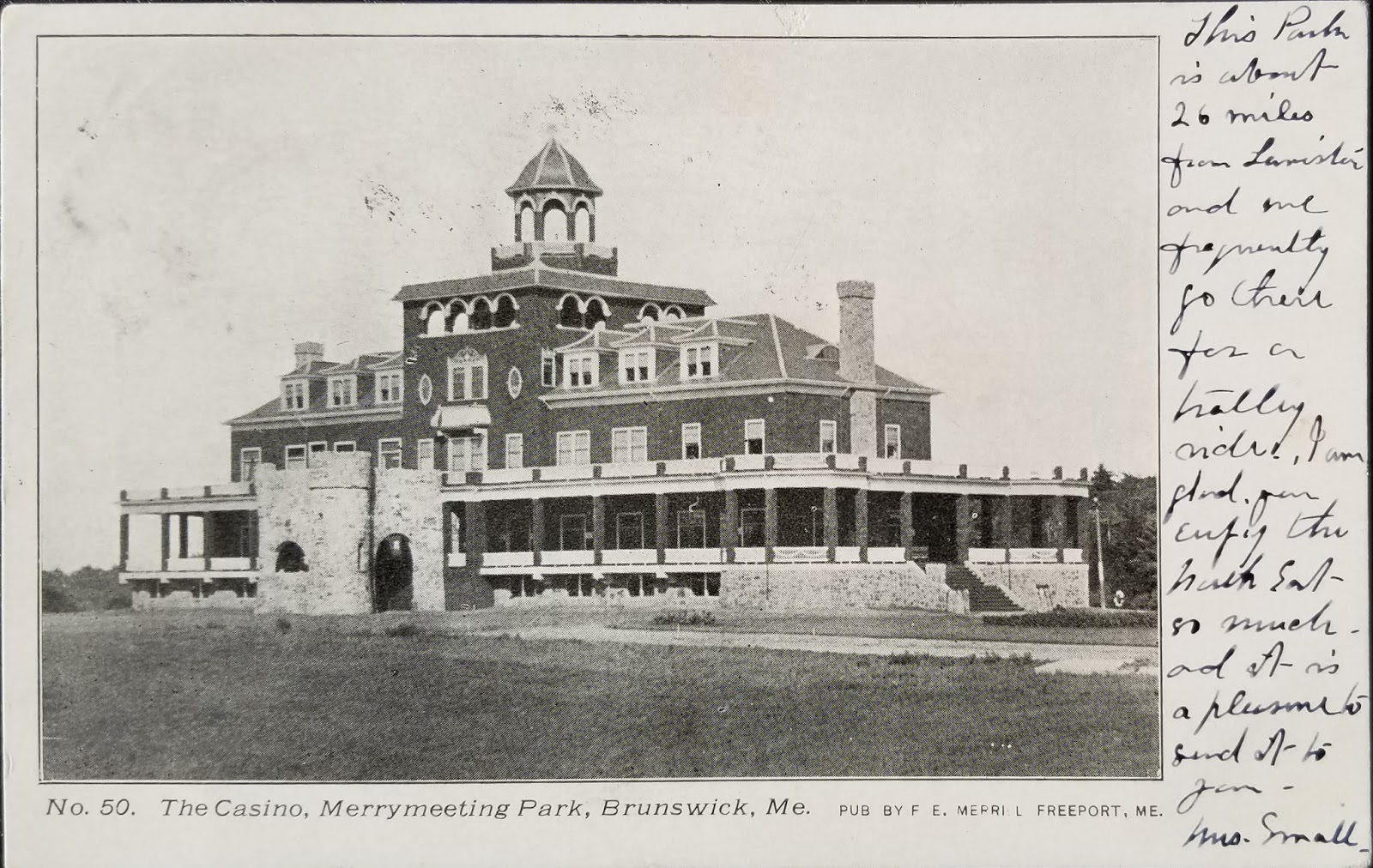
Merrymeeting Park was opened to the public in the summer of 1899.
The attractions included this $30,000 casino. Casinos of the day were
not gambling establishments. The three-story casino had broad verandas,
a very large dining room, a dance hall, a parlor, and smoking rooms.
PWM postcard

Twenty-six miles from Lewiston. Notice the castle-like stone attachment
to the veranda. Amos F. Gerald, the builder of the Lewiston, Brunswick
& Bath line, loved castles and frequently incorporated a castle into the
trolley parks he was associated with. PWM postcard

    Merrymeeting Park was located one and a half miles from Brunswick on a 147-acre tract along the Androscoggin River. On approach to the casino, the visitors passed through the zoological department, where numerous houses, cages, and pens for the fine collection of animals formed the principal attractions. The collection included a herd of buffaloes, bears, moose, elk, deer, and foxes. Vast lawns, ponds, and groves of trees made for a relaxing atmosphere. Frequently, the attendance in the early years at the park was from 2,000 to 4,000 people on a given day. The park's popularity did decline fairly quickly, though, and it was closed after the 1906 season.

PWM postcard

The amphitheater had seats for up to three thousand patrons and
programs that included band concerts, vaudeville, magic shows,
minstrels, comedies, and dramas.  PWM postcard

 Lake Grove Park
Lake Grove Park was located three miles from Lewiston at Auburn Lake. The attractions included a small rustic theater with an open stage. The setting was well shaded, and scattered among the trees were several animals, including bears, moose, and elk. On the lake, a large number of boats were kept, which were hired for boating and fishing. parties. Lake Grove was Maine's first park developed by a railway - opened in 1883 by the Lewiston and Auburn Horse Railway. It closed in 1928.

PWM postcard

PWM postcard

PWM postcard

Tacoma Inn
    The Tacoma Inn, near the intersection of Sand & Woodbury Ponds, was a favorite spot for factory and commercial outings. Only 14 miles from the Lewiston waiting station, there were many charter trips from Lewiston and Auburn to the Inn. An annual excursion was that of the Healy Asylum, a boys' orphanage in Lewiston. This yearly event was financed by a bequest in the will of W. Scott Libbey, builder of the Portland-Lewiston Interurban. Bates College, and probably Colby College classes and groups, held outings and reunions at the inn.

A feature attraction at the Tacoma Inn was the "High Diving White
Horses." The handsome white horses, "King" and "Queen," would jump
into Sand Pond from a high platform (info provided by

New Meadows Inn
     Another attraction on the Lewiston-Bath line was the privately-owned New Meadows Inn, on the bank of the New Meadows River in Bath. The inn was world-renowned for the quality and abundance of its shore dinners. Because of heavy traffic to and from the famous eating place, the railway provided a passenger platform, a small waiting station, and a siding near the inn.

Trolley stops at the New Meadows Inn platform. The Inn was
between   Merrymeeting stop (3 miles) and the Bath carhouse
(2.5 miles). O. R. Cummings collection at STM

A trolley on the Portland line to Yarmouth, Maine, where riders
could then board a trolley to Brunswick, change to a third trolley,
and then be on the way to Lewiston. PWM postcard
~~~~~~~~~~~~~~~
Click Here: For the list of links to Theodore Roosevelt Maine Heritage Trail Posts in Easy Order to View

We continue the restoration work on the 1912 Narcissus, the only surviving high-speed, luxury interurban coach of the Portland-Lewiston Interurban. 

Click Here: Narcissus Restoration-Related Posts

Being more than a century old, the stately "Elegant Ride," Narcissus, is a gem.  This shimmering precious stone of Maine transportation history is brilliantly resplendent as it emanates so many elements of history, including time, places, people, and events, that it was coupled to, that when just a smattering of its seemingly innumerable stories are shared, the contents first captivate, fascinate, then generate interest to learn more 🙋. The majestic Narcissus is listed in the National Register of Historic Places.

Please consider joining the epic journey to complete the Narcissus Project by making a donation today!

Click Here: Donation Options

The restoration of this majestic icon of Maine's electric railway history is but one in a series of captivating stories containing an abundance of incredible coalition narratives.

Click Here: History-Related Posts - Narcissus and Portland-Lewiston Interurban

     The Narcissus is featured in the national Gold Award-winning novel, Teddy Roosevelt, Millie, and the Elegant Ride. The "Elegant Ride" is the Narcissus. Theodore Roosevelt was a passenger on the Narcissus on August 18, 1914, between Lewiston and Portland, Maine, while campaigning for the Progressive Party candidates.

Click Here: Bookstores and Businesses promoting the Narcissus Project

Independent book publisher, Phil Morse, holding
Gold Book Award Winner plaque for
 Middle Reader category for The Eric
Hoffer Book Award. Congratulations to
award-winning Maine author,
Jean M. Flahive