Showing posts with label William Sewall. Show all posts

Thursday, February 23, 2023

Theodore Roosevelt Timeline Parallel with STM Railway Collection Part 1 - 1858-1900

Theodore Roosevelt utilized rail transportation throughout
his life. August 31, 1916, TR was a passenger aboard
the Portland-Lewiston Interurban, No. 16, Clematis.
He would also ride a PLI  interurban, No. 14, Narcissus,
August 18, 1914.  The Narcissus is currently undergoing
restoration in Kennebunkport, Maine, at the

Updated 6-10-2026

May 31, 2026, Joe Banavige released this wonderful American 250 Tribute to William W " Bill" Sewall, TR's Maine guide (along with Wilmot Dow, Bill's nephew) 
Click Here to see Joe's Substack post

Part 1 - 1858-1900

Click Here - Part 2 - 1901-1909
Click Here - Part 3 - 1910-1919

Theodore Roosevelt's Timeline and Parallels with
Seashore Trolley Museum's Historic Railway Collection 

(Excerpts in  part from Trolley Car Treasury, (1956) by Frank Rowsome)
      In the year of TR's birth, 1858, Philadelphia opened its first horsecar line.
Horse Railroads/Horse-drawn passenger cars (horsecars) on rails first came onto the public transportation scene in the late 1820s. They evolved from the earlier horse-drawn omnibus, which was basically a city version of the stagecoach. Manhattan had its first horsecar line in 1832. By the early 1850s, horsecar lines had been spreading throughout Manhattan and Brooklyn.

Horse Railroad of Fryeburg, Maine, 1887-1917 - postcard above
postmarked October 22, 1909 Collection of  PWM

     Many forms of "horseless" cars were tried over many years, but the system that ultimately won out was the electrically-fed trolley car designed by Frank Julian Sprague and first put into large-scale operation in Richmond, VA, beginning in January 1888.

     Seashore Trolley Museum's extensive collection includes railway vehicles and buildings that were built and were part of the fabric of public transportation throughout TR's life.
Trolley description details from the Seashore Trolley Museum website, a guide to the Seashore Trolley Museum Collection, and from Historic Cars by Ben Minnich.
Theodore Roosevelt's timeline info was taken from the NPS Theodore Roosevelt's Timeline.

Theodore Roosevelt (Left)                               Seashore Trolley Museum Collection (Right)
Timelines (abridged)

Click Here for the 28th East 20th Street - site                             Details on any of the vehicles
Click Here for the TR's First Visit to Maine - site                        in the Museum's Collection: Click Here
Click Here for the Island Falls, Maine began in 1878 - site           and then enter the car ##, scroll & hit enter

                                                      To see the STM Cars in the National Register of Historic Places: Click Here
Click Here for the TR visits MDI - site                                      Details on any of the vehicles
Click Here for the TR's wife Alice Lee related site                      in the Museum's Collection: Click Here
Click Here for the Dakota Territory related site                         and then enter the car ##, scroll & hit enter
                                                                                         Click Here for a brief history of the Mousam River RR

                                                     To see the STM Cars in the National Register of Historic Places: Click Here
Click Here for the Elkhorn Ranch site                                    Details on any of the vehicles
Click Here for the TR's wife Edith Carrow - site                         in the Museum's Collection Click Here
                                                                                         and then enter the car ##, scroll & hit enter
                                                                                                   
                                           To see the STM Cars in the National Register of Historic Places: Click Here
Click Here for the Rough Riders - site                                     Details on any of the vehicles
Click Here for the Spanish-American War site                          in the Museum's Collection Click Here
Click Here for the Remember the Maine site                          and then enter the car ##, scroll & hit enter
                                                                                  Click Here for a brief history of the Biddeford & Saco RR

Click Here - Part 2 - 1901-1909
Click Here - Part 3 - 1910-1919
                                                                                                                          
Resources 

Many Theodore Roosevelt-related Links are here - scroll down from here 

Following the guidance of the Maine Department of Education, these lesson plan units target the

2019 Maine Learning Results for Social Studies and Common Core State Standards:


English Language Arts Standards > History/Social Studies > Grades 6-8

The lesson plans in this companion to the curriculum explore a variety of topics, including;

  • The history of the trolley used early in the 20th Century - Maine
  • Maine rural life at the turn of the century,
  • The story of Theodore Roosevelt and his relationship with Maine
  • World War One
  • The flu pandemic of 1918-1920

Maine Historical Society has created eight companion lesson plan units inspired

by Teddy Roosevelt, Millie, and the Elegant Ride - These companion curricula are State standard-based

units for classroom use in grades 3-5 & 6-8 are now available as open-access

resources online through the Seashore Trolley Museum's website

www.trolleymuseum.org/elegantride/ and online at

Maine Memory Network with other statewide K-12 lesson plans. 


Content Areas and Strands:

* Social Studies - Civics & Government

* Social Studies - Geography

* Social Studies - History


Duration: 8-18 days


A time period: 1851-1920


Bicentennial Themes:

* Living in Maine

* The Business of Maine

* Maine Leads

* The Maine Character


Intended Outcomes:

  • Students will practice the skills involved in researching and analyzing primary sources.
  • Students will practice historical research skills.
  • Students will be able to identify different modes of transportation historically used in Maine
  • Students will be able to answer why the use of the trolley system was innovative and efficient.
  • Students will be able to identify different types of trolley cars that were used in Maine.
  • Students will be able to describe the history of the Portland-Lewiston Interurban and the Narcissus.
  • Students will be able to describe the shift from small family farms to commercial farming in ME.
  • Students will be able to identify the major agricultural industries and products historically associated with Maine.
  • Students will be able to describe life on an early 20th-century Maine family farm and how life has changed in Maine since the early 1900s.
  • Students will be able to describe the difference between attending school in the early 20th century and attending school today.
  • Students will be able to explain Theodore Roosevelt's connections to Maine and the people of Maine.
  • Students will be able to describe the work and accomplishments of Theodore Roosevelt.
  • Students will be able to describe the platform of the Bull Moose Party.
  • Students will be able to explain the role and duties of the president of the United States.
  • Students will consider what qualities and skills would make a person a good candidate for President of the United States.
  • Students will be able to describe the lives, work, and contributions of Americans on the home front during World War I using primary resources.
  • Students will be able to explain what propaganda is and how it was used by the U. S. government during World War I.
  • Students will be able to describe what many soldiers faced during World War I.
  • Students will be able to describe the impact of the 1918-1920 flu pandemic on World War I and the people in Maine.

Titles of Companion Lesson Plan Units

* "Clang, Clang, Clang, Went the Trolley..."
* Then and Now: Life in Maine
* Maine Agriculture
* The Narcissus and the PLI (Portland-Lewiston Interurban)
* Teddy Roosevelt in Maine
* President Theodore Roosevelt 
* World War l Letters
* United States Home Front and Propaganda during World War l

Vocabulary (Word banks and Reading activities) for grades 3-8, along with grades 6-8 ELA and History/Social Studies unit lesson plans, are available at www.trolleymuseum.org/elegantride/

Links to blog posts that include materials related to Lesson Plans above - More will be added over time

* "Clang, Clang, Clang, Went the Trolley..."
Click Here: Destinations Travel Times by Trolley "In-State" and to "Out-of-State"
Click Here: Field Guide to Maine Trolley Car Types - the 1870s-1930s
Click Here: Poetry Inspired by Trolleys and Operators 1898-1940

* Then and Now: Life in Maine
Click Here: Mildred Knowles Obrey 1908-2007 Oral History Transcript

* The Narcissus and the PLI (Portland-Lewiston Interurban)
Click Here: Narcissus and the PLI 

Continue to scroll down to see links and resources, People, Places, and Events in Teddy Roosevelt, Millie, and the Elegant Ride.

Click Here to go to the People, Places, and Events online resource post
Theodore Roosevelt
His Life and Times on Film -  Timeline - Library of Congress
Theodore Roosevelt Timeline - World War I  Theodore Roosevelt Center
Theodore Roosevelt Timeline - The Life of Theodore Roosevelt Theodore Roosevelt Center
TR - Brief Biography Theodore Roosevelt Center
TR - Connections to Maine: Narcissus Project Blog
TR - 26th President of the U.S. Whitehouse.gov
TR - Rough Rider in the White House (43a) USHistory.org
TR - Alice Hathaway Lee Roosevelt (First Wife) Theodore Roosevelt Center
TR - Alice Lee Roosevelt (First Daughter) Theodore Roosevelt Center
TR - Edith Carrow Roosevelt (Second Wife) Theodore Roosevelt Center
TR - Spanish-American War Theodore Roosevelt Center
TR - "Remember the Maine!" (44c)  USHistory.org
TR - Spanish-American War and Its Consequences (44d) USHistory.org
TR - 1912 Presidential Election (43f) USHistory.org
TR - Amazon Expedition/River of Doubt-Videos Library of Congress
TR - Malaria MentalFloss
TR - Panama Hat President 1906
TR - My Debt to Maine (TR's letter) - TR Maine Heritage Trail post
TR - Sagamore Hill National Park Service
TR - Sagamore Hill Friends of Sagamore Hill
TR - Died January 6, 1919/Young Memorial Cemetery-Video Library of Congress
TR - Quotes ("Feet on the Ground...") Goodreads
TR - General Wood  First World War
TR - African Safari - 1909

Suffrage/Women's Rights
Maine and National  Maine Suffrage Centennial
Women's Suffrage At Last (42-c) USHistory.org
Florence Whitehouse - suffragette - publicist for the Red Cross - Maine items - Maine Memory Network
Federal Suffrage amendment - Maine and National resources: Maine Suffrage Centennial
TR quotes in support of Women's Rights: Theodore Roosevelt Association
TR at Sagamore Hill with Suffragettes: Library of Congress video
19th Amendment to the Constitution Interactive Constitution

TR Children WW I - Library of Congress videos
Sons in Regiments - WWI-Video Library of Congress
Theodore (Ted) Roosevelt, Jr (First Son) Theodore Roosevelt Center
Kermit Roosevelt (Second Son) Theodore Roosevelt Center
Archibald (Archie) Roosevelt (Third Son) Theodore Roosevelt Center
Quentin (Fourth Son) Military.com
Ethel Roosevelt (Second Daughter) Theodore Roosevelt Center

TR and the Badlands/Dakota Territory
Timeline  Theodore Roosevelt Center

William (Bill) W. Sewall
William W. Sewall Theodore Roosevelt Center
Bill Sewall & Wilmot Dow - National Park Service
Mattawamkeag, Maine (train station) Mattawamkeag Facebook page
"The County" - Aroostook County
TR's visits to Island Falls: 1878 & 1879,  TR Maine Heritage Trail post

Politics
Bull Moose Party Britannica.com
Bull Moose Party Progressivism Sweeps the Nation 42 USHistory.org
Progressive Party - Student-Teacher Resource Study.com
Progressive Party U-S-History.com
Republican Party - 1916 UCSB.edu
Conservative/Progressive wings of the Republican Party (1916): Library of Congress
Democratic Party - 1916 UCSB.edu
William McKinley (25th President of the U. S.) Whitehouse.gov
William Howard Taft (27th President of the U.S.) Whitehouse.gov
Woodrow Wilson (28th President of the U.S.) Whitehouse.gov
Woodrow Wilson's New Freedom-43g USHistory.org
Charles Evan Hughes ConstitutionCenter.org

A portion of my collection of TR-related books :)
~~~~~~~~~~~~~~~
Click Here: For the list of links to Theodore Roosevelt Maine Heritage Trail Posts in Easy Order to View

We continue the restoration work on the 1912 Narcissus, the only surviving high-speed, luxury interurban coach of the Portland-Lewiston Interurban. 

Click Here: Narcissus Restoration-Related Posts

Being more than a century old, the stately, "Elegant Ride," Narcissus, is a gem.  This shimmering precious stone of Maine transportation history is brilliantly resplendent as it emanates so many elements of history, including time, places, people, and events, that it was coupled to, that when just a smattering of its seemingly innumerable stories are shared, the contents first captivates, fascinates, then generates interest to learn more 🙋. The majestic Narcissus is listed in the National Register of Historic Places.

Please consider joining the epic journey to complete the Narcissus Project by making a donation today!

Click Here: Donation Options

The restoration of this majestic icon of Maine's electric railway history is but one in a series of captivating stories containing an abundance of incredible coalition of narratives.

Click Here: History-Related Posts - Narcissus and Portland-Lewiston Interurban

     The Narcissus is featured in the national Gold Award-winning novel, Teddy Roosevelt, Millie, and the Elegant Ride. The "Elegant Ride" is the Narcissus. Theodore Roosevelt was a passenger on the Narcissus on August 18, 1914, between Lewiston and Portland, Maine, while campaigning for the Progressive Party candidates.

Click Here: Bookstores and Businesses promoting the Narcissus Project

Independent book publisher Phil Morse, holding
Gold Book Award Winner plaque for
 Middle Reader category for The Eric
Hoffer Book Award. Congratulations to
award-winning Maine author,
Jean M. Flahive

Saturday, August 27, 2022

Theodore Roosevelt Maine Heritage Trail - Star #29 - Northeast Piscataquis 1879

William Windgate Sewall (with an ax) and Wilmot S. Dow
(with a rifle) at camp on Pratt Cove, Mattawamkeag Lake,
Island Falls, Maine. The file is dated circa 1921. However,
Wilmot died in 1891 (35 years old). So, this image is pre-1891.
TRC 560.12-053 Houghton Library, Harvard University
Updated 6-10-2026

May 31, 2026, Joe Banavige released this wonderful American 250 Tribute to William W " Bill" Sewall, TR's Maine guide (along with Wilmot Dow, Bill's nephew) 
Click Here to see Joe's Substack post

    I first started researching Theodore Roosevelt in 2010. As a volunteer at Seashore Trolley Museum in Kennebunkport, Maine, overseeing the Narcissus project (Roosevelt was a passenger on the Narcissus on August 18, 1914), I felt the need to learn more about Roosevelt's visit to Maine. This initial research piqued my curious nature. I wanted to learn more about Theodore Roosevelt and his various visits to Maine.
    Twelve years later, that seed of curiosity has taken root and blossomed into the development of what is the Theodore Roosevelt Maine Heritage Trail: Connecting Maine Communities. Insight throughout the State of Maine is what this trail provides by tracing and describing Theodore Roosevelt's connections with each of these communities.

Each community is identified with a star with a number or
a moose with a letter. The key to the logo landmarks is below.
Each moose represents a community that has an indirect
connection with Roosevelt, meaning he may not have paid the
community a visit, and there is a meaningful connection to Roosevelt
in that community. The stars indicate a community
that Roosevelt visited and probably engaged with the people
and/or the local geography. As research continues, other
communities will be added to the logo.
Logo: "Designs by Reece" - Reece Saunders

Over the ensuing weeks, each of these
communities/landmarks with its Roosevelt
connections will have a separate page describing
details of TR's connections. Each will also
have a link(s) to local resources/venues.
Key by "Designs by Reece" - Reece Saunders

Today, we describe "Star 29" shown on the list (key) above - Northeast Piscataquis

The Sewall House in Island Falls, Maine. Theodore Roosevelt
spent many a night with the Sewall family when he was 
when he was visiting during three separate trips to the county
in 1878 and 1879. This image is c 1921 by Hermann Hagedorn
TRC 560.12-075 Houghton Library, Harvard University 

    TR's 1879 journal describes his visit to the Northeast Piscataquis area during the late summer. 
During the Mount Katahdin journey, he was joined by his cousin, William "Emlen" Roosevelt, and family friend, Arthur Cutler. Then, after returning from the Katahdin trek, TR and William Sewall together headed north to the  Oxbox, where they would paddle down the Aroostook River to the Munsunguns and Chase Rivers and back...then walk the approximately forty miles to Island Falls

Houghton Library, Harvard University

Katahdin trek 
* Mount Katahdin is now within the Baxter State Park
* The trek across the East Branch of the Penobscot, Wassataquoik Stream, and on to Katahdin Lake and Sandy Stream, all within the Katahdin Woods and Waters National Monument

Roosevelt writes...(No edits were made to the original writings)...

Saturday, August 23 - Reached Mattawamkeag at 10 a.m. and drove over to Island Falls. With Dave Sewall. Emlen and Mr. Cutler are here, and I shall make a short trip with them to Katahdin. 

Sunday, August 24 - Spent the day chiefly in preparations. I have 2 complete changes of clothes, & plenty of handkerchiefs & woolen socks. I dress in a flannel shirt & light, strong duck trousers & heavy underflannels; carry a heavy jacket & a blanket and have my necessaries in a small bag. I have taken both rifle & shot gun.

Tuesday, August 26 - Emlen, Arthur Cutler, Will Dow, Will Sewall & I started for Mt. Katahdin. Drove 23 miles; and carried our packs about 10, when we went into camp. I carried about 45 lbs, including my gun & cartridges. Crossing a stream I lost one of my shoes; fortunately, I had brought a pair of moccasins tied to my pack.

Wednesday, August 27 - Walked up the head of Katahdin Lake where we camped. I get along very well with my pack. Killed four ducks in a logan, after a rather neat stable; also picked up a couple of partridges. We caught a few trout. Black flies are pretty bad; but they do not bother us at night; it is very pleasant in the evenings, with the roaring logs of the camp fire.

Thursday, August 28 - After lunch we started for Katahdin; (before I had tramped about 5 miles after partridges). We caught about 100 trout at Sandy Brook; then got lost; and after tramping through frightful ground till after dark camped out by a small water hole; wet, tired and hungry - but happpy. There are plenty of fresh tracks of both bear & caribou, but we saw nothing living except the usual woodpeckers, chickadees, jay, &c &c.

Friday, August 29 - Started before daybreak, walking straight through the woods, & up then up Katahdin; it was very difficult walking, & both Emlen & Arthur gave out before reaching the summit, the view from which was beautiful. I find I can endure fatigue & hardship pretty nearly as well as these lumbermen. Coming back we followed a spotted trail which sometimes set at fault even the two skilled backwoodsmen. Reached our camp at Katahdin Lake about dark, having caught about 60 trout. It is railing & we are all soaked through but in excellent health and spirits.

Saturday, August 30 - In the morning walked half way round the lake but saw nothing; there are very few partridges and few ducks round here & larger game is not scarce, but almost impossible to get at. In the afternoon walked some distance down beside Sandy Brook; coming home killed a duck in Moose Pond. Trout of small size are very plentiful.

Sunday, August 31 - Loafed about camp, cleaning guns, mending clothes, bathing in the lake &c. You get pretty dirty in camp. Black flies have been very numerous this trip, and have been a great annoyance to the others; funnily enough they do not bother me very much. There are plenty of fish round here, game is very scarce; but I am enjoying myself exceedingly.

Monday, September 1 - Was up before sunrire and took a trip round barrens and bogs; crippled a duck in a logan, but it crawled off among the rushes. In the afternoon we shouldered our packs, broke camp & started for Island Falls. After crossing the Wissatocook went into camp for the night. Am in beautiful condition & find I can walk, wrestle & shoot with most of the lumbermen

Tuesday, September 2 - Started in good season, walking out to the East branch of the Penobscot, which we crossed, & then drove to Island Falls. I have enjoyed the trip exceedingly; the boys are most pleasant companions.

Munsungun Lakes Trek

Thursday, September 4 - Spent the day preparing for my Munsungun trip; I shall go in a canoe, alone with Sewall. For provisions I took pork and hardtack and some flour; we have a shelter tent, two blankets & some cooking utensils; & one complete change of clothing each. I take 50 cartridges for the rifle and 100 for the shotgun. I shall only use moccasins.

Friday, September 5 - Started out at 5 a.m. in a rough wagon to drive to the Oxbow of the Aroostook River - 46 miles distant. We reached it 6 p.m. and are staying in a regular backwoods house - fare and sleeping accommodations being both primitive to a degree. The route all day long was through a sparsely settled, thickly wooded country & for about 3 miles through a dreary waste of burnt land.

Saturday, September 6 - Started in fair season in a pirogue or dugout. It stands rough work better than a birch canoe. We went about 20 miles up the Aroostook, paddling sometimes, but poling most of the way. The scenery is very beautiful and wild; I saw no trace of man - but also no trace of game. Trout are plenty, however. Pitched a camp before dark, to cook the bread, trout & partridge. Black flies, mosquitoes & midge pretty plentiful; I don't mind them much.

Sunday, September 7 - We started as usual, as there was no use of laying up; but I compromised by not shooting or fishing. We poled up the Aroostook (River) till lunch time, when we were near the mouth of the Munsungun; up this we had to wade, dragging our boats - the water now up to our ankles, now to our hips. It was heavy work; moreover it was raining heavily; and towards dusk we pitched camp, drenched through & tired out. Midges bad.

Monday, September 8 - Rained hard all day. We started early; for several hours it was rapid, shoal water, through which we waded, dragging the heavy dugout over the rocks and shallows; then we got into deeper, dead water, but this was nearly as bad owing to the beaver dams and log jams which we had to cut through or pull round. There were some falls we had to get up, taking everything out of the boat; then we poled up through more dead water; then paddled through the lowe rMunsungun Lake, & halfway up the middle one, where we camped. Tired out, & wet through, hungry & cold - but am having a lovely time. But no trace of game.

Tuesday, September 9 - Rained all day; but we paddled up the middle lake and then walked  (through most frightfull ground) to the head of the upper one (Chase Lake). On the way I saw a few partridges; an old moose track; a recent bear track; and a few old signs of deer and caribou. On the lake are a few loons and fish ducks. As game is so scarce I shall go right back to Island Falls, instead of staying up here, as I had intended. Am wet through, as usual, and rather tired, but, although the work is very hard, I am enjoying the trip greatly.

Wednesday, September 10 - Rose before daybreak & started before sunrise, down the lake. Paddled through the lake and dead water, running that falls, then waded down through the Munsungun quick water, lunching where we camped Sunday night; then we poled, (making fine time down the swift waters and only occasionally having to get out and wade) until early in the afternoon we reached our Saturday camp where we are now. I am very fond of the evenings round the camp fire, beneath the shelter tent.

Thursday, September 11 - Started in fair season, paddled down stream in great style; on the way I shot a wood duck. At the Oxbow we disembarked and walked about 15 miles (half of the way across country) to a rough backwoods house, where we are now. Fare pretty rough, but plenty of good milk, and we have shot our own meat - as, besides the duck, I killed a rabbit and a partridge on the way.

    Theodore Roosevelt made several visits to Maine. Yes, there were times, when he was older, that those visits would have been made as necessitated by his politics. However, the majority of his visits were for personal gain. I speak of personal gain in the sense of his own personal health and well-being. We know Maine as "Vacationland" or as "The Way Life Should Be". Maine has long been known as a place to "re-create", renew one's self and contemplate one's purpose or direction. Whether being near the ebb and flow of the mesmerizing coastline or taking in its breathtaking vistas along so many beautiful rivers and mountains, this great state of Maine has drawn many a soul in seeking fresh air and perhaps inner guidance to a fresh start.

TR, late in his sophomore year at Harvard,  ca 1878 May
His first visit to Island Falls, Maine, was in September 1878
TRC 520.12-003, Houghton Library, Harvard University

 Throughout his adult life, Theodore Roosevelt, the 26th President of the United States, expressed how much he treasured his visits to Maine as a young man and, in particular, how much he truly valued the friends he made in Island Falls during those visits.

William "Bill" W. Sewall - Bio
William W. Sewall - Theodore Roosevelt Center, Dickinson State University, ND
Bill Sewall & Wilmot Dow - The National Park Service

Mt Katahdin from Katahdin Stream Camp Grounds,
image from a postcard, PWM

Chimney Pond on Mt. Katahdin, image from a postcard, PWM

I strongly recommend you acquire a copy of Andrew Vietze's book, Becoming Teddy Roosevelt: How a Maine Guide Inspired America's 26th President. Great reading for all ages.

Paperback issue

Hardcover first edition copy
of Andrew Vietze's "Becoming Teddy
Roosevelt" PWM Collection

A great resource for TR's diaries
1877-1886 - A Most Glorious Ride
Edited by Edward P. Kohn
PWM Collection

A portion of my collection of TR-related books :)
~~~~~~~~~~~~~~~
Click Here: For the list of links to Theodore Roosevelt Maine Heritage Trail Posts in Easy Order to View

We continue the restoration work on the 1912 Narcissus, the only surviving high-speed, luxury interurban coach of the Portland-Lewiston Interurban. 

Click Here: Narcissus Restoration-Related Posts

Being more than a century old, the stately, "Elegant Ride," Narcissus, is a gem.  This shimmering precious stone of Maine transportation history is brilliantly resplendent as it emanates so many elements of history, including time, places, people, and events, that it was coupled to, that when just a smattering of its seemingly innumerable stories are shared, the contents first captivates, fascinates, then generates interest to learn more 🙋. The majestic Narcissus is listed in the National Register of Historic Places.

Please consider joining the epic journey to complete the Narcissus Project by making a donation today!

Click Here: Donation Options

The restoration of this majestic icon of Maine's electric railway history is but one in a series of captivating stories containing an abundance of incredible coalition narratives.

Click Here: History-Related Posts - Narcissus and Portland-Lewiston Interurban

     The Narcissus is featured in the national Gold Award-winning novel, Teddy Roosevelt, Millie, and the Elegant Ride. The "Elegant Ride" is the Narcissus. Theodore Roosevelt was a passenger on the Narcissus on August 18, 1914, between Lewiston and Portland, Maine, while campaigning for the Progressive Party candidates.

Click Here: Bookstores and Businesses promoting the Narcissus Project

Independent book publisher Phil Morse, holding
Gold Book Award Winner plaque for
 Middle Reader category for The Eric
Hoffer Book Award. Congratulations to
award-winning Maine author,
Jean M. Flahive

Tuesday, August 23, 2022

Theodore Roosevelt Maine Heritage Trail - Start #19 - Bangor 1902

President Roosevelt at the Bangor train station
August 27, 1902. TRC 560.51 1902-079
Houghton Library, Harvard University

 Updated 7-12-2026

May 31, 2026, Joe Banavige released this wonderful American 250 Tribute to William W " Bill" Sewall, TR's Maine guide (along with Wilmot Dow, Bill's nephew) 
Click here to see Joe's Substack post

    I first started researching Theodore Roosevelt in 2010. As a volunteer at Seashore Trolley Museum in Kennebunkport, Maine, overseeing the Narcissus project (Roosevelt was a passenger on the Narcissus on August 18, 1914), I felt the need to learn more about Roosevelt's visit to Maine. This initial research piqued my curious nature. I wanted to learn more about Theodore Roosevelt and his various visits to Maine.

    Twelve years later, that seed of curiosity has taken root and blossomed into the development of what is the Theodore Roosevelt Maine Heritage Trail: Connecting Maine Communities. Insight throughout the State of Maine is what this trail provides by tracing and describing Theodore Roosevelt's connections with each of these communities.

Each community is identified with a star with a number or
a moose with a letter. The key to the logo landmarks is below.
Each moose represents a community that has an indirect
connection with Roosevelt, meaning he may not have paid the
community a visit, and there is a meaningful connection to Roosevelt
in that community. The stars indicate a community
that Roosevelt visited and probably engaged with the people.
And/or the local geography. As research continues, other
communities will be added to the logo.
Logo: "Designs by Reece" - Reece Saunders

Over the ensuing weeks, each of these
communities/landmarks with its Roosevelt
connections will have a separate page describing
details of TR's connections. Each will also
have a link or links to local resources/venues.
Key by "Designs by Reece" - Reece Saunders

Today, we describe "Star 19" shown on the list (key) above - Auburn 1902

Biddeford Daily Journal - Evening - August 27, 1902

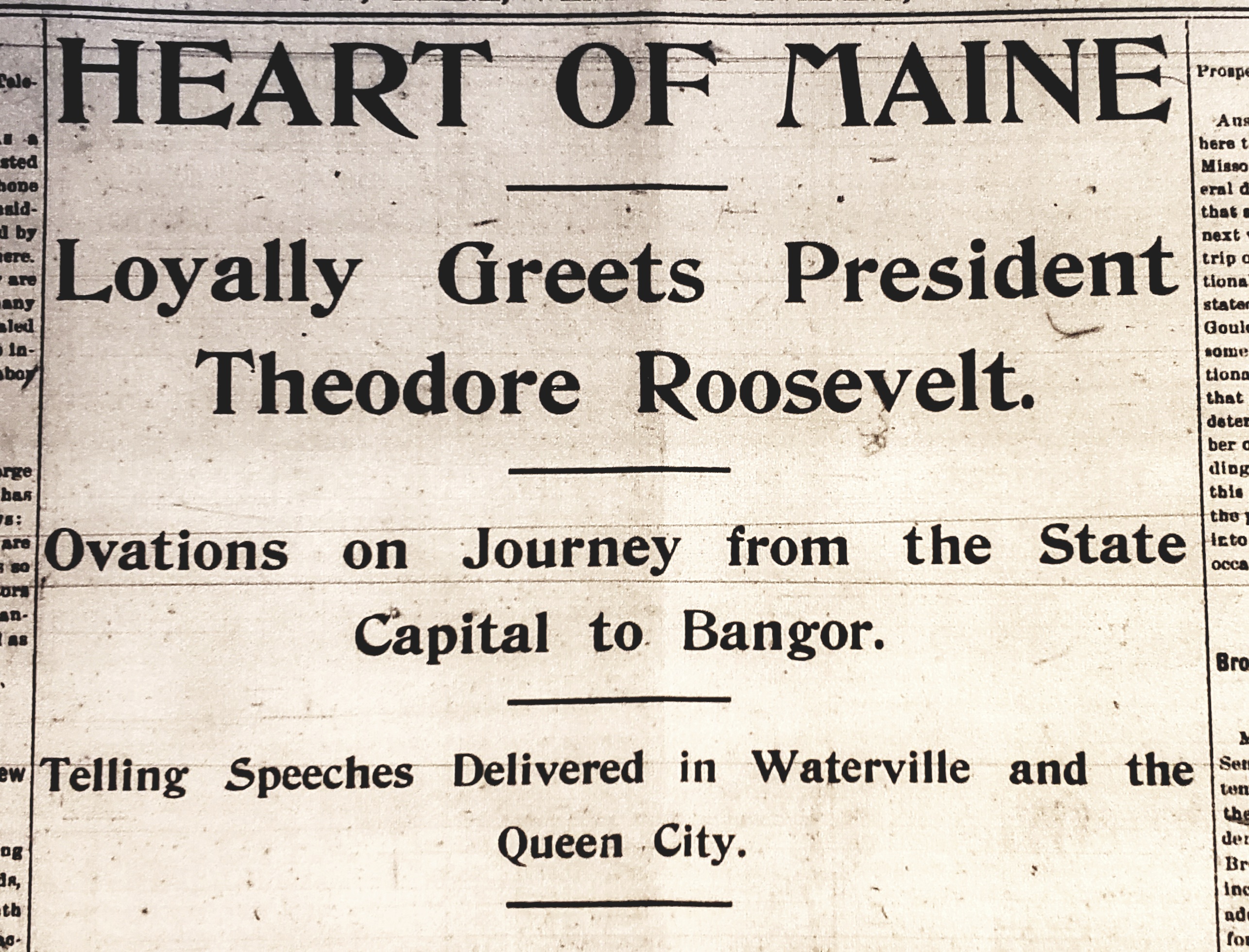
Many details of President Roosevelt's visit
 - front page of the Daily Kennebec Journal -
August 28, 1902 - Library of Congress

Hundreds of people would be at the
various train stations along the route
to see the Presidential train passing through their
community. This was the scene at every Maine depot.

A brief summary of the President's Day in Bangor. Newspaper estimates of the number of people attending the President's speech at the fairgrounds - 30,000 to 50,000.

Biddeford Weekend Journal, August 29, 1902

The Bangor House c 1895-1900 

Details of the President's visit to Bangor.

Library of Congress

Ibid

Ibid

Ibid

Ibid


The Daily Kennebec Journal, August 28, 1902. Publication of the President’s speech in Bangor at the Bangor House on August 27. 1902:
(autocorrect disconnected - text is as written)

My fellow citizens, my fellow countrymen:

It is indeed a great pleasure to be greeted by you today, as it has been to be greeted by people all over Maine. I can see by your faces that the old American spirit still burns as freely as ever. Driving through the thronged streets, I see men who wear the button which tells that they fought in the great struggle. As soon as I saw the mounted policemen, I knew that some of them were old cavalrymen.

You men who fought in that war did the greatest deed which men have ever done. You preserved for us a united country and showed the world that it was ever to be united.

While modes of fighting were different in the time of Lincoln from that of Washington, and still more different today, the spirit that wins is just the same.

The soldier of today who is worth his salt must have the same spirit which won at Appomattox. The only way to obtain good government is for each man to do his own share.

Now, my friends, let me interrupt just for a moment. I have a friend here who is lost in the crowd somewhere. He is Bill Sewall, of Island Falls, Aroostook County, and if anyone sees him, please say to him that I want him to come to lunch with me here and now.


(Daily Kennebec Journal, Augusta, Maine, August 28, 1902)
The Daily Kennebec Journal article describes the end of Roosevelt's speech from
Bangor House balcony, and his accounts during the rest of the day in Bangor.


Daily Kennebec Journal, Morning -
Library of Congress


Ibid

Ibid

Ibid


Ibid

President Theodore Roosevelt's speech made at the Bangor Fairgrounds (Bass Park) on August 27, 1902:

My fellow citizens:

I am glad to greet the farmers of Maine. During the century that had closed, the growth of industrialism has necessarily meant that cities and towns have increased in population more rapidly than the country districts. And yet it remains true now, as it always has been, that in the last resort the country districts are those in which we are surest to find the old American spirit, the old American habits of thought and ways of living. Conditions have changed in the country far less than they have changed in the cities, and in consequences, there has been little breaking away from the methods of life which have produced the great majority of the leaders of the Republic in the past. Almost aloof our great Presidents have been brought up in the country, and most of them worked hard on the farms in their youth and got their early mental training in the healthy democracy of farm life.

The forces which made these farm-bred boys leaders of men when they had come to their full manhood are still at work in our country districts. Self-help and individual initiative remain to a peculiar degree typical of life in the country, life on a farm, in the lumbering camp, on a ranch. Neither the farmers nor their hired hands can work through combinations as readily as the capitalists or the wage-workers of cities can work.

It must not be understood from this that there has been no change in farming and farm life. The contrary is the case. There has been much change, much progress. The granges and similar organizations, the farmers’ institutes, and all the agencies which promote intelligent cooperation and give opportunity for social and intellectual intercourse among the farmers have played a large part in raising the level of life and work in the country districts. In the domain of government, the Department of Agriculture, since its foundation, has accomplished results as striking as those obtained under any other branch of the national administration. By scientific study of all matters connected with the advancement of farm life; by experimental stations; by the use of trained agents, sent to the uttermost countries of the globe; by the practical application of anything which in theory has been demonstrated to be efficient; in these ways, and in many others, great good has been accomplished in raising the standard of productiveness in farm work throughout the country. We live in an era when the best results can only be achieved if to individual self-help we add the mutual self-help which comes by combination, both of citizens in their individual capacity and of the citizens working through the state as an instrument. The farmers of the country have grown more and more to realize this, and farming has tended more and more to take its place as an applied science - though, as with everything else, the theory must be tested in practical work, and can avail only when applied in practical fashion.

But after all this has been said, it remains true that the countryman - the man on the farm, more than any other of our citizens today, is called upon continually to exercise the qualities which we like to think of as typical of the United States throughout its history - the qualities of rugged independence, masterful resolution, and individual energy and resourcefulness. He works hard (for which no man is to be pitied), and often he lives hard (which may not be pleasant); but his life is passed in healthy surroundings, surroundings which tend to develop a fine type of citizenship. In the country, moreover, the conditions are fortunately such as to allow a closer touch between man and man than, too often, we find to be the case in the city. Men feel more vividly the underlying sense of brotherhood, of community of interest. I do not mean by this that there are not plenty of problems connected with life in our rural districts. There are many problems, and great wisdom and earnest disinterestedness in effort are needed for their solution.

After all, we are one people, with the same fundamental characteristics, whether we live in the city or in the country, in the East or in the West, in the North or in the South. Each of us, unless he is contented to be a cumberer of the earth’s surface, must strive to do his life-work with his whole heart. Each must remember that, while he will be noxious to everyone unless he first do his duty by himself, he must also strive ever to do his duty by his fellow. The problem of how to do these duties is acute everywhere. It is most acute in great cities, but it exists in the country, too. A man, to be a good citizen, must first be a good bread-winner, a good husband, a good father - I hope the father of many healthy children; just as a woman’s first duty is to be a good housewife and mother. The business duties, the home duties, the duties to one’s family come first. The couple who bring up plenty of healthy children, who leave behind them many sons and daughters fitted in their turn to be good citizens, emphatically deserve well of the State.

But duty to one’s self and one’s family does not exclude duty to one’s neighbor. Each of us, rich or poor, can help his neighbor at times; and to do this, he must be brought into touch with him, into sympathy with him. Any effort is to be welcomed that brings people closer together, so as to secure a better understanding among those whose walks of life are in ordinary circumstances far apart. Probably the good done is almost equally great on both sides, no matter which one may seem to be helping the other. But it must be kept in mind that no good will be accomplished at all by any philanthropic or charitable work unless it is done along certain definite lines. In the first place, if the work is done in a spirit of condescension, it would be better never to attempt it. It is almost as irritating to be patronized as to be wronged. The only safe way of working is to try to find out some scheme by which it is possible to make a common effort for the common good. Each of us needs at times to have a helping hand stretched out to him or her. Every one of us slips on some occasion, and shame to the fellow who then refuses to stretch out the hand that should always be ready to help the man who stumbles. It is our duty to lift him up, but it is also our duty to remember that there is no earthly use in trying to carry him. If a man will submit to being carried, that is sufficient to show that he is not worth carrying. In the long run, the only kind of help that really avails is the help which teaches a man to help himself. Such help every man who has been blessed in life should try to give to those who are less fortunate, and such help can be accepted with entire self-respect.

The aim to set before ourselves in trying to aid one another is to give that aid under conditions which will harm no man’s self-respect, and which will teach the less fortunate how to help themselves as their stronger brothers do. To give such aid, it is necessary not only to possess the right kind of heart, but also the right kind of head. Hardness if heart is a dreadful quality, but it is doubtful whether, in the long run, it works more damage than softness of head. At any rate, both are undesirable. The prerequisite to doing good work in the field of philanthropy - in the field of social effort, undertaken with one’s fellows for the common good - is that it shall be undertaken in a spirit of broad sanity no less than broad and loving charity.

The other day, I picked up a little book called “The Simple Life,” written by an Alsatian, Charles Wagner, and he preaches such wholesome, sound doctrine that I wish it could be used as a tract throughout our country. To him, the whole problem of our complex, somewhat feverish modern life can be solved only by getting men and women to lead better lives. He sees that the permanence of Liberty and democracy depends upon a majority of the people being steadfast in morality and in that good plain sense which, as a national attribute, comes only as the result of slow and painful labor of centuries, and which can be squandered in a generation by the thoughtless and vicious. He preaches the doctrine of the superiority of the moral to the material. He does not undervalue the material, but he insists, as we of this nation should always insist, upon the infinite superiority of the moral, and the sordid destruction which comes upon either the nation or the individual is it or he becomes absorbed only in the desire to get wealth. The true line of cleavage may, and often does, run at right angles to that which divides the rich and the poor. The sinews of virtue lie in man’s capacity to care for what is outside himself. The man who gives himself up to the service of his appetite, the man who, the more goods he has, the more wants, has surrendered himself to destruction. It makes little difference whether he achieves his purpose or not. If his point of view is all wrong, he is a bad citizen whether he be rich or poor. It is a small matter to the community whether in arrogance and insolence, he has misused great wealth, or whether, though poor, he is possessed by the mean and fierce desire to seize a morsel, the biggest possible, of that prey which the fortunate of earth consume. The man who lives simply, and justly, and honorably, whether rich or poor, is a good citizen. Those who dream only of idleness and pleasure, who hate others, and fail to recognize the duty of each man to his brother, these, be they rich or poor, are the enemies of the State. The misuse of property is one manifestation of the same evil spirit which, under changed circumstances, denies the right of property because this right is in the hands of others. In a purely material civilization, the bitterness of attack on another’s possession is only additional proof of the extraordinary importance attached to possession itself. When outward well-being, instead of being regarded as a valuable foundation on which happiness may with wisdom be built, is mistaken for happiness itself, so that material prosperity becomes the one standard, then, alike by those who enjoy such prosperity in slothful or criminal ease, and by those who in no less evil manner rail at, envy, and long for it, poverty is held to be shameful, and money, whether well or ill-gotten, to stand for merit.

All this does not mean condemnation of progress. It is mere folly to try to dig up the dead past, and scant is the good that comes from asceticism and retirement from the world. But let us make sure that prosperity without moral lift toward righteousness means a diminished capacity for happiness and a debased character. The worth of a civilization is the worth of the man at its center. When this man lacks moral rectitude, material progress only makes bad worse, and social problems still darker and more complex.


The newspaper background on the goings-on in the crowd. Several newspapers report that a band of pickpocket thieves was identified as following the President's travels and stealing from the people in large crowds.

Daily Kennebec Journal, Morning -

August 28, 1902- page 3 

Library of Congress


A few more details from the President's Bangor visit on August 27, 1902


Library of Congress


New York Tribune - August 28, 1902 -
page 2 - Library of Congress 

President Roosevelt's train departed Ellsworth
at 10 p.m. Arrived in Bangor at about 11:30 p.m.
Soon after, he departed for Kittery Junction.
Lewiston Daily Sun, August 28, 1902 - 
front page

Roosevelt did not return to Maine
that fall of 1902 to go hunting with
William Sewall is based out of Island Falls.
Biddeford Weekly Journal - August 29, 1902.

Kittery Junction station is where President Theodore
Roosevelt's train would stop very early in the morning of August 28, 1902,
State of New Hampshire dignitaries boarded the train  to travel to
New Hampshire with the President.
He extended his New England tour with stops in New Hampshire.
Photo: Raymond E. Tobbey Collection
from the 1986 publication, DOWNEAST DEPOTS:
Maine Railroad Stations in the Steam Era by Robert F. Lord

Great source of information for the railroad stations in Maine.
1986 publication by Robert F. Lord - PWM Collection and photo

A portion of my collection of TR-related books :)
~~~~~~~~~~~~~~~
Click Here: For the list of links to Theodore Roosevelt Maine Heritage Trail Posts in Easy Order to View

We continue the restoration work on the 1912 Narcissus, the only surviving high-speed, luxury interurban coach of the Portland-Lewiston Interurban. 

Click Here: Narcissus Restoration-Related Posts

More than a century old, the stately "Elegant Ride," Narcissus, is a gem.  This shimmering precious stone of Maine transportation history is brilliantly resplendent as it emanates so many elements of history, including time, places, people, and events, that it was coupled to, that when just a smattering of its seemingly innumerable stories are shared, the contents first captivate, fascinate, then generate interest to learn more 🙋. The majestic Narcissus is listed in the National Register of Historic Places.

Please consider joining the epic journey to complete the Narcissus Project by donating today!

Click Here: Donation Options

The restoration of this majestic icon of Maine's electric railway history is but one in a series of captivating stories containing an abundance of incredible coalition narratives.

Click Here: History-Related Posts - Narcissus and Portland-Lewiston Interurban

     The Narcissus is featured in the national Gold Award-winning novel, Teddy Roosevelt, Millie, and the Elegant Ride. The "Elegant Ride" is the Narcissus. Theodore Roosevelt was a passenger on the Narcissus on August 18, 1914, between Lewiston and Portland, Maine, while campaigning for the Progressive Party candidates.

Click Here: Bookstores and Businesses promoting the Narcissus Project

Independent book publisher Phil Morse, holding
Gold Book Award Winner plaque for
 Middle Reader category for The Eric
Hoffer Book Award. Congratulations to
award-winning Maine author,
Jean M. Flahive