Showing posts with label Toonervilles of Maine. Show all posts

Wednesday, February 27, 2019

Maine Bicentennial Series - The Somerset Traction Company 1895-1928

No. 3 of the Somerset Traction Company in Madison, Maine.
Photo from Eastern Illustrating and Publishing Co. Belfast,
Maine. Photo from O.R. Cummings 1955 publication,
Toonervilles of Maine: The Pine Tree State

Here is the newest release in the Maine Bicentennial series of electric railways in Maine. This blog post features the summary of the Somerset Traction Company as written by O. R. Cummings in his 1955 book, Toonervilles of Maine: The Pine Tree State
Additional photos will be credited accordingly. This material is taken from a copy of the Toonervilles of Maine book acquired by this blogger.

To see the online version of the 1955 book, Toonevilles of Maine at Bangor Public Library here

Click Here for the post: Ninety Communities in Maine with Electric Railway Service!
Click Here for the post: 57 Million Passengers Carried on Electric Railways in Maine in 1915!
Click Here for the post: Maine Bicentennial series - History of the Portland Railroad 1860-1941
Click Here for the post: Maine Bicentennial series - History of the Calais Street Railway 1894-1929
Click Here for the post: Maine Bicentennial series - History of Aroostook Valley Railroad 1909-1946
Click Here for the post: Maine Bicentennial series - Fryeburg Horse Railroad 1887-1913
Click Here for the post: Maine Bicentennial series - The Norway and Paris Street Railway 1894-1918
Click Here for the post: Maine Bicentennial series - Skowhegan & Norridgewock Railway 1894-1903
Click Here for the post: Maine Bicentennial series - Benton and Fairfield Railway 1898-1928
Click Here for the post: Maine Bicentennial series - The Fairfield and Shawmut Railway 1903-1927
Click Here for the post: Maine Bicentennial series - Waterville, Fairfield, & Oakland Rwy 1887-1937
Click Here for the post: Maine Bicentennial series - Trolleys to Augusta, Maine 1889-1932
Click Here for the post: Maine Bicentennial series - Rockland, South Thomaston, & St. George Rwy
Click Here for the post: Maine Bicentennial series - Rockland, Thomaston, & Camden St.Rwy. '92-1931
Click Here for the post: Maine Bicentennial series - Biddeford and Saco Railroad Co. 1888-1939
Click Here for the post: Maine Bicentennial series - Mousam River Railroad 1892-1899
Click Here for the post: Maine Bicentennial series - Sanford & Cape Porpoise Railway 1899-1904
Click Here for the post: Maine Bicentennial series - Portsmouth, Kittery & York St. Rwy 1897-1903
Click Here for the post: Maine Bicentennial series - Bangor Street Railway 1889-1905
Click Here for the post: Maine Bicentennial series - Bangor Railway & Electric Company 1905-1925
Click Here for the post: Maine Bicentennial series - Bangor, Orono & Old Town Railway 1895-1905
Click Here for the post: Maine Bicentennial series - Bangor, Hampden & Winterport Rwy 1896-1905
Click Here for the post: Maine Bicentennial series - Penobscot Central Railway 1898-1906
Click Here for the post: Maine Bicentennial series - Bangor Hydro-Electric Company 1925-1945
Click Here for the post: Maine Bicentennial series - Lewiston, Brunswick & Bath St Rwy 1898-1907
Click Here for the post: Maine Bicentennial series - Lewiston, Augusta & Waterville St Rwy 1907-19
Click Here for the post: Maine Bicentennial series - Androscoggin & Kennebec Railway 1919-1941
Click Here for the post: Maine Bicentennial series - Portland & Brunswick Street Railway 1902-1911
Click Here for the post: Maine Bicentennial series - Auburn & Turner Railroad 1905-1928
Click Here for the post: Maine Bicentennial series - Auburn, Mechanic Falls & NorwayStRwy1902-7
Click Here for the post: Maine Bicentennial series - Portsmouth, Dover & York St Rwy 1903-1906
Click Here for the post: Maine Bicentennial series - Atlantic Shore Line Railway 1900-1910
Click Here for the post: Maine Bicentennial series - Atlantic Shore Railway 1911-1923
Click Here for the post: Maine Bicentennial series - York Utilities Company 1923-1949
Click Here for the post: Maine Bicentennial series - Portland-Lewiston Interurban - It Begins 1914
Click Here for the post: Maine Bicentennial series - Portland-Lewiston Interurban - The End 1933

Seashore Trolley Museum, the Museum of Mass Transit in Kennebunkport, Maine, is celebrating its 80th Birthday year in 2019! Many events are scheduled and many more will be scheduled before the opening of public operations on May 4, 2019. 

The Somerset Traction Company
     Serving the Kennebec Valley towns of Skowhegan and Madison, the Somerset Traction Company was chartered in perpetuity by the Maine legislature in 1895. The incorporators were, General Russell B. Shepherd, Lewis Anderson, Joseph O. Smith, Albert G. Blunt, Joseph P. Oak, Samuel W. Gould, and Thomas H. Anderson, all of Skowhegan. General Shepherd was named the president of the company and Thomas H. Anderson was treasurer.

     The road was capitalized at $200,000 but only 228 shares of stock, at $100 par, were issued and outstanding. There was a real estate mortgage of $75,000 on the property but no bonded indebtedness.

     Construction began in 1895 and was suspended in the fall of that year after the entire line had been graded and the track laid for five and one-half miles, about three miles of which were ballasted. Work resumed in the spring of 1896 and on June 5, the Railroad Commissioners granted a certificate of safety for the portion of the road from Water Street, Skowhegan, to Hayden Brook in Madison, a distance of 5.5 miles. The operation commenced the following day. On August 12, the balance of the route, from Hayden Brook to Maison Center and Madison, another six miles, was placed in operation.

Map of Somerset Traction Company
between Skowhegan, Maine, and Madison, Maine.
Photo from O.R. Cummings 1955 publication,
Toonervilles of Maine: The Pine Tree State

     A brief description of the road appeared in the 1896 report of the Maine Railroad Commissioners and read as follows:

               "This line, extending from Skowhegan to Madison, was commenced last year and
completed during the past season. The rails are laid in the streets of Skowhegan and Madison, but out of the village proper, by the side, and in a large part entirely outside of the highway. It is a well-built road in all respects, graded to hauling standard railroad freight cars. The track is laid with heavy steel, on good ties, and well ballasted. The bridges are substantial wooden structures, built by the company and of ample strength to carry any load that may be put upon them."

No. 2 of the Somerset Traction Company at the 
end of the line on Madison Avenue, Skowhegan, Maine.
Photo from O.R. Cummings 1955 publication,
Toonervilles of Maine: The Pine Tree State

     The two bridges referred to in the above quotation were trestles 208 and 272 feet in length, located over Cold Brook in Skowhegan and Hayden Brook respectively.

     A short extension in Madison, from the original terminus near the Congregational church to the post office, .25 mile, was completed and placed in operation on September 24, 1897.

     According to the Railroad Commissioners report for 1898, the Somerset Traction Company operated 12 miles of mainline plus .23 miles of sidings and turnouts for a total of 12.23 miles of track.

     In 1899, the railway acquired a tract of land on the shore of Hayden Lake (also known as Wasserrunset Lake) and began the development of Lakewood Park, a typical summer resort complete with a hotel, outdoor theatre, dance hall, and other attractions. 

The grounds of Lakewood Park
From the 2012 NEERHS book,
"The Trolley Parks of Maine" Photo within the collection of
the Seashore Trolley Museum. 

     A wharf was built on the lakefront and a steamboat was purchased to provide cruises around the lake. A short track extension, .20 mile in length, from Madison Center into the park, was completed in 1902.

The boat landing dock at Lakewood Park, with the steam launch
in the background. From the 2012 NEERHS book,
"The Trolley Parks of Maine" Photo within the collection of
the Seashore Trolley Museum. 

 Operations
     Like most New England street railways, the Somerset Traction carried on operations according to the season of the year.

     In winter, two cars were used, each making five round trips daily except on Sundays when only four round trips were made. the first car left Skowhegan at 6 in the morning and the last at 7 at night. The running time was one hour.

     Summer schedules called for three cars, with the first leaving Skowhegan at 5:45 a.m. and the last at 9 p.m. This gave practically hourly service. In addition, there were extra cars from Skowhegan at 6:30 and 7:30 p.m. and from Madison at 7:30 for the accommodation of theatre patrons at Lakewood. Cars ran from Lakewood to both Madison and Skowhegan after the theatre performance ended, after dances, and occasionally during intermissions on dance nights.

No. 11 of the Somerset Traction Company after being rebuilt
with steel sides. At the time, the car was still without
air brakes. Photo from O.R. Cummings 1955 publication,
Toonervilles of Maine: The Pine Tree State

     On special occasions, such as the Fourth of July, service was half-hourly, with nearly every car the company owned being out on the line.

Freight and Express
     The Somerset Traction Company intended to haul standard steam railroad freight cars over its line and for this purpose, a siding was extended into the Skowhegan freight yard and a physical connection was effected with the Maine Central Railroad. The expected business failed to develop and the siding was relocated to parallel the steam road iron so freight and express could be transferred directly between railroad and trolley cars.

     It is related that the company made quite a business of hauling package freight and at times, the road handled carloads lots of various items such as wood, pulp, potatoes, sawed lumber, etc. Considerable baggage was transported, with a combination car making one round trip daily for many years. Mail was also handled by the railway, usually on the regular passenger cars but occasionally in combination if the load was heavy.

The original freight car of the Somerset Traction Company,
No.8, built by Briggs. The extreme right can be seen at
the end of the combination car.
Photo from O.R. Cummings 1955 publication,
Toonervilles of Maine: The Pine Tree State

Fare
     The through fare from Skowhegan to Madison was 30 cents, and the route was divided into six five-cent fare zones. From either terminus to Lakewood, the fare was 15 cents or 25 cents round trip. For many years, the 25-cent ticket included the admission fee to the park. Forty ride tickets for local travel in Skowhegan and Madison were sold for $1 and there were other types of special tickets for regular patrons.

Rolling Stock
     The initial equipment of the Somerset Traction consisted of two, single-truck closed cars, one, single-truck passenger-baggage combination, four 10-bench single-truck opens, and a double-truck,  motor freight car, all built by the Briggs Carriage Company of Amesbury, Mass., and two work cars. A Taunton four-wheel snow plow was purchased in the fall of 1896.

     The passenger cars and the freight motor were equipped with Peckham trucks and General Electric motors and controllers.

     A double-truck Duplex convertible was acquired in 1901 and in 1902, a Ruggles rotary plow was purchased. Maine winters are rugged and the little four-wheel plow apparently wasn't powerful enough to keep the road clear. It is said that the rotary was sold after being used for only a few seasons. It was slow and stiff and derailed easily - and property owners along the line objected to its use.

     The Duplex, when delivered, had open platforms, and vestibules had to be added. The car had only two motors, was hard to handle, and had poor brakes. At one time, some homemade air brakes were installed but did not work too well. About 1914, two additional motors and a new braking system were installed and steel plates were riveted to the sides of the car, eliminating the convertible feature. The body was insulated so it could be heated in winter.

     Another single-truck open car and a single-truck combination were purchased from the defunct Skowhegan and Norridgewock Railway in 1907. The combine was later used as a work car by the Somerset line.

     For several years, double-truck open cars were rented from the Waterville and Oakland Railway during the fair week at Skowhegan. These were brought to the Somerset Traction on flat cars and were returned the same way. Upon at least one occasion, two Somerset Traction opens went to Waterville and Oakland.

     The original motor freight car appears to have disappeared from the scene about 1900 and is believed to have been converted into a flatcar. A new motor flat car was built by the company in 1913 and in 1915, a box motor with a steel underframe was purchased from the Laconia Car Company.

     In 1912, the Somerset Traction designed and built at its carbarn a new four-wheel snow plow, replacing the old Taunton plow, for $1,300 without electrical equipment. This plow had special ice cutters that could remove high centers between the rails. 

Another view of Madison Avenue, Skowhegan shows the
Somerset Traction plow, "Miss Skowhegan", the
combination car, and one of the single-truck closed cars.
Note the ruins of the building in the left background.
Photo from O.R. Cummings 1955 publication,
Toonervilles of Maine: The Pine Tree State

     Two of the original single-truck closed cars were rebuilt for one-man operation in about 1922 and a third single-truck closed was reportedly purchased at about the same time.

     In its final year of operation, the Somerset Traction owned nine passengers and three freight cars, according to the "Electric Traction Pocket List" of March 1927.

Carhouse and Power Station
     The carhouse of the Somerset Traction Company was located on upper Madison Street in Skowhegan and was a wooden building with three tracks and a capacity of nine single-truck cars. A fourth track at the right of the carhouse was used for shop purposes.

The Somerset Traction Company carhouse on Madison
Avenue, Skowhegan, Maine.
Photo from O.R. Cummings 1955 publication,
Toonervilles of Maine: The Pine Tree State

     Several additions to the building were constructed at various times and a new machine shop was provided in 1912. The barn was painted in two shades of green and the building stood for several years after the railway was discontinued.

     Power for the railway was first provided by a hydroelectric plant in Skowhegan but this was not too dependable because of occasional low water in the Kennebec River. During 1904, for example, operations were curtailed for about seven months because of a lack of sufficient power.
     
     In 1912, arrangements were made to purchase power from the Central Maine Power Company and a substation was built near Lakewood Park for $8,500. This building was of fireproof construction, with a concrete roof, and was equipped with a 300 KW. Westinghouse rotary converter, with the latest electrolytic lightning arrestor. The amount of power available from this substation proved to be ample for every need and the distribution of power midway through the line gave much better service on the Madison end and was of great help in keeping the road open during severe snowstorms.

     In 1916, a 100 KW. Westinghouse generator was installed in the Central Maine Power Company's Skowhegan station, to be used as required for auxiliary power for the street railway. Before this time, one of the old generators from the hydroelectricity plant had been an auxiliary power source.

Track, Roadway, and Overhead
     According to the U. S. Street Railway Census for 1907, the Somerset Traction operated 12.2 miles of the main track and .48 miles in sidings and turnouts for a total of 12.68 single-track miles. There was .75 mile of track on a private way and the line was constructed with 40 and 58-pound "T" rail. Overhead construction was 12.08 miles side bracket and .12 mile span wire.
    
     Further details on track, roadway, and overhead are contained in the annual inspection reports of the Maine Railroad Commissioners, several of which are quoted in part as follows:

          1908 - "The long trestle at Madison has been filled. The trestle near Skowhegan has been partially filled and will be completed another season. 4,000 new ties were put in during the year. Three new substantial culverts made of granite and five culverts made of boiler shells have been built during the year. The roadbed and track are in excellent condition."

          1909 - "The physical condition of this road was fully reported last year. This past season the trestle at Cold Brook has been strengthened by new posts and other timbers."

          1910 - "This company has built during the year a reinforced concrete bridge with steel girders over Cold Brook and completed filling the approaches, at a cost of about $1,800. Nine miles of old No. 0 trolley wire were replaced with new No. 00 wire.

     Little was done in 1911, only ordinary repairs being made. In 1912, three thousand new ties were laid and .75 mile of No. 0 trolley wire was replaced with new No. 00 wire.

     During 1913, a large part of the line was re-ballasted and 4,000 new ties were laid. In Madison, for a distance of nearly one-half mile, the track was moved from the side to the center of the highway to facilitate street improvements by the town. In making this change, all new materials were used. At Lakewood, a new siding and loading platform for freight was built, a new passenger and freight station was erected and the wharf was rebuilt.

     Activities in 1914 included the installation of 2,500 new wood ties and the installation of a third track at the carhouse.

     during the 11 months from Nov. 30, 1914, to Nov. 1m 1915, 2,000 ties were replaced, and about a quarter-mile of the track was relaid with 67(?)-pond rail. A ballast pit one mile west of Madison was acquired. In 1916, 2,500 new wood ties were installed and more than half a mile of track was re-ballasted.

     In 1920, the Public Utilities Commission reported on the SomersetTraction as follows:

          "The grass, weeds, and bushes on the private right-of-way have not been all cut. During the year, there have been 53 tons of old 40-pound rails relaid, 3,000 new rail joints used, 3,632 new crossties used, 1,200 feet of new switch ties used, 1.5 miles of gravel and sand ballast used and two, 10-inch metal culverts installed."
          
     Inspection reports for 1920 were not available at the time of this writing.

                                 *                                            *                                         *

     There were comparatively few accidents on the road. One man lost a leg in the early days. A head-on collision killed one motorman. One young woman was thrown from a sleigh or wagon when the horse shied. She landed between the rails and a car passed over her, cutting off a portion of her hair where it lay on the track. The woman was otherwise uninjured.

     A high-tension transmission line crossed the tracks. One clear summer day, this was struck by lightning several miles from Skowhegan. The charge jumped to the trolley wire and entered a car that happened to be passing at the right second. One or both motors were burned out.

     No history of the Somerset Traction would be complete without a mention of Herbert L. Sweet. He became associated with the company around 1900 and served as assistant manager, superintendent, and general manager before acquiring control of the road in the early twenties.

Abandonment
     After many years of prosperity, the Somerset Traction Company began a gradual decline in the early twenties as improved roads between Skowhegan and Madison resulted in steadily increasing automobile competition. The last trolleys ran in May 1928 and the rails were promptly torn up. Several car bodies were sold to private parties and the rest of the equipment was scrapped.

     Lakewood Park, founded by the Somerset Traction, continues to operate to this day and is the site of one of Maine's outstanding summer theatres.
~~~~~~~~~~~~~~~
Click Here: For the list of links to Theodore Roosevelt Maine Heritage Trail Posts in Easy Order to View

We continue the restoration work on the 1912 Narcissus, the only surviving high-speed, luxury interurban coach of the Portland-Lewiston Interurban. 

Click Here: Narcissus Restoration-Related Posts

Being more than a century old, the stately, "Elegant Ride," Narcissus, is a gem.  This shimmering precious stone of Maine transportation history is brilliantly resplendent as it emanates so many elements of history, including time, places, people, and events, that it was coupled to, that when just a smattering of its seemingly innumerable stories are shared, the contents first captivates, fascinates, then generates interest to learn more 🙋. The majestic Narcissus is listed in the National Register of Historic Places.

Please consider joining the epic journey to complete the Narcissus Project by making a donation today!

Click Here: Donation Options

The restoration of this majestic icon of Maine's electric railway history is but one in a series of captivating stories containing an abundance of incredible coalition of narratives.

Click Here: History-Related Posts - Narcissus and Portland-Lewiston Interurban

     The Narcissus is featured in the national Gold Award-winning novel, Teddy Roosevelt, Millie, and the Elegant Ride. The "Elegant Ride" is the Narcissus. Theodore Roosevelt was a passenger on the Narcissus on August 18, 1914, between Lewiston and Portland, Maine, while campaigning for the Progressive Party candidates.

Click Here: Bookstores and Businesses promoting the Narcissus Project

Independent book publisher, Phil Morse, holding
the Gold Book Award Winner plaque for
 Middle Reader category for The Eric
Hoffer Book Award. Congratulations to
award-winning Maine author,
Jean M. Flahive

Thursday, January 31, 2019

Maine Bicentennial Series - The Norway & Paris Street Railway 1894-1918

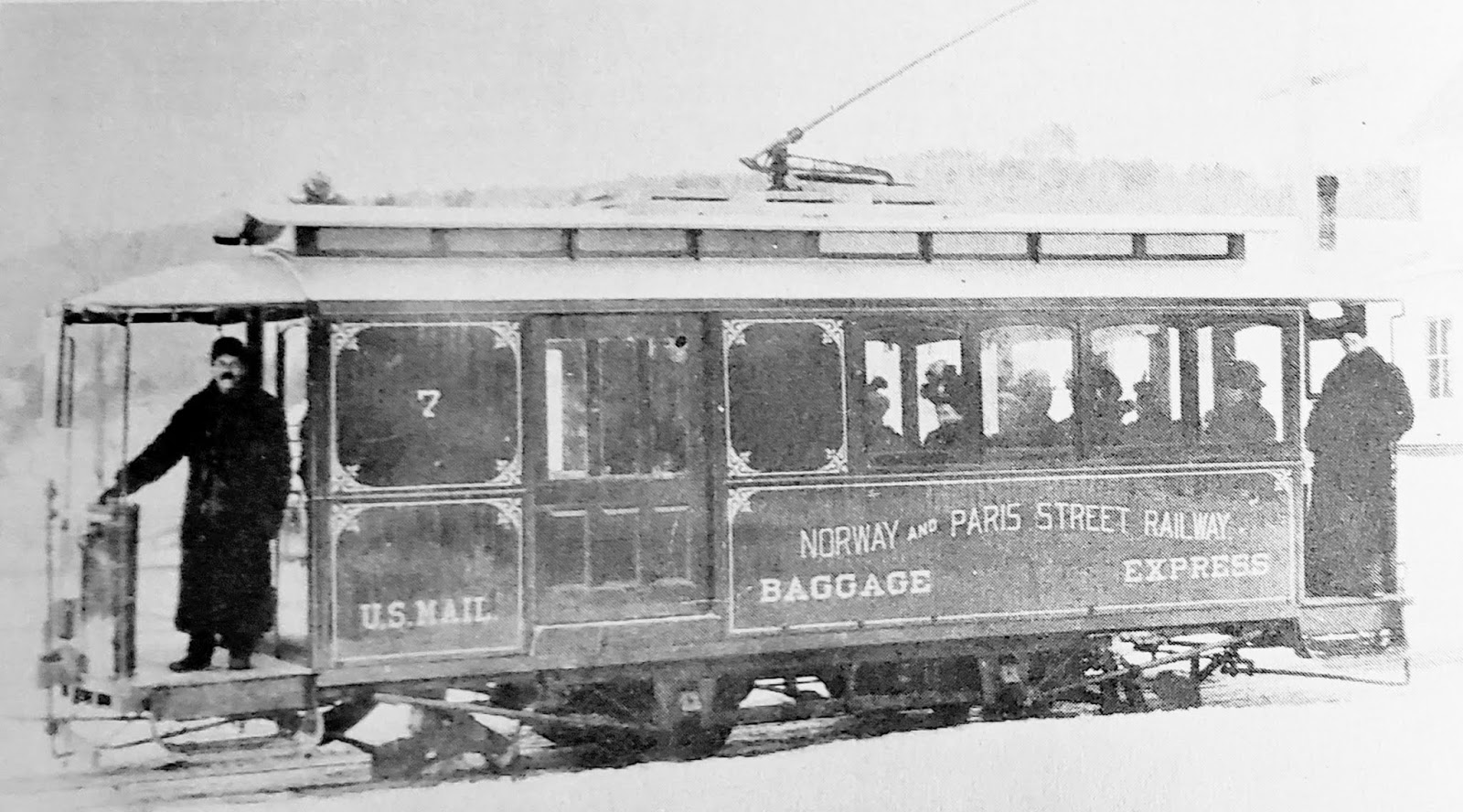
In 1907, this, single-truck, combination
baggage-passenger car (originally No. 12) was acquired from
the Rockland, Thomaston, & Camden Street Railway,
by the Norway and Paris Street Railway and became No. 7.
Photo from O.R. Cummings 1955 publication,
Toonervilles of Maine: The Pine Tree State

Here is the newest release in the Maine Bicentennial series of electric railways in Maine. This blog post features the summary of the Norway and Paris Street Railway as written by O. R. Cummings in his 1955 book, Toonervilles of Maine: The Pine Tree State
Additional photos will be credited accordingly. This material is taken from a copy of the Toonervilles of Maine book acquired by this blogger.

To see the online version of the 1955 book, Toonevilles of Maine at Bangor Public Library here

  • 3.15.2020 - Maine Bicentennial Series - York Utilities Company 1923-1949
  • 3.14.2020 - Maine Bicentennial Series - Atlantic Shore Railway 1911-1923
  • 3.11.2020 - Maine Bicentennial Series - Portsmouth, Dover & York St Rwy 1903-1906
  • 3.9.2020 - Maine Bicentennial Series - Auburn, Mechanic Falls & NorwayStRwy1902-3
  • 3.7.2020 - Maine Bicentennial Series - Portland & Brunswick Electric Railway 1902-1911
  • 3.7.2020 - Maine Bicentennial Series - Androscoggin & Kennebec Railway Co. 1919-1941
  • 3.7.2020 - Maine Bicentennial Series - Lewiston, Augusta & Waterville St Rwy 1907-1919
  • 3.6.2020 - Maine Bicentennial Series - Lewiston, Brunswick & Bath St Rwy 1898-1907
  • 3.4.2020 - Maine Bicentennial Series - Bangor Hydro-Electric Company 1925-1945
  • 3.4.2020 - Maine Bicentennial Series - Penobscot Central Railway 1898-1906
  • 3.3.2020 - Maine Bicentennial Series - Bangor. Hampden & Winterport Rwy 1896-1905
  • 3.2.2020 - Maine Bicentennial Series - Bangor, Orono & Old Town Railway 1895-1905
  • 3.2.2020 - Maine Bicentennial Series - Bangor Railway & Electric Company 1905-1925
  • 3.1.2020  - Maine Bicentennial Series - Bangor Street Railway 1889-1905
  • 2.23.2020 -Maine Bicentennial Series - Portsmouth, Kittery & York St. Rwy 1897-1903
  • 2.22.2020 - Maine Bicentennial Series - Sanford & Cape Porpoise Railway 1899-1904
  • 2.21.2020 - Maine Bicentennial Series - Mousam River Railroad 1892-1899
  • 1.31.2019 - Maine Bicentennial Series - The Norway and Paris Street Railway 1894-1918
  • 1.27.2019 - Maine Bicentennial Series - Aroostook Valley Railroad 1909-1946
  • 10.17.2018 - Maine Bicentennial - Portland Railroad History 1860-1941

Seashore Trolley Museum, the Museum of Mass Transit in Kennebunkport, Maine, is celebrating its 80th Birthday year in 2019! Many events are scheduled and many more will be scheduled before the opening of public operations on May 4, 2019. 

Maine's Shortest Trolley line was the Norway and Paris Street Railway
     which, from 1895 to 1918, connected South Paris, the seat of Oxford County, with the neighboring town of Norway, a little more than two miles away.
     Chartered on November 14, 1894, under the provisions of Chapter 268 of the Public Laws of 1893, the Norway and Paris had been organized on April 25th of that year by George L. Beal and Freeland Howe, both of Norway; George E. Macomber, J. Manchester Haynes, John F. Hill, and Orville Baker, all of Augusta, and Herbert L. Shepherd of Rockport. 
     At the same time, Mssrs. Macomber, Haynes, and Shepherd were directors of the Rockland, Thomaston, and Camden Street Railway, and Macomber, Haynes, and Hill were on the directorate of the Augusta, Hallowell, and Gardiner Railroad, later absorbed into the extensive Lewiston, Augusta, and Waterville system.
     The new company was capitalized at $10,000 (later increased to $25,000) and its first officials included Freeland Howe, president; H. L. Shepherd, treasurer, and John F. Hill, clerk of the corporation. Directors included the three officers and the other incorporators of the road.
     The proposed route of the Norway and Paris, approved by the Railroad commissioners on January 1, 1895, began at Pleasant and Main Streets in Norway, continued through Main Street, to Paris Street, and ran along Paris Street, first on the left and then on the right side of the road, to south Paris Square, terminating opposite the old Andrews Hotel. There were to be two grade crossings of the Grand Trunk Railway; one across the Norway branch on Paris Street, near the Norway-Paris town line, and the second across the Grand Trunk's mainline, near the South Paris depot.

Norway & Paris Street Railway map - 2.1 miles of total trackage
Map created by Charles D. Heseltine - from 
the NEERHS 2015 book, "The Illustrated Atlas of
Maine's Street & Electric Railways 1863-1946."

     Construction began in the late spring of 1895, the work being done by a contractor. Forty-five-pound T-rail was used in building the 2.13-mile line and the overhead was of both side bracket and span wire suspension, there being 1.07-mile of the former and 1.06-mile of the latter. A turnout was provided near the Agricultural building at the Oxford County Fairgrounds in South Paris.
     A two-track brick carhouse, with a wooden office building adjoining, was erected on Paris Street, Norway, and four single-truck passenger cars - two open and two closed - were purchased. Arrangements were made to purchase power from the Norway Electric Light Company which operated the combination steam and hydroelectric plant.

Norway and Paris Street Railway carhouse in Norway.
Photo from O.R. Cummings 1955 publication,
Toonervilles of Maine: The Pine Tree State

Operation
     With construction nearly completed in late June, the management made plans to commence operations as soon as possible, and on June 28, the Railroad Commissioners issued a certificate of safety for the trackage from Norway Village to the South Paris depot. Regular service began July 1, with M. W. Sampson of Norway and Frank A. Taylor of South Paris, conductors, and John D. Cole of Norway and C. F. Penley of South Paris, motormen, as the first crews. F. B. Lee was the general manager and superintendent of the railway.
     The certificate of safety for the balance of the line - from South Paris depot to South Paris Square - was received on August 2nd and operations between Norway Village and South Paris Square began the following day.
     Under the schedule set up by the company, cars left the head of Maine Street, Norway, the hour and a half hour, and hour. A five-cent fare was charged and the running time was about 15 minutes.
     One car was enough to maintain base service on the line, with two or three cars being placed in operation during Oxford County Fair week in the fall. The U. S. Mail was carried from the South Paris depot to the Norway post office and, in addition, the N&P carried on a small package and express business. In later years, a second turnout was built near the South Paris depot.
     Several attractions were offered by the railway to include patronage of the trolleys. On a warm evening in June 1896, a small orchestra rode aboard one of the cars, and in 1897, the company purchased a pine grove about midway between the two towns and created "Electra Park", later renamed "Central Park". This area contained an outdoor theatre with seats for several hundred people, a croquet lot, an electric fountain with colored lights, and refreshment stands. In later years, motion picture shows were presented at the theatre.

A sign advertising Electra Park is carried on the roof of
one of the 10-bench opens of Norway and Paris St. Rwy
in South Paris. Photo from O.R. Cummings 1955 publication,
Toonervilles of Maine: The Pine Tree State

Rolling Stock
     The original passenger equipment of the Norway and Paris Street Railway consisted of two 10-bench open and two 20-foot closed single-truck cars, believed to have been built by the Briggs Carriage Company of Amesbury, MA. The closed cars were numbered 3 and 4 and the open cars, 5 and 6.

No. 3 of the Norway and Paris at the carhouse in Norway.
 Photo from Charles C. Holt in O.R. Cummings
1955 publication, Toonervilles of Maine: The Pine Tree State

     There were only four motors and they were placed under the open cars in summer and under the closed cars during other seasons of the year. The trucks, of Bemis manufacture, may also have been exchanged between the two types of cars.
     Pictorial evidence indicates that No. 3 may have been a former horsecar rebuilt for electric service as its roof type was characteristic of horsecar construction.
     Closed cars were painted Pullman green and the open cars were yellow in color.

No. 6 open car of the Norway and Paris Street Railway near
the carhouse in Norway. 
Photo from O.R. Cummings 1955 publication,
Toonervilles of Maine: The Pine Tree State

     A third closed car was purchased in 1900. This was No. 2 and was of the 20-foot box type, with a steam coach roof and equipped with a Peckham truck. It was on the property only a few months, subsequently being sold to the Augusta, Hallowell, and Gardiner Railroad.
     In 1907, a single-truck passenger-baggage combination car, No. 7, built by Briggs, was acquired from the Rockland, Thomaston, and Camden Street Railway. Later, one of the original closed cars was retired and a second No. 2 - this a single-truck closed car with home-built vestibules - was purchased from an unknown source.

The original No. 2 of the Norway and Paris at the Norway
carhouse. Photo from Charles C. Holt in O.R. Cummings
1955 publication, Toonervilles of Maine: The Pine Tree State

     For snow fighting in winter, there was a four-wheel, homemade contraption with a nose plow mounted on one end. This rig, properly weighted down, was pushed by one or both of the closed cars when necessary to clear the line and old-timers relate that it frequently derailed. Also, there was no place to turn it around.

The home-built snowplow of the Norway and Paris Street
Railway at the Norway carhouse.
Photo from Ernest R. Rowe in O.R. Cummings
1955 publication, Toonervilles of Maine: The Pine Tree State

Power
     The equipment at the power station of the Norway Electric Light Company, later the Oxford Light Company, consisted of one 75Kw. Thompson-Houston 600-volts d.c. generator belted to a jackshaft driven by either a water wheel or steam engine, A 1,100-volt, 60-cycle, alternator, was belted to the same jackshaft that drove the railway generator. A second alternator was driven by a Corliss steam engine.
     In addition to the Norway plant, there was a small hydroelectric station, owned by the Maine Power Company, in South Paris. This station was equipped with a 75Kw. 600-volt d.c. generator and a small alternator, both driven by a water wheel through a single jackshaft.
     The alternators at the Norway and South Paris plants were used to provide electricity for house lighting in the two towns.

One of the 10-bench Briggs opens near the end of the line
in Norway Villiage.
Photo from Ernest R. Rowe in O.R. Cummings
1955 publication, Toonervilles of Maine: The Pine Tree State

Financial and Corporate
     During its first year of operation, Norway and Paris carried 177,102 passengers who paid fares totaling $8,103.93. Operating expenses were $4,445.51, leaving a net operating income of $3,658.42. Miscellaneous revenues were $202.71, producing a gross income above operating expenses of $3,861.13. From this was deducted an advance of $2,136.77 to the building contractor and a five percent dividend on the common stock, leaving a surplus of $474.36.
     Operations in 1897 and early 1898 were also profitable but for the year ended June 30, 1899, there was a deficit of $943.21. From then on, the railway followed a pattern of having a deficit one year and a profit the next - neither very large, and, about balanced each other out, as time passed.
     F. B. Lee was succeeded by W. J. Jones of Norway as general manager and superintendent in 1900 and in 1903, Mr. Jones was replaced by H. B. Young. Mr. Young remained with the railway until its abandonment.
     The Norway Electric Light Company, owned by the same parties as Norway and Paris, changed its name to the Oxford Light Company on February 3, 1897, and on December 27, 1904, the lighting company was merged with the street railway. The latter increased its capitalization by $50,000 and floated a second mortgage of $20,000, due in 1925. In addition, it assumed the $80,000 funded debt of the Oxford Light Company.
     Freeland Howe, president and one of the founders of Norway and Paris, died in 1912 and was succeeded in the presidency by the late Guy P. Gannett, owner of a chain of newspapers in the Pine Tree State. During the following year, the railway came under the control of the Central Maine Power Company, and Maynard S. Bird, of Rockland, was named the president. William T. Cobb, also of Rockland, became president in 1915.
      Norway and Paris absorbed the Maine Power Company on May 29, 1914, and 18 months later, on January 6, 1916, the name of the Norway and Paris Street Railway was changed to the Oxford Electric Company.
     The new management immediately undertook the task of rehabilitating the railway to bring it up to the standards of the other traction properties of the Central Maine Power Company. In 1915, nine hundred feet of the original 45-pound rail were replaced with 70-pound steel, and 600 new wood ties were installed. A 15-foot by 60-foot addition to the carhouse, for the storage of electrical supplies, was constructed. In 1916, 2,482 feet of track were relaid with the 70-pound rail, and 986 new wood ties were installed. Additional improvements were carried out in 1917 - and plans were made to acquire new rolling stock for the line. Unfortunately, this never came to pass.

Abandonment
     The rise in prices that accompanied World War I had an effect on Norway and Paris. Operating expenses increased rapidly without a corresponding boost in revenues. But the railway might have kept on had it not been for the winter of 1917-18 when trolley service was suspended for several months because of deep snow blocking the tracks. Operations resumed in the spring but the cars ran only a short time thereafter, abandonment taking place on October 5, 1918. The decision to discontinue railway service was apparently made to avoid losses that would have to be charged against the profitable electricity business.
     Attempts were made to induce the Oxford Electric Company to resume trolley operations in the spring of 1919 but Central Maine Power vetoed the idea. During the summer, the rails were torn up, the overhead was removed and the cars were junked. So far as Norway and Paris were concerned, the electric railway was a thing of the past.


A 2007 publication by O. R. Cummings and Peter C. Hammond; Norway & Paris Street Railway - The Shortest Streetcar Line in The State of Maine 1895-1918 is a very comprehensive history of the line containing dozens and dozens of photos, copies of advertising, and statistics for all the years in service.
~~~~~~~~~~~~~~~
Click Here: For the list of links to Theodore Roosevelt Maine Heritage Trail Posts in Easy Order to View

We continue the restoration work on the 1912 Narcissus, the only surviving high-speed, luxury interurban coach of the Portland-Lewiston Interurban. 

Click Here: Narcissus Restoration-Related Posts

Being more than a century old, the stately, "Elegant Ride," Narcissus, is a gem.  This shimmering precious stone of Maine transportation history is brilliantly resplendent as it emanates so many elements of history, including time, places, people, and events, that it was coupled to, that when just a smattering of its seemingly innumerable stories are shared, the contents first captivates, fascinates, then generates interest to learn more 🙋. The majestic Narcissus is listed in the National Register of Historic Places.

Please consider joining the epic journey to complete the Narcissus Project by making a donation today!

Click Here: Donation Options

The restoration of this majestic icon of Maine's electric railway history is but one in a series of captivating stories containing an abundance of incredible coalition of narratives.

Click Here: History-Related Posts - Narcissus and Portland-Lewiston Interurban

     The Narcissus is featured in the national Gold Award-winning novel, Teddy Roosevelt, Millie, and the Elegant Ride. The "Elegant Ride" is the Narcissus. Theodore Roosevelt was a passenger on the Narcissus on August 18, 1914, between Lewiston and Portland, Maine, while campaigning for the Progressive Party candidates.

Click Here: Bookstores and Businesses promoting the Narcissus Project

Independent book publisher, Phil Morse, holding
the Gold Book Award Winner plaque for
 Middle Reader category for The Eric
Hoffer Book Award. Congratulations to
award-winning Maine author,
Jean M. Flahive

Wednesday, January 30, 2019

Maine Bicentennial Series -The Skowhegan & Norridgewock Railway 1894-1903


1894 Skowhegan and Norridgewock combination passenger
and baggage car No. 5  seen here in front of the carhouse in
Skowhegan on Island Avenue.
O. R. Cummings Collection 2009_2_18_33

Here is the newest release in the Maine Bicentennial series of electric railways in Maine. This blog post features the summary of the Skowhegan and Norridgewock Railway as written by O. R. Cummings in his 1955 book, Toonervilles of Maine: The Pine Tree State
Additional photos will be credited accordingly. This material is taken from a copy of the Toonervilles of Maine book acquired by this blogger.

To see the online version of the 1955 book, Toonevilles of Maine at Bangor Public Library here

Click Here for the post: Ninety Communities in Maine with Electric Railway Service!
Click Here for the post: 57 Million Passengers Carried on Electric Railways in Maine in 1915!
Click Here for the post: Maine Bicentennial series - History of the Portland Railroad 1860-1941
Click Here for the post: Maine Bicentennial series - History of the Calais Street Railway 1894-1929
Click Here for the post: Maine Bicentennial series - History of Aroostook Valley Railroad 1909-1946
Click Here for the post: Maine Bicentennial series - Fryeburg Horse Railroad 1887-1913
Click Here for the post: Maine Bicentennial series - The Norway and Paris Street Railway 1894-1918
Click Here for the post: Maine Bicentennial series - Benton and Fairfield Railway 1898-1928
Click Here for the post: Maine Bicentennial series - The Somerset Traction Company 1895-1928
Click Here for the post: Maine Bicentennial series - The Fairfield and Shawmut Railway 1903-1927
Click Here for the post: Maine Bicentennial series - Waterville, Fairfield, & Oakland Rwy 1887-1937
Click Here for the post: Maine Bicentennial series - Trolleys to Augusta, Maine 1889-1932
Click Here for the post: Maine Bicentennial series - Rockland, South Thomaston, & St. George Rwy
Click Here for the post: Maine Bicentennial series - Rockland, Thomaston, & Camden St.Rwy. '92-1931
Click Here for the post: Maine Bicentennial series - Biddeford and Saco Railroad Co. 1888-1939
Click Here for the post: Maine Bicentennial series - Mousam River Railroad 1892-1899
Click Here for the post: Maine Bicentennial series - Sanford & Cape Porpoise Railway 1899-1904
Click Here for the post: Maine Bicentennial series - Portsmouth, Kittery & York St. Rwy 1897-1903
Click Here for the post: Maine Bicentennial series - Bangor Street Railway 1889-1905
Click Here for the post: Maine Bicentennial series - Bangor Railway & Electric Company 1905-1925
Click Here for the post: Maine Bicentennial series - Bangor, Orono & Old Town Railway 1895-1905
Click Here for the post: Maine Bicentennial series - Bangor, Hampden & Winterport Rwy 1896-1905
Click Here for the post: Maine Bicentennial series - Penobscot Central Railway 1898-1906
Click Here for the post: Maine Bicentennial series - Bangor Hydro-Electric Company 1925-1945
Click Here for the post: Maine Bicentennial series - Lewiston, Brunswick & Bath St Rwy 1898-1907
Click Here for the post: Maine Bicentennial series - Lewiston, Augusta & Waterville St Rwy 1907-19
Click Here for the post: Maine Bicentennial series - Androscoggin & Kennebec Railway 1919-1941
Click Here for the post: Maine Bicentennial series - Portland & Brunswick Street Railway 1902-1911
Click Here for the post: Maine Bicentennial series - Auburn & Turner Railroad 1905-1928
Click Here for the post: Maine Bicentennial series - Auburn, Mechanic Falls & NorwayStRwy1902-7
Click Here for the post: Maine Bicentennial series - Portsmouth, Dover & York St Rwy 1903-1906
Click Here for the post: Maine Bicentennial series - Atlantic Shore Line Railway 1900-1910
Click Here for the post: Maine Bicentennial series - Atlantic Shore Railway 1911-1923
Click Here for the post: Maine Bicentennial series - York Utilities Company 1923-1949
Click Here for the post: Maine Bicentennial series - Portland-Lewiston Interurban - It Begins 1914
Click Here for the post: Maine Bicentennial series - Portland-Lewiston Interurban - The End 1933

Seashore Trolley Museum, the Museum of Mass Transit in Kennebunkport, Maine, is celebrating its 80th Birthday year in 2019! Many events are scheduled and many more will be scheduled before the opening of public operations on May 4, 2019. 

One of the shortest-lived of New England's many street railway lines
     was the Skowhegan and Norridgewock Railway and Power Company which operated for nine years - from 1894 to 1903.

Photo from O.R. Cummings 1955 publication,
Toonervilles of Maine: The Pine Tree State

     It was on August 7, 1894, that the articles of association of the Skowhegan and Norridgewock were filed with the Railroad Commissioners for their approval. Two of the incorporators of the company were Amos F. Gerald of Fairfield and I. C. Libby of Waterville.
     The articles of association were approved on August 15, 1894, and the formal organization of the company followed on August 28. W. H. Wildes of Skowhegan was named the chairman of the board of directors and president of the company while I. C. Libby became treasurer and Amos F. Gerald, general manager.
     Construction began immediately, the work being done under contract by the Worcester Construction Company of Worcester, MA, and the road was completed early in October. A certificate of safety for the 5.75 miles of track was given by the Railroad Commissioners on October 13 and operation began the following day.

O. R. Cummings Collection 2009_2_18_45

     The route began on Main Street in Skowhegan, crossed the tracks of the Maine Central Railroad near the Skowhegan depot, and followed the country road to the MCRR (then the Somerset Railway) station in Norridgewock Village. Forty-pound T-rail was used and the overhead construction was with 3/4 of a mile span wire and five miles of side brackets. There were two wooden trestles, with a total length of 100 feet.

Skowhegan & Norridgewock open car in Norridgewock at
the Maine Central Depot Circa 1900
O. R. Cummings Collection 2009_2_18_38

     A two-track carhouse, with a capacity of six cars, was located in Norridgewock. There is little information about the power plant except that it had a generator of 110 h.p. capacity driven by "hired steam power".

An open car in Norridgewock turns into the track that
leads to the Maine Central Railroad station. Circa 1900
O. R. Cummings Collection 2009_2_18_37

     The initial rolling stock consisted of two 10-bench single-truck open cars, and, two single-truck combination passenger baggage cars, built by Jackson and Sharp, and one homemade snowplow. A third single truck open, also built by Jackson and Sharp, was added in 1895.

A Jackson & Sharp photograph - a builder's photo of the newly
manufactured body of S&N combination car No. 5 on the
loading dock before being shipped to Maine in 1894.
O. R. Cummings Collection 2009_2_18_34

     On December 2, 1896, the S&N was granted permission to build two extensions in Skowhegan, one to connect with a spur track of the Maine Central Railroad and the other to extend to the mill of the Skowhegan Pulp Company. It was supposed to haul freight between the railroad and the pulp mill. However, for some reason, the extensions were never built.
     Equipment owned by the Skowhegan and Norridgewock in 1896 included the two, single-truck combinations, three single-truck open cars, two work cars, and one snowplow. The road had only six Westinghouse motors and it was necessary to shift them from the open cars to the combines and snowplow in the fall and back to the opens in the spring.

S&N open-car No. 4 at the Norridgewock depot
of the Maine Central Railroad circa 1900
O. R. Cummings Collection 2009_2_18_39

     In 1898, the S&N purchased a plot of woodland midway between Skowhegan and Norridgewock and created a picnic grove known as "The Pines". It was hoped this park would stimulate pleasure riding on the trolleys during the summer months. Various improvements were made from time to time, and a total of more than $2,000 was invested in the resort, but it never lived up to expectations.

Norridgewock with trolley tracks circa 1900
 O. R. Cummings Collection 2009_2_18_36

     There is some evidence that an attempt was made to start a freight business over the line in 1901 for the equipment report for 1902 lists a platform freight car and revenue for the year included $317.40 from carrying express and parcels. Most of this was undoubtedly handled in the combination cars.
     The Skowhegan and Norridgewock Railway was not a profitable line. In 1896, there was an operating deficit of $694.29 and in 1897, the road ended the fiscal year with a profit of only $5.23. The operating deficit on June 30, 1898, was $3,254.74, and on June 30, 1899, $3,716.30. The total accrued deficit as of that date was $57,464.22. It is not surprising that the road operated at a loss because gross earnings were seldom much more than $4,000 - and the annual fixed charges alone were $3,000.
     Obviously, the road could not continue operating under such circumstances, and in 1903, with a total deficit of $66,593.48 on the books, service was temporarily suspended. Attempts were made to reorganize the company but they were unsuccessful and the line was permanently abandoned in 1906. The cars were sold and the railway was dismantled.
~~~~~~~~~~~~~~~
Click Here: For the list of links to Theodore Roosevelt Maine Heritage Trail Posts in Easy Order to View

We continue the restoration work on the 1912 Narcissus, the only surviving high-speed, luxury interurban coach of the Portland-Lewiston Interurban. 

Click Here: Narcissus Restoration-Related Posts

Being more than a century old, the stately, "Elegant Ride," Narcissus, is a gem.  This shimmering precious stone of Maine transportation history is brilliantly resplendent as it emanates so many elements of history, including time, places, people, and events, that it was coupled to, that when just a smattering of its seemingly innumerable stories are shared, the contents first captivates, fascinates, then generates interest to learn more 🙋. The majestic Narcissus is listed in the National Register of Historic Places.

Please consider joining the epic journey to complete the Narcissus Project by making a donation today!

Click Here: Donation Options

The restoration of this majestic icon of Maine's electric railway history is but one in a series of captivating stories containing an abundance of incredible coalition of narratives.

Click Here: History-Related Posts - Narcissus and Portland-Lewiston Interurban

     The Narcissus is featured in the national Gold Award-winning novel, Teddy Roosevelt, Millie, and the Elegant Ride. The "Elegant Ride" is the Narcissus. Theodore Roosevelt was a passenger on the Narcissus on August 18, 1914, between Lewiston and Portland, Maine, while campaigning for the Progressive Party candidates.

Click Here: Bookstores and Businesses promoting the Narcissus Project

Independent book publisher, Phil Morse, holding
the Gold Book Award Winner plaque for
 Middle Reader category for The Eric
Hoffer Book Award. Congratulations to
award-winning Maine author,
Jean M. Flahive