Showing posts with label Portsmouth Dover and York Street Railway. Show all posts

Sunday, March 15, 2020

Maine Bicentennial Series - York Utilities Company 1923 - 1949

 
The accident ended it all. The front end of No. 90 is
over the Mousam River after the car derailed on the Mill
Square Bridge, February 6, 1947. Operator Stanley Cram
stands on a small islet in the river after he jumped from the
trolley. Some 17 passengers scurried to safety through the
rear door. This picture appeared in newspapers all over the
world, taken by Michael Shalhoup, the Sanford Tribune photographer
Regular passenger service ended less than two months later.
O. R. Cummings Collection

The Last Electric Railway Company to Operate in Maine
Here is the release in the Maine Bicentennial series of electric railways in Maine. This blog post features the York Utilities Company summary/images from the book, "Atlantic Shore Trolleys" Bulletin No. 2 NEERHS by O. R. Cummings, January 1, 1966, "Atlantic Shore Line Railway" by O. R. Cummings, presented as Transportation Volume 4 by the Connecticut Electric Railway and the National Railway Historical Society-Connecticut Chapter - June 1950 Re-issued January 1957. And text/images are also taken from an O. R. Cummings book, "Trolleys To York Beach: The Portsmouth Dover & York Street Railway", Bulletin No. 1, New England Electric Historical Society, December 30, 1964. Some text/images may be from the NEERHS 2015 publication, "The Illustrated Atlas of Maine's Street & Electric Railways 1863-1946. Additional images will be credited or are from the O. R. Cummings Collection.

To see the online version of the 1957 book, Atlantic Shore Line Railway at Bangor Public Library - click here 


Click here to view the August 25, 1899 Sanford and Cape Porpoise Railway - Sanford Tribune
Click here to view the post on the Kennebunk Segment of the Sanford & Cape Porpoise 1899-1927
Click here to view the post on the Cape Porpoise Segment of the S&CP Rwy 1899-1925
  • 3.14.2020 - Maine Bicentennial Series - Atlantic Shore Railway 1911-1923
  • 3.11.2020-Maine Bicentennial Series - Portsmouth, Dover & York St Rwy 1903-1906
  • 3.9.2020 - Maine Bicentennial Series - Auburn, Mechanic Falls & NorwayStRwy1902-3
  • 3.7.2020 - Maine Bicentennial Series - Portland & Brunswick Electric Railway 1902-1911
  • 3.7.2020 - Maine Bicentennial Series - Androscoggin & Kennebec Railway Co. 1919-1941
  • 3.7.2020 - Maine Bicentennial Series - Lewiston, Augusta & Waterville St Rwy 1907-1919
  • 3.6.2020 - Maine Bicentennial Series - Lewiston, Brunswick & Bath St Rwy 1898-1907
  • 3.4.2020 - Maine Bicentennial Series - Bangor Hydro-Electric Company 1925-1945
  • 3.4.2020 - Maine Bicentennial Series - Penobscot Central Railway 1898-1906
  • 3.3.2020 - Maine Bicentennial Series - Bangor. Hampden & Winterport Rwy 1896-1905
  • 3.2.2020 - Maine Bicentennial Series - Bangor, Orono & Old Town Railway 1895-1905
  • 3.2.2020 - Maine Bicentennial Series - Bangor Railway & Electric Company 1905-1925
  • 3.1.2020  - Maine Bicentennial Series - Bangor Street Railway 1889-1905
  • 2.23.2020 -Maine Bicentennial Series - Portsmouth, Kittery & York St. Rwy 1897-1903
  • 2.22.2020 - Maine Bicentennial Series - Sanford & Cape Porpoise Railway 1899-1904
  • 2.21.2020 - Maine Bicentennial Series - Mousam River Railroad 1892-1899
  • 1.31.2019 - Maine Bicentennial Series - The Norway and Paris Street Railway 1894-1918
  • 1.27.2019 - Maine Bicentennial Series - Aroostook Valley Railroad 1909-1946
  • 10.17.2018 - Maine Bicentennial - Portland Railroad History 1860-1941
  • York Utilities Company
     Early in 1922, the bondholders of the Atlantic Shore Railway instituted reorganization proceedings, and after a series of conferences and hearings, an agreement was finally reached among all parties. And a new operation of a railway system was to be created, with some prospect of success.

     The reorganization took place on February 1, 1923, when the Atlantic Shore Railway was sold to a group of bondholders who, on the same day, incorporated the York Utilities Company.

     From the start, the management faced almost insurmountable obstacles to continuing as a viable railway operation. Automobiles were increasingly popular, and the era of restlessness following WWI was leading travelers to destinations away from local beaches.

No. 50 at Central Square in Sanford, circa 1925. No. 50 was 
a two-operator car when in service with the Atlantic Shore
Railway. Once No. 50 was with the York Utilities Company,
it was converted to a one-operator car. 
O. R. Cummings Collection

    One-man trolley operations were introduced in an attempt to pare the expenses, but earnings continued to decrease. Due to a lack of funds, the proper maintenance of facilities and trackage. properties' condition was suffering 

Rebuilt semi-convertible No. 56 - one of nine cars rebuilt
to a one-operator car by the York Utilities Company.
Folding steps, air-controlled doors, and dead-man controls
were installed. photo from Harold Forsyth in
the O. R. Cummings Collection

     To promote service between Sanford and Springvale, a new line was built on Main Street and opened in December 1923. This new line provided a loop service between the two communities. Serving as a loop was limited to evenings and Sundays only.

York Utilities Company map of operations in
the Sanford-Springvale area - not to scale.
sketched by R. Borrup in O. R. Cummings Coll.

     The first line to be abandoned was the Kennebunk-York Beach line, which was suspended on March 31, 1924, after a lifespan of only 17 years, nearly all of which were unprofitable. The rails and overhead were removed in the fall. That same year, bus operation began over a new route between Sanford and Springvale.

     In 1925, bus service replaced the trolleys on the Town House-Cape Porpoise and the Town House-Kennebunkport lines. The tracks were retained for freight service. Bus service also began between Sanford and Biddeford via Alfred.


     Early in 1927, rail service between Sanford and Biddeford was reduced to four trips a day, with the trolleys operating every two hours between West Kennebunk and Biddeford. Later that year, the company received permission to operate buses from Biddeford to Kennebunk and Kennebunkport, and on September 15, all rail service outside of Sanford and Springvale was discontinued. The Town House car barn was closed, and the repair shops were moved to Sanford, where a new frame carhouse had been built earlier.

Interurban bus No. 209 - an early type used
on the line from Sanford to Biddeford.
O. R. Cummings Collection

     The six miles of track saved when the Town House-Biddeford track was torn up in 1929 were used to re-lay more than 80 percent of the trackage on the two lines between Sanford and Springvale. The relaid rail was carefully bonded and heat-treated. The new overhead wire was also installed, along with many new poles and ties, and the shops were rebuilt and modernized.

Birney safety car No. 82 of YUCo at the Sanford
car barn on June 21, 1935. The paint scheme was
blue with aluminum trim. This car and its mate,
No. 80 was transferred to Seashore Trolley
Museum, for preservation purposes, in 1946. These
two cars were originally Nos. 1 and 2 from the
Denver & South Platte (CO) in 1919. Converting
these two cars to handle standard-gauge tracks
of the YUCo was one of the last jobs undertaken
in the Town House shop in Kennebunkport.
No. 80 is currently under restoration at Seashore
Trolley Museum. It is being restored to
be No. 1, the representative of the Denver
& South Platte Street Railway. No. 82 will
be restored to be the Birney Safety car
representative of the York Utilities Company.
O. R. Cummings Collection

     On August 19, 1935, the last trolleys operated on Main Street, with buses taking over the next day. River Street trolley passenger service continued for twelve more years. Operations were reduced to one car, with a 30-minute headway. Regular freight service continued.

Sanford Village bound is No. 88 or 90 on Pleasant Street, 
at George Street, Springvale, May 30, 1946. Trolley
operations, on River Street, had less than a year left.
O. R. Cummings Collection

     The final regular trolley passenger trip was made on April 1, 1947, by No. 88. On April 27th, a special farewell excursion was made for the Boston Division of the Railroad Enthusiasts, Inc.
At the time it discontinued service, the York Utilities Company was operating the only passenger trolley car service in the State of Maine and the last small rail operation in New England.

Trolley passenger service between Sanford and Springvale
villages ended on April 1, 1947, but on April 27, a special
farewell excursion was run for the Railroad Enthusiasts.
Here is No. 88 in Springvale. No. 88 was the last trolley
car in Maine to carry passengers during a public operation.
No. 88 was acquired by the Seashore Trolley Museum for
historic preservation. It awaits the funding needed to
have its turn to be restored. O. R. Cummings Coll.

     On April 1, 1949, the newly formed Sanford & Eastern Railroad, which previously had purchased the route of the former Portland & Rochester Railroad, bought the Sanford-Springvale freight line. In June, once a newly ordered diesel locomotive arrived, the trolley locomotive, No. 100, was replaced.
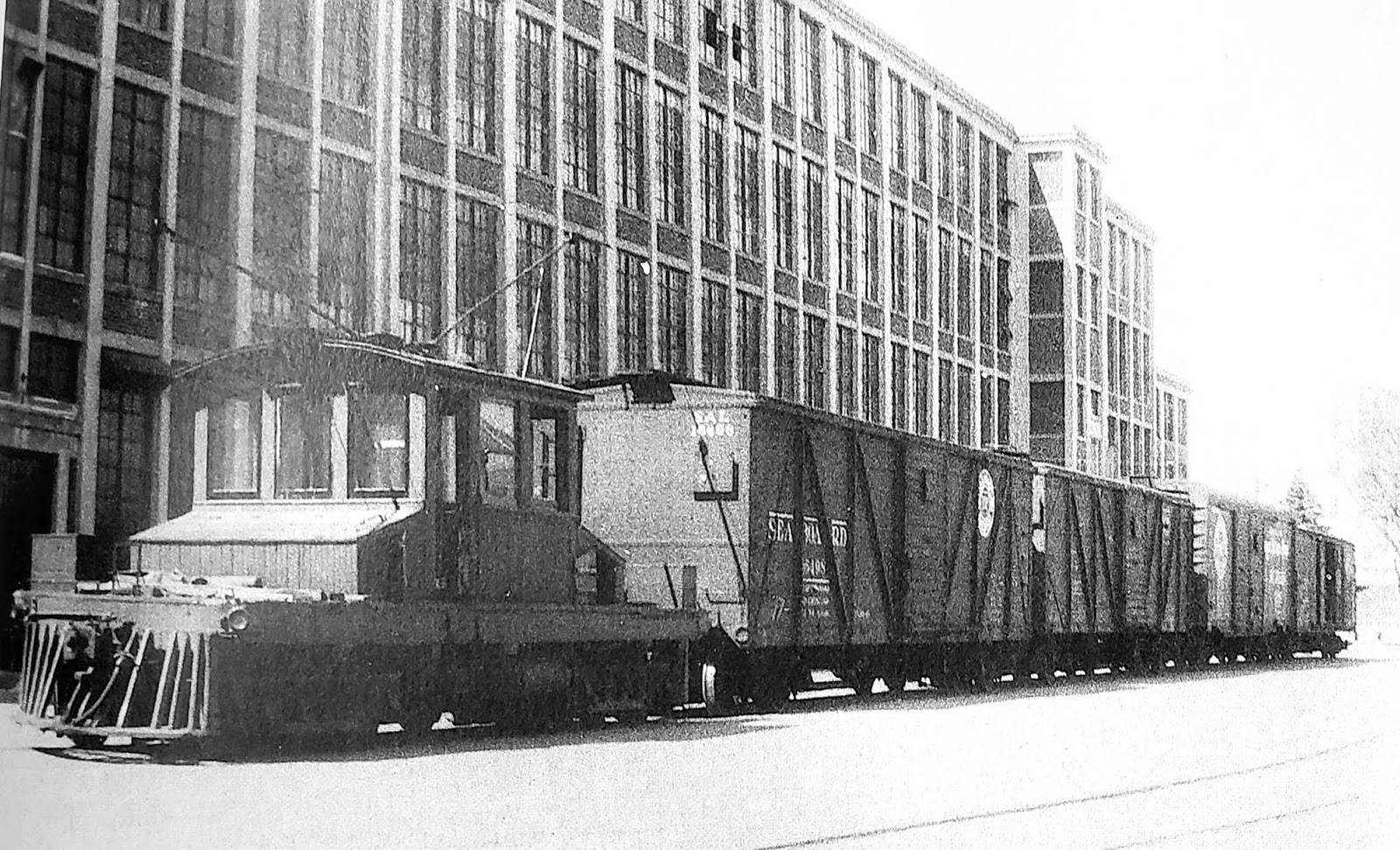
1906 electric locomotive No. 100 was originally purchased
for use by the Atlantic Shore Line Railway, then used by the 
Atlantic Shore Railway. Public freight service ended in
 1949 with the York Utilities Company. No. 100
was used to haul coal from the Cape Porpoise Pier to the
mills in Sanford. Hauling tree-length lumber harvested
along the right-of-way between Kennebunkport and 
Biddeford. Hauling railroad boxcars to and from
mills in Kennebunk, West Kennebunk, and Alfred,
Sanford and Springvale, making connections with various
railroad terminals. No. 100 was acquired by Seashore
Trolley Museum 1949 for historic preservation.
No. 100 was thoroughly restored from 2006 to 2009.
O. R. Cummings Collection


Former U. S. Mail and Express car No. 108 was purchased in 1904
for use by the Portsmouth, Dover & York Street Railway. It served
as an overhead line maintenance work car for YUCo. No. 108
was acquired by the Seashore Trolley Museum in 1949 for historic
preservation. No. 108 underwent exterior restoration work
in the early 1980s, returning it to its U. S. Mail service
look.  No. 108 needs additional major restoration.
O. R. Cummings Collection

A YUCo bus is sandwiched between the disabled No. 90,
left, and No. 88 at the Sanford car barn in March 1947. The
body of No. 90 was sold to a private party and became part of
a summer cottage in Moody Beach, Maine.
O. R. Cummings Collection

     Five pieces of electric railway equipment and a small baggage car were acquired by the New England Electric Railway Historical Society (NEERHS dba: Seashore Trolley Museum). The organization also negotiated a trade to acquire some track, overhead wire brackets, and other line-related materials.  York Utilities Company continued on as a passenger carrier, utilizing buses.

Trolley No. 88 is transferred to Seashore
Trolley Museum - The general manager of
YUCo, Albert Moineau (left) and
Theodore Santarelli de Brasch, vice-
president and general manager of
Seashore Trolley Museum, shake hands
as No. 88 makes its "farewell" run
on Sunday, April 27, 1947. Photo
by Michael Shalhoup, Sanford, ME.

     The Seashore Trolley Museum has ten historic Maine railway vehicles in its collection that are listed in the National Register of Historic Places
~~~~~~~~~~~~~~~
Click Here: For the list of links to Theodore Roosevelt Maine Heritage Trail Posts in Easy Order to View

We continue the restoration work on the 1912 Narcissus, the only surviving high-speed, luxury interurban coach of the Portland-Lewiston Interurban. 

Click Here: Narcissus Restoration-Related Posts

More than a century old, the stately "Elegant Ride," Narcissus, is a gem.  This shimmering precious stone of Maine transportation history is brilliantly resplendent as it emanates so many elements of history, including time, places, people, and events, that it was coupled to, that when just a smattering of its seemingly innumerable stories are shared, the contents first captivate, fascinate, then generate interest to learn more 🙋. The majestic Narcissus is listed in the National Register of Historic Places.

Please consider joining the epic journey to complete the Narcissus Project by donating today!

Click Here: Donation Options

The restoration of this majestic icon of Maine's electric railway history is but one in a series of captivating stories containing an abundance of incredible coalition narratives.

Click Here: History-Related Posts - Narcissus and Portland-Lewiston Interurban

     The Narcissus is featured in the national Gold Award-winning novel, Teddy Roosevelt, Millie, and the Elegant Ride. The "Elegant Ride" is the Narcissus. Theodore Roosevelt was a passenger on the Narcissus on August 18, 1914, between Lewiston and Portland, Maine, while campaigning for the Progressive Party candidates.

Click Here: Bookstores and Businesses promoting the Narcissus Project

Independent book publisher Phil Morse, holding
Gold Book Award Winner plaque for
 Middle Reader category for The Eric
Hoffer Book Award. Congratulations to
award-winning Maine author,
Jean M. Flahive

Thursday, March 12, 2020

Maine Bicentennial Series - Atlantic Shore Line Railway - 1900 - 1910

Left is a 15-bench open car ready to head to Dock Square,
Kennebunkport, from Town House Junction circa 1907. In the
background to the left is the large brick ASLRwy carbarn/
offices. The waiting station in the center of the photo had
a creamery. The combination car on the right could carry
express freight and passengers. That section of the line would
lead to Kennebunk, Cape Porpoise, or Biddeford.
O. R. Cummings Collection

     Here is the newest release in the Maine Bicentennial series of electric railways in Maine. This blog post features the Atlantic Shore Line Railway summary/images from the book, "Atlantic Shore Line Railway" by O. R. Cummings, presented as Transportation Volume 4 by the Connecticut Electric Railway and the National Railway Historical Society-Connecticut Chapter - June 1950, Re-issued January 1957. And text/images are also taken from an O. R. Cummings book, "Trolleys To York Beach: The Portsmouth Dover & York Street Railway", Bulletin No. 1, New England Electric Historical Society, December 30, 1964. Some text/images may be from the NEERHS 2015 publication, "The Illustrated Atlas of Maine's Street & Electric Railways 1863-1946. Additional images will be credited, or they are from the O. R. Cummings Collection.

To see the online version of the 1957 book, Atlantic Shore Line Railway at Bangor Public Library, here 

The Atlantic Shore Line car station at Wells Corner was
situated for many years in the Moulton store. This building
was Wells House of Pizza and was razed in recent years.
O. R. Cummings Collection

Click Here for the post: Ninety Communities in Maine with Electric Railway Service!
Click Here for the post: 57 Million Passengers Carried on Electric Railways in Maine in 1915!
Click Here for the post: Maine Bicentennial series - History of the Portland Railroad 1860-1941
Click Here for the post: Maine Bicentennial series - History of the Calais Street Railway 1894-1929
Click Here for the post: Maine Bicentennial series - History of Aroostook Valley Railroad 1909-1946
Click Here for the post: Maine Bicentennial series - Fryeburg Horse Railroad 1887-1913
Click Here for the post: Maine Bicentennial series - The Norway and Paris Street Railway 1894-1918
Click Here for the post: Maine Bicentennial series - Skowhegan & Norridgewock Railway 1894-1903
Click Here for the post: Maine Bicentennial series - Benton and Fairfield Railway 1898-1928
Click Here for the post: Maine Bicentennial series - The Somerset Traction Company 1895-1928
Click Here for the post: Maine Bicentennial series - The Fairfield and Shawmut Railway 1903-1927
Click Here for the post: Maine Bicentennial series - Waterville, Fairfield, & Oakland Rwy 1887-1937
Click Here for the post: Maine Bicentennial series - Trolleys to Augusta, Maine 1889-1932
Click Here for the post: Maine Bicentennial series - Rockland, South Thomaston, & St. George Rwy
Click Here for the post: Maine Bicentennial series - Biddeford and Saco Railroad Co. 1888-1939
Click Here for the post: Maine Bicentennial series - Mousam River Railroad - 1892-1899
Click Here for the post: Maine Bicentennial series - Sanford & Cape Porpoise Railway 1899-1904
Click Here for the post: Maine Bicentennial series - Portsmouth, Kittery & York St Rwy 1897-1903
Click Here for the post: Maine Bicentennial series - Bangor Street Railway 1889-1905
Click Here for the post: Maine Bicentennial series - Bangor Railway & Electric Company 1905-1925
Click Here for the post: Maine Bicentennial series - Bangor, Orono & Old Town Railway 1895-1905
Click Here for the post: Maine Bicentennial series - Bangor, Hampden & Winterport Rwy 1896-1905
Click Here for the post: Maine Bicentennial series - Penobscot Central Railway 1898-1906
Click Here for the post: Maine Bicentennial series - Bangor Hydro-Electric Company 1925-1945
Click Here for the post: Maine Bicentennial series - Lewiston, Brunswick & Bath St Rwy 1898-1907
Click Here for the post: Maine Bicentennial series - Lewiston, Augusta & Waterville St Rwy 1907-19
Click Here for the post: Maine Bicentennial series - Androscoggin & Kennebec Railway 1919-1941
Click Here for the post: Maine Bicentennial series - Portland & Brunswick Street Railway 1902-1911
Click Here for the post: Maine Bicentennial series - Auburn & Turner Railroad 1905-1928
Click Here for the post: Maine Bicentennial series - Auburn, Mechanic Falls & NorwayStRwy1902-7
Click Here for the post: Maine Bicentennial series - Portsmouth, Dover & York St Rwy 1903-1906
Click Here for the post: Maine Bicentennial series - Atlantic Shore Railway 1911-1923
Click Here for the post: Maine Bicentennial series - York Utilities Company 1923-1949
Click Here for the post: Maine Bicentennial series - Portland-Lewiston Interurban - It Begins 1914
Click Here for the post: Maine Bicentennial series - Portland-Lewiston Interurban - The End 1933


Atlantic Shore Line Railway
     Even before the Mousam River Railroad commenced operations, plans for an electric railway from Biddeford to York Beach were in the process of formation. On March 28, 1893, the Maine legislature granted a charter to the Atlantic Shore Line Electric Railroad, which proposed to build "from some point on the Saco River, in the city of Biddeford, through the towns of Kennebunk and Wells, and to a point near the depot of the York Harbor & York Beach Railroad at York Beach." The act of incorporation was extended for two years in 1895 and again in 1897.

     On October 18, 1899, having acquired the charter of the Atlantic Shore Line Electric Railroad, members of the board of directors of the Sanford & Cape Porpoise Railway and the Mousam River Railroad filed articles of association for the Atlantic Shore Line Railway (ASLRwy) with the State RR Commissioners. This new company proposed basically the same route as the electric railroad six years earlier. The new charter was approved on February 9, 1900, for the Atlantic Shore Line Railway.

     The first trackage built by the new company was a 1.57-mile line from Dock Square in the village of Kennebunkport to Town House Junction, where it connected to the Sanford & Cape Porpoise Railway.

The Cape Porpoise trestle with the coal-loading mechanism.
The ASLRwy Casino is on the right. 
O. R. Cummings Collection

     The next step in the order of events was the merging of the Sanford & Cape Porpoise Railway, the Mousam River Railroad, and the Sanford Power Company with the Atlantic Shore Line Railway. The Maine Legislature authorized the consolidation, which officially took place on April 1, 1904.

Kennebunkport-Arundel-Biddeford Map
from the 2015 NEERHS book,
"The Illustrated Atlas of Maine's Street
& Electric Railways 1863-1946"

Stringing the trolley wire "alive" between York Beach and 
Ogunquit in the late spring of 1907.
O. R. Cummings Collection

York Beach-Wells-Kennebunk Map from
2015 NEERHS book,
"The Illustrated Atlas of Maine's Street
& Electric Railways 1863-1946"

     A large brick carhouse was built at Town House, and later, construction began on the line from Town House to Biddeford, using rails and line materials purchased from the New Hampshire Traction Company's proposed, but never built, Exeter-Newmarket line. 

The original Town House carhouse, shop, and main offices
for the Atlantic Shore Line Railway, circa 1904. This building
suffered from a major fire early in 1909 and was rebuilt.
O. R. Cummings Collection

     The new extension from Town House to Biddeford opened on August 8, 1904, where it connected to the Biddeford & Saco Railroad. Another legislative act, this one during 1905, enabled the ASLRwy to secure control of the Portsmouth, Dover & York Street Railway on February 1, 1906. Later in 1906, construction began to connect the ASLRwy from Main Street in Kennebunk with the PD&Y trackage in York Beach.

The Ogunquit carbarn and power substation is shown here
shortly after the completion of the Kennebunk-York Beach in 1907.
The carbarn was razed in 1924, but the substation was used for
many years thereafter as a Central Maine Power Company
storage building. The Viking restaurant occupied this site.
 O. R. Cummings Collection

    The new connection between Kennebunk and York Beach opened on Sunday, July 20, 1907. With this stretch of trackage completed, an electric railway passage was opened from New York City to Lewiston, Maine. And in a couple of years, the Lewiston to Augusta and Waterville would be completed as well. Total trackage of the ASLRwy in 1907; owned: 87.627 miles, leased: 2.783, siding, etc. owned:4.644, and leased: .110 = 95.164 total miles. Making the ASLRwy, the second-longest electric railway system in Maine.

The conductor of the York Beach-bound No. 48 emerges from
the telephone booth at the Elms turnout on Post Road (Route
One), Wells. O. R. Cummings Collection

     The Atlantic Shore Line Railway earned the name"Sea View Route."

Looking north along the Post Road (Route One) from Wells
Corner.  O. R. Cummings Collection

     For operating convenience, the system was divided into three divisions. Central, Western, and Eastern. The Western Division, formerly the Portsmouth, Dover & York Railway, connects Portsmouth, Dover, and Salmon Falls, NH, Eliot, South Berwick, Kittery, York, York Beach, ME; the Central Division, constituting the latest addition, connects York Beach, Ogunquit, Moody, Webhannet, Wells, The Elms, and Kennebunk; the Western Division includes the Sanford-Springvale-Cape Porpoise route and is the one doing the heaviest freight business. On the ASLRwy, there were eighteen intersections with steam railroads, only one of which was at grade. This was at South Berwick, which was changed to an under-grade crossing.

 Another view, at the terminus of the South Berwick line
at the Boston & Maine crossing. O. R. Cummings Collection

Waiting station at the intersection of Post Road (Route One)
and Eldrige Road in Wells.  O. R. Cummings Collection

     In general, the fares for passengers were based on about 2 cents a mile, except on the new line between Kennebunk and York Beach, where the 16-mile trip cost 40 cents. There were several discounted ticket programs available. 


Crews were being changed at Bald Head Cliff turnout in York
as No. 50 was about to make a northbound trip towards
Kennebunk. O. R. Cummings Collection

     Express and Mail services generated additional revenues for the line, and freight service was substantial. During the summer, the coal used by the mills in Sanford came by way of Cape Porpoise, where the company had barge-unloading equipment and a coal pocket near Town House. Winter coal was hauled from the Boston & Maine Railroad connections. About 125 tons of coal a day was the average amount shipped on this division of the line.
  
The Bald Head Cliff Waiting Station of the Atlantic Shore
Line Railway in August 1909. This was near the famous
Cliff House, which was built in 1872. O. R. Cummings Coll.

     The high water mark for passengers carried in a single year was the year ending June 30, 1908, when 5,881,581 passengers rode the cars of the ASLRwy. With other revenues, the line ended the year with a surplus of $51,759.

One of three identical electric locomotives was built
by the Laconia Car Company Works in 1906 for the
Atlantic Shore Line Railway. Here is No. 102 in its original
configuration. Nos. 101 and 102 were reconfigured early in
their careers. Only No. 100 stayed in its original configuration
until it was retired in 1949 to the Seashore Trolley Museum.
No. 100 is listed on the National Register of Historic Places.
O. R. Cummings Collection

     The best gross revenue year was the year ending June 30, 1909, when the passenger revenues were $284,715, Freight: $34,016, Express: $10,493, and Mail: $ 4,951, all added up to $354,250 of total revenues. However, this year began the steady year-after-year of deficits, with a deficit of [$34,378], that would continue for the Atlantic Shore Railway when it took over the ASLRwy in 1911.
~~~~~~~~~~~~~~~
Click Here: For the list of links to Theodore Roosevelt Maine Heritage Trail Posts in Easy Order to View

We continue the restoration work on the 1912 Narcissus, the only surviving high-speed, luxury interurban coach of the Portland-Lewiston Interurban. 

Click Here: Narcissus Restoration-Related Posts

Being more than a century old, the stately, "Elegant Ride," Narcissus, is a gem.  This shimmering precious stone of Maine transportation history is brilliantly resplendent as it emanates so many elements of history, including time, places, people, and events, that it was coupled to, that when just a smattering of its seemingly innumerable stories are shared, the contents first captivates, fascinates, then generates interest to learn more 🙋. The majestic Narcissus is listed in the National Register of Historic Places.

Please consider joining the epic journey to complete the Narcissus Project by making a donation today!

Click Here: Donation Options

The restoration of this majestic icon of Maine's electric railway history is but one in a series of captivating stories containing an abundance of incredible coalition of narratives.

Click Here: History-Related Posts - Narcissus and Portland-Lewiston Interurban

     The Narcissus is featured in the national Gold Award-winning novel, Teddy Roosevelt, Millie, and the Elegant Ride. The "Elegant Ride" is the Narcissus. Theodore Roosevelt was a passenger on the Narcissus on August 18, 1914, between Lewiston and Portland, Maine, while campaigning for the Progressive Party candidates.

Click Here: Bookstores and Businesses promoting the Narcissus Project

Independent book publisher, Phil Morse, holding
Gold Book Award Winner plaque for
 Middle Reader category for The Eric
Hoffer Book Award. Congratulations to
award-winning Maine author,
Jean M. Flahive

Wednesday, March 11, 2020

Maine Bicentennial Series - Portsmouth, Dover & York Street Railway 1903-1906

Rosemary Junction in Eliot about 1903. The car on the left
has arrived from Badger's Island, while No. 20, at right, is
headed for York Beach over what was popularly called,
the "Airline," between Rosemary Junction and York Corner
Junction. Through cars ran hourly between Dover and
the resort, in summer, while shuttle trips operated on a
two-hour headway between Rosemary and The Goldenrod
in other seasons.

Here is the newest release in the Maine Bicentennial series of electric railways in Maine. This blog post features the Portsmouth, Dover & York Street Railway summary/images from the book, "Atlantic Shore Line Railway" by O. R. Cummings, presented as Transportation Volume 4 by the Connecticut Electric Railway and the National Railway Historical Society-Connecticut Chapter - June 1950, Re-issued January 1957. And text/images are also taken from an O. R. Cummings book, "Trolleys To York Beach: The Portsmouth Dover & York Street Railway", Bulletin No. 1, New England Electric Historical Society, December 30, 1964. Some text/images may be from the NEERHS 2015 publication, "The Illustrated Atlas of Maine's Street & Electric Railways 1863-1946. Additional images will be credited or are from the  O. R. Cummings Collection.

To see the online version of the 1957 book, Atlantic Shore Line Railway: Its Predecessors and its Successors at Bangor Public Library, here 
  • 3.15.2020 - Maine Bicentennial Series - York Utilities Company 1923-1949
  • 3.14.2020 - Maine Bicentennial Series - Atlantic Shore Railway 1911-1923
  • 3.11.2020-Maine Bicentennial Series - Portsmouth, Dover & York St Rwy 1903-1906
  • 3.9.2020 - Maine Bicentennial Series - Auburn, Mechanic Falls & NorwayStRwy1902-3
  • 3.7.2020 - Maine Bicentennial Series - Portland & Brunswick Electric Railway 1902-1911
  • 3.7.2020 - Maine Bicentennial Series - Androscoggin & Kennebec Railway Co. 1919-1941
  • 3.7.2020 - Maine Bicentennial Series - Lewiston, Augusta & Waterville St Rwy 1907-1919
  • 3.6.2020 - Maine Bicentennial Series - Lewiston, Brunswick & Bath St Rwy 1898-1907
  • 3.4.2020 - Maine Bicentennial Series - Bangor Hydro-Electric Company 1925-1945
  • 3.4.2020 - Maine Bicentennial Series - Penobscot Central Railway 1898-1906
  • 3.3.2020 - Maine Bicentennial Series - Bangor. Hampden & Winterport Rwy 1896-1905
  • 3.2.2020 - Maine Bicentennial Series - Bangor, Orono & Old Town Railway 1895-1905
  • 3.2.2020 - Maine Bicentennial Series - Bangor Railway & Electric Company 1905-1925
  • 3.1.2020  - Maine Bicentennial Series - Bangor Street Railway 1889-1905
  • 2.23.2020 -Maine Bicentennial Series - Portsmouth, Kittery & York St. Rwy 1897-1903
  • 2.22.2020 - Maine Bicentennial Series - Sanford & Cape Porpoise Railway 1899-1904
  • 2.21.2020 - Maine Bicentennial Series - Mousam River Railroad 1892-1899
  • 1.31.2019 - Maine Bicentennial Series - The Norway and Paris Street Railway 1894-1918
  • 1.27.2019 - Maine Bicentennial Series - Aroostook Valley Railroad 1909-1946
  • 10.17.2018 - Maine Bicentennial - Portland Railroad History 1860-1941
O. R. Cummings Collection

Portsmouth, Dover & York Street Railway
     The short summary of the history of the Portsmouth, Dover & York Street Railway (PD&Y) requires a look back at the circumstances that led up to the establishment of the PDY, which in short order came under the control of the Atlantic Shore Line Railway in 1906.

The terminus of the South Berwick village line was at a
Boston & Maine Northern Division grade crossing on Salmon
Street near the east end of the Salmon Falls River bridge.
O. R. Cummings Collection

     The Kittery & Eliot Street Railway was chartered on March 20, 1897, and was authorized to build from Government Street, Kittery, through South Eliot to Sturgeon Creek in Eliot. The charter was revived on March 13, 1901, and later in the year, the connection to the Portsmouth, Kittery & York Street Railway at Government and New March Streets is where the line would begin. Construction began early in July 1903. The line operated from Government Square to Greenacres, a distance of about 3.5 miles, as a branch of the PK&Y.

The original Shapleigh's bridge across the Eastern Division of
the Boston & Maine near Gould Corner in Eliot before 1907.
O. R. Cummings Collection

     During the summer of 1901, Maine Governor John F. Hill announced his intentions of building a cross-country trolley line from Dover, NH, through South Berwick, and his hometown of Eliot, to York Village and York Beach. At the time, Governor Hill, who had been active in the state's traction industry for several years, was a director of the Augusta, Hallowell & Gardiner Railroad  (a predecessor of the Lewiston, Augusta & Waterville Street Railway) and the Norway & Paris and the Rockland, Thomaston & Camden Street Railways in association with George E. Macomber, one of the promoters of these three railways.

After the original York Beach carhouse was destroyed by fire
in 1904, a replacement was erected by the PD&Y in 1905 on
the same site on the west side of Long Beach Avenue
between Nubble Road and Church Street. Two tracks
inside the building, which also housed a 220-cell storage
battery. Required to ensure adequate voltage at the resort.
This building was sold after the line went out of business
in 1923. Eventually, this building became the York Beach
Casino, a popular dance hall, was destroyed by fire
on May 6, 1976. O. R. Cummings Collection

     In pursuance of his purpose, he organized two provisional corporations, the Berwick, Eliot & York Street Railway in Maine and the Dover & Eliot Street Railway in New Hampshire; purchased the controlling stock and assumed the debt of the Eliot Bridge Company, owning a toll bridge over the Salmon Falls River between Dover and South Berwick, and subsequently acquired substantial interests in the Portsmouth, Kittery & York and the Kittery & Eliot Street Railways.

Passing the Philip Furbish home in Eliot is a 13-bench open
car headed for Dover. The tracks in Dover ended in Franklin
Square on Central Avenue, where they almost-but-not-quite
connected physically with those of Dover, Somersworth
& Rochester Street Railway. A Philip Furbish image in
O. R. Cummings Collection

     The Berwick, Eliot & York Street Railway was approved by the Maine Railroad commissioners on February 7, 1902, and the Dover & Eliot Street Railway was approved in NH on February 26, 1902. Late in 1902, Governor Hill, by then a director of both the Portsmouth, Kittery & York Street Railway and the Kittery & Eliot Street Railway, moved to consolidate the properties into a single operating company. On February 11, 1903, permission was authorized for the Berwick, Eliot & York to change its name to the Portsmouth, Dover & York Street Railway; to lease or purchase the Portsmouth, Kittery & York, the Kittery & Eliot, the Berwick & South Berwick, and the Dover & Eliot Street Railway, and the Eliot Bridge Company, and to construct a branch from some point on its mainline to connect with the Kittery & Eliot's existing trackage at Greenacre. The name change occurred on May 20, 1903.

PWM Collection

PWM Collection

     The Berwick and South Berwick Street Railway was chartered in 1901, but no steps were taken to begin construction, so the charter was allowed to lapse in 1903. The PD&Y leased the Berwick & Eliot line. Absorbed the PK&Y, and the Kittery & Eliot, and took over on November 1, 1903.

Map of the Portsmouth, Dover & York Street Railway with
fare zones as of 1911. In 1911, the PD&Y was the
Western Division of the Atlantic Shore Railway.
O. R. Cummings' 1964 book, "Trolleys to York Beach."

     In all, more than 20 miles of new railway were built during 1903, including the Dover & Eliot from Dover to the Eliot Bridge; from Eliot Bridge (at the state line) to South Berwick, from South Berwick Junction to York Corner, and from Rosemary Junction to Greenacres. As of November 1, 1903, when the Portsmouth, Kittery & York was consolidated with the PD&Y, the line operated on about 40 miles of mainline trackage, 21 miles of which were over the property's private right-of-way.

The Gould Corner waiting station in Eliot in about 1903. 
Located on what is now Route 103, about one mile northeast of
Rosemary Junction. O. R. Cummings Collection

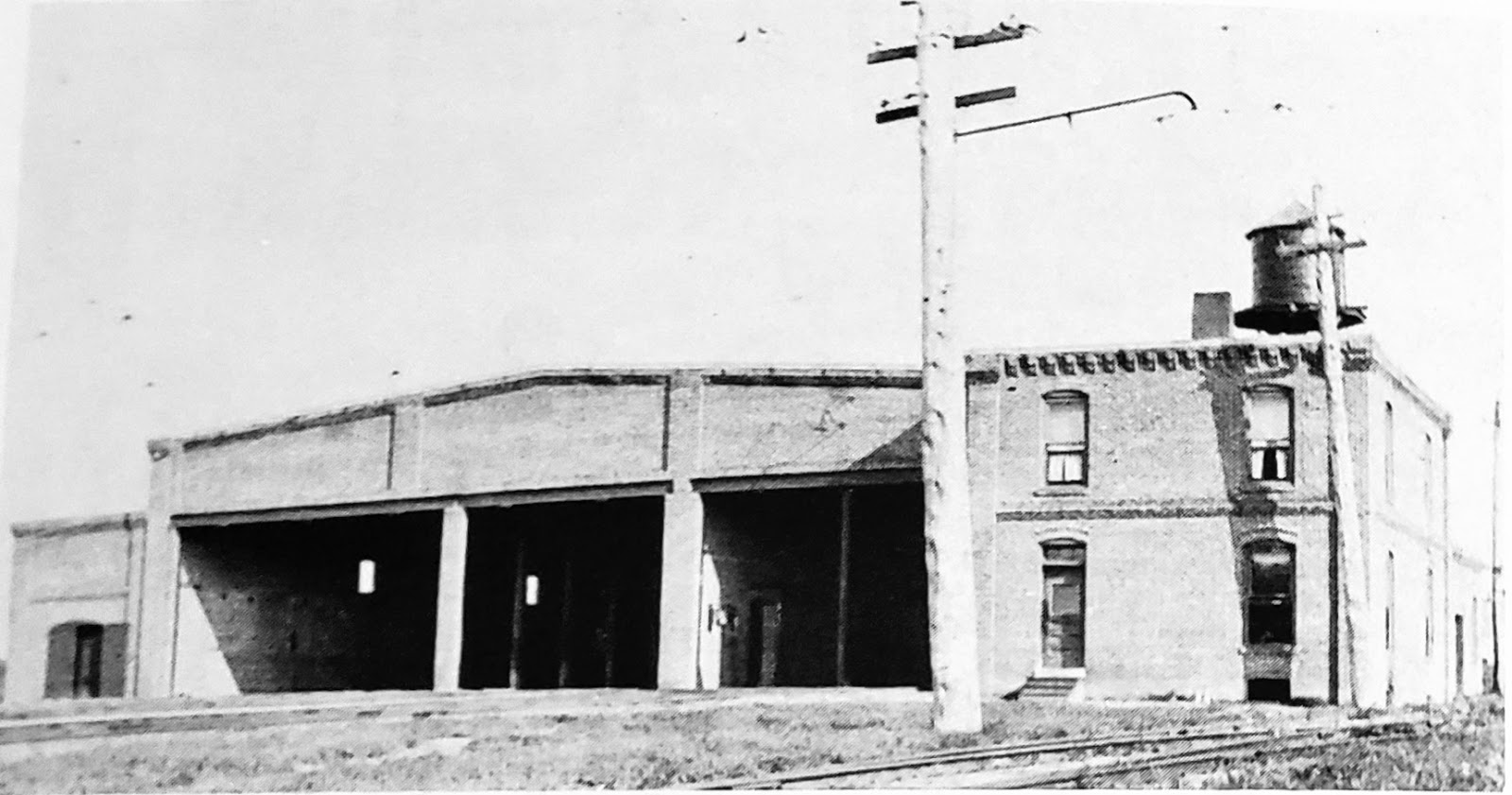
The South Berwick carhouse is shown here shortly after its
completion in 1903. The elevated tank contained water for
an automatic sprinkler system in the barn. There were seven
tracks and a two-story ell at the right, which contained offices,
a crew's lobby, a power substation, and a second-floor
dormitory. A fire on November 16, 1918, destroyed a
good portion of the building. No trace of the building
remains today. O. R. Cummings Collection

Just a short distance from the South Berwick carhouse was
South Berwick Junction, where the tracks to South Berwick
village branched from the mainline between Dover and
Rosemary Junction. Nearby was Quamphegan Park, a
privately owned resort bordering Quamphegan Brook
and the Salmon Falls River. Boating, fishing, bathing, and
a dancing pavilion were among its simple attractions.
O. R. Cummings Collection

     No special ceremonies appear to have marked the opening of the new routes constructed by Portsmouth, Dover & York. The certificate of safety was granted on June 29, and regular service between Dover and York Beach commenced on July 1. Because of a delay in the completion of the viaduct over the Boston & Maine near the Eliot depot, the extension from Rosemary Junction to Greenacre did not open until July 14. Operations for new construction were finalized on August 13, 1903, with the "Airline" route from Rosemary Junction in Eliot to York Corner, mainly over the private right-of-way, opened on November 1, 1903, as a direct route from Dover to York Beach.

Open car No. 19 at the Greenacre on July 24, 1902, 
opening day of the Kittery & Eliot Railway.
O. R. Cummings Collection

     The basic fare on the PD&Y system was five cents, and each route was divided into two or more five-cent zones. 
Portsmouth-York Beach: Portsmouth and Emery's (Ferry Lane), Kittery; Emery's and Sea Point; Sea Point and Seabury, York; Seabury and Club Stables, York Harbor; Club Stables and St. Aspinquid Park, York Beach.
Portsmouth - Dover: Portsmouth and Cross Street, South Eliot; Cross Street and Rosemary Junction; Rosemary Junction and South Berwick Junction; South Berwick Junction and Dover.
Dover-York Beach: Dover and South Berwick Junction, South Berwick Junction, and Rosemary Junction; Rosemary Junction and Langley's Road, East Eliot; Langley's Road and Rice's Bridge; Rice's Bridge and Club Stables, York Harbor; Club Stables and York Beach.
Dover-South Berwick: Dover and South Berwick Junction; South Berwick Junction and South Berwick.

Dover-Eliot-Kittery Map from
2015 NEERHS book,
"The Illustrated Atlas of Maine's Street
& Electric Railways 1863-1946"

Kittery-York Beach Map from
2015 NEERHS book,
"The Illustrated Atlas of Maine's Street
& Electric Railways 1863-1946"


Click Here: for the post on the P,K&Y StRy Powerhouse and car barn


     In addition to the passenger receipts and revenue from mail and express, the PD&Y had another source of income - the tolls from the railway-owned Eliot Bridge.
A few typical tolls were as follows:
     Foot Passenger..............................................  .02
     One Person with Horse.................................  .08
     Carriage Drawn by One Horse......................  .15
     Carriage Drawn by Two Horses....................  .25
     Coach, Hack, or Sleigh Drawn by Four-Horse .40
     Led Horses or Cattle, Each............................  .05
     Sheep or Swine, Each....................................  .01
     Bicycle...........................................................  .03

      In later years, the rate for bicycles was increased to five cents. The rate for automobiles with two seats was fifteen cents, with a two-cent charge added for each additional seat, occupied or unoccupied. The rate for motor trucks (limited in weight) was 25 cents.

Built by the Laconia Car Company Works for the PD&Y in
1904, U. S. Mail car No. 108 also carried Express. No. 108
is among the collection of Maine railway vehicles at
Seashore Trolley Museum is listed in the
O. R. Cummings Collection

Railway Mail Service clerk Charles Preston sorts letters in
the postal compartment of No. 108 somewhere between
Badger's Island and York Beach. 
O. R. Cummings Collection

     The PD&Y utilized about 41 total miles of trackage. During its full fiscal year of operation ending June 30, 1905, the line carried 2,812,046 passengers and generated $99,482 in passenger revenues.

     Late in 1905, stock control of the Portsmouth, Dover & York was acquired by the syndicate that controlled the Atlantic Shore Line Railway (ASL), and on February 1, 1906, the PD&Y was formally consolidated with the Atlantic Shore Line and the PD&Y became the ASL's Western Division.
~~~~~~~~~~~~~~~
Click Here: For the list of links to Theodore Roosevelt Maine Heritage Trail Posts in Easy Order to View

We continue the restoration work on the 1912 Narcissus, the only surviving high-speed, luxury interurban coach of the Portland-Lewiston Interurban. 

Click Here: Narcissus Restoration-Related Posts

Being more than a century old, the stately, "Elegant Ride," Narcissus, is a gem.  This shimmering precious stone of Maine transportation history is brilliantly resplendent as it emanates so many elements of history, including time, places, people, and events, that it was coupled to, that when just a smattering of its seemingly innumerable stories are shared, the contents first captivates, fascinates, then generates interest to learn more 🙋. The majestic Narcissus is listed in the National Register of Historic Places.

Please consider joining the epic journey to complete the Narcissus Project by making a donation today!

Click Here: Donation Options

The restoration of this majestic icon of Maine's electric railway history is but one in a series of captivating stories containing an abundance of incredible coalition of narratives.

Click Here: History-Related Posts - Narcissus and Portland-Lewiston Interurban

     The Narcissus is featured in the national Gold Award-winning novel, Teddy Roosevelt, Millie, and the Elegant Ride. The "Elegant Ride" is the Narcissus. Theodore Roosevelt was a passenger on the Narcissus on August 18, 1914, between Lewiston and Portland, Maine, while campaigning for the Progressive Party candidates.

Click Here: Bookstores and Businesses promoting the Narcissus Project

Independent book publisher, Phil Morse, holding
Gold Book Award Winner plaque for
 Middle Reader category for The Eric
Hoffer Book Award. Congratulations to
award-winning Maine author,
Jean M. Flahive