Showing posts with label Teddy Roosevelt Days. Show all posts

Friday, September 2, 2016

Narcissus Restoration Update - August 2016

The Narcissus with all of its roof boards removed. Each of the ash
roof ribs will be inspected, and if necessary, removed, repaired,
and/or replaced. Most are in very good shape. All original steel
screws will be replaced with stainless steel screws. The roof
boards were in varying degrees of condition. Some were missing,
some had water damage, some had critter damage, some needed
repairs, and then returned to service. August 15, 2016, PWM

Critters gnawed their way through the roof boards, entered the
comfy confines of the Narcissus, and set up a multi-family
housing complex. August 14, 2016. PWM

Many of the original steel nails from 1912 had lost their ability to
properly hold the roof boards securely to the roof ribs, so that at
some point in years past, galvanized nails were nailed next to every
original nail on every roof board. This double-nailing made it twice
as difficult to remove the roof boards without further damaging
the original poplar tongue-and-groove boards.
August 13, 2016. PWM

The 1912 Narcissus on August 15, 2016. Looking rather skeletal, 
like, following the removal of all its roof boards. It looked much
different a week earlier, as it had many restored components put in
place for the annual fundraising event weekend to benefit the project.
The 2016 Teddy Roosevelt event was a great success. All the guests
who attended throughout the three days were treated to a glimpse
of just how truly beautiful the Narcissus will be when its restoration
is complete. August 15, 2016. PWM

On the right side of the Narcissus (with the number 2 end on the
left,  affectionately called the "Teddy End," Theodore Roosevelt
was a passenger on the Narcissus on August 18, 1914, with the
thirteen ornate leaded-stained glass clerestory windows, temporarily
in place for the 2016 Teddy Roosevelt Days event weekend.
To the right, you can see the large leaded stained glass
"eyebrow" window in place in the smoking compartment.
August 4, 2016. PWM

The left side of the 1912 Narcissus (number 1 end on the left) on
the evening of August 4, 2016. PWM

Donald Curry, Lead Restoration Technician on the Narcissus
restoration, during the early stages of assembling the various
components necessary to enclose the right side of the smoking
compartment on the number 1 end. August 1, 2016.  PWM

Interior of the right side of the smoking compartment at the number
1 end. Restored original mahogany sash passenger windows with
their polished original brass hardware. Original Santo Domingo
mahogany pieces that were restored 15 to 20 years ago were removed
from storage for use to enclose the window openings. August 4, 2016.
PWM

Right side smoking compartment with restored windows and sash
in place on August 4, for the Narcissus fundraising event weekend
Teddy Roosevelt Days 2016. From this vantage point, you can see
through the smoking compartment to view the large leaded stained
glass "eyebrow" on the left side and the pair of restored leaded
stained glass windows in the clerestory. On the exterior, you can
see the top of the eyebrow is held in place with a restored
exterior poplar frame and by the faceboard between the
restored mahogany passenger window sash. Also, the vertical
tongue-and-groove sheathing is in place surrounding the double
sash/eyebrow assembly. August 4, 2016. PWM

The right side of the Narcissus smoking compartment was prepared
specifically for guest photo opportunities during the benefit event. In
the background of this image is the number 1 end vestibule. One can 
see the original bulkhead window sash with brass hinges (left and right),
the center train door, the large window sash on either side of the train
door, and the lower panels below the sash. These are all original
mahogany components of the Narcissus. August 5, 2016.
Photo by Patricia Pierce Erikson 

Original poplar tongue-and-groove vertical sheathing for the number
1 end dasher, repaired, primed, and ready for finish coats of Pullman
Green. August 8, 2016. PWM

Original poplar tongue-and-groove vertical sheathing for the number
1 end with finish coats of Pullman Green. August 12, 2016. PWM

A few of the original poplar exterior arch halves were repaired,
primed, joined together, and ready for finish coats of Pullman
Green. Each of these is over one of the large leaded stained glass
"eyebrows" above the double sash
passenger windows. August 13, 2016. PWM

A few of the original poplar exterior arch halves after their finish
coats of Pullman Green. Each of these is over one of the large
leaded stained glass "eyebrows," above the double-sash passenger
windows. August 19, 2016. PWM
~~~~~~~~~~~~~~~
We continue the restoration work on the 1912 Narcissus, the only surviving high-speed, luxury interurban coach of the Portland-Lewiston Interurban. 

Click Here: Narcissus Restoration-Related Posts

More than a century old, the stately "Elegant Ride" Narcissus is a gem.  This shimmering precious stone of Maine transportation history is brilliantly resplendent as it emanates so many elements of history, including time, places, people, and events, that it was coupled to, that when just a smattering of its seemingly innumerable stories are shared, the contents first captivate, fascinate, then generate interest to learn more 🙋. The majestic Narcissus is listed in the National Register of Historic Places.

Please consider joining the epic journey to complete the Narcissus Project by making a donation today!

Click Here: Donation Options

The restoration of this majestic icon of Maine's electric railway history is but one in a series of captivating stories containing an abundance of incredible coalition narratives.

Click Here: History-Related Posts - Narcissus and Portland-Lewiston Interurban

     The Narcissus is featured in the national Gold Award-winning novel, Teddy Roosevelt, Millie, and the Elegant Ride. The "Elegant Ride" is the Narcissus. Theodore Roosevelt was a passenger on the Narcissus on August 18, 1914, between Lewiston and Portland, Maine, while campaigning for the Progressive Party candidates.

Click Here: Bookstores and Businesses promoting the Narcissus Project

Independent book publisher Phil Morse, holding
Gold Book Award Winner plaque for
 Middle Reader category for The Eric
Hoffer Book Award. Congratulations to
award-winning Maine author,
Jean M. Flahive

Tuesday, August 16, 2016

The 2016 Narcissus Benefit Event Weekend, Teddy Roosevelt Days, a Success :)

Dan and Rose Vallee are together once again in the Narcissus.
Married for 49 years, Dan first introduced Rose to his parents when
the elder Vallees were living in the Narcissus in Sabattus,
Maine. Photo by Patricia Pierce Erikson

This photo opportunity was prepared specifically for photo opportunities inside the right side of the
smoking compartment during the three-day event to benefit the Narcissus project. The restored original passenger windows in Santo Domingo mahogany sash, with restored original leaded stained glass eyebrow
above, also in an original mahogany sash. All the mahogany components seen here encasing the windows and the bulkhead frame (on the far left unfinished), including the brass hardware, which is original to the Narcissus. Notice the framed pictures of the 26th President, Theodore Roosevelt, in the White House next to a 1914 image of the Narcissus in Gray :) 

The 1912 Portland-Lewiston Interurban, Narcissus, the night
before the Teddy Roosevelt Days benefit event. Guests will be
invited to investigate the beauty that we volunteers, or staff,
have at the Seashore Trolley Museum. A privilege to
experience daily.  All 26 restored stained glass clerestory windows
 (13 on each side) were in place for the event. PWM

The right side, at the number 1 end, smoking compartment
of the Narcissus. The large leaded stained glass "eyebrow,"
on high, above the double-sash passenger windows. Also in
place for event guests viewing, for the three-day benefit
event, is the vertical sheathing on each side working
its way into the vertices of the restored exterior poplar
arch halves. PWM 

Lead Restoration Technician, Donald Curry, leaning against a
window in the Narcissus, as Narcissus project manager, Phil
Morse chats with event guests inside the Seashore Trolley

Captured, capturing, a special moment. The right side of the
Narcissus' smoking compartment was prepared specifically for
guest photo opportunities during the benefit event. In the
background is the number 1 end vestibule. One can see the
original bulkhead window sash with brass hinges (left and right),
the center train door, a large window sash on either side of the
train door, and lower panels below the sash. All original mahogany!
Photo by Patricia Pierce Erikson

Did I mention how popular this photo opportunity was?
Photo by Patricia Pierce Erikson

Left to Right - Narcissus project manager, Phil Morse, author,
Michael Canfield, Dan Vallee, and Seashore Trolley Museum
Library Committee member, Karen Dooks.
Photo by Patricia Pierce Erikson

Presque Isle Historical Society's display of the beautiful artifacts of
Theodore Roosevelt's. In the case on the left is TR's birch-bark
moose call he used while hunting in Maine in 1878 & 1879 with
Maine guides, William Sewall and Wilmot Dow. The mirror on the
wall in the back is the original buffalo horn mirror from TR's Elkhorn
Ranch in North Dakota. Sewall and Dow were hired as ranch hands
for the ranch in the mid-1880s. The Maine guides cut down trees
and built the Elkhorn Ranch, and lived in the ranch house with
their wives (and had children) and with TR. In the case on the right
is TR's single-action Colt 40-caliber long-barreled revolver used
 in the Dakotas. PWM

How cool is this shot? The reflection in Theodore Roosevelt's
Elkhorn Ranch mirror is one of the three men who used this very
mirror daily, for three years in North Dakota in the mid-1880s!
(L-R)  Theodore Roosevelt, Wilmot Dow, and William Sewall.
The image is from February 1879 in Maine.
TRC 520.12.015 PWM

Presque Isle Historical Society's Kimberly Smith introduces the
Roosevelt items to the guests assembled during the Friday
reception of Teddy Roosevelt Days event to benefit the Narcissus.
Photo by Patricia Pierce Erikson

Author Michael Canfield discussed many intriguing points
within his new book about TR, "Theodore Roosevelt in the
Field". I personally found the book very engaging and
enlightening, and strongly recommend it. PWM

Dan Vallee gave an extremely entertaining explanation of what
his life was like as he grew up living in the Narcissus in the 1940s,
50s, and 60s. Stories of living conditions, family members, and
life in general as told through a variety of personal stories.
Well Done, Dan! Photo by Patricia Pierce Erikson

Teddy Root Beer

Raffle prizes included a pine wood-barreled pen. The pine is
from a Narcissus clerestory, nailing roof rib. Also, an ash
wood-barreled pen was raffled off as well. PWM

An image that shows what the future has in store for us.
After seeing so many of the stained glass windows in place
in the Narcissus over the three-day event, my sense is
that the Narcissus is going to be even more beautiful when fully
restored. We dreamed it might be. Photo by Patricia Pierce Erikson

360-degree view of the reception set up just before guests arrive. PWM
~~~~~~~~~~~~~~~
We continue restoration work on the 191, Narcissus, the only surviving high-speed, luxury interurban coach of the Portland-Lewiston Interurban. 

Click Here: Narcissus Restoration-Related Posts

More than a century old, the stately "Elegant Ride," Narcissus, is a gem.  This shimmering precious stone of Maine transportation history is brilliantly resplendent as it emanates so many elements of history, including time, places, people, and events, that it was coupled to, that when just a smattering of its seemingly innumerable stories are shared, the contents first captivate, fascinate, then generate interest to learn more 🙋. The majestic Narcissus is listed in the National Register of Historic Places.

Please consider joining the epic journey to complete the Narcissus Project by making a donation today!

Click Here: Donation Options

The restoration of this majestic icon of Maine's electric railway history is but one in a series of captivating stories containing an abundance of incredible coalition narratives.

Click Here: History-Related Posts - Narcissus and Portland-Lewiston Interurban

     The Narcissus is featured in the national Gold Award-winning novel, Teddy Roosevelt, Millie, and the Elegant Ride. The "Elegant Ride" is the Narcissus. Theodore Roosevelt was a passenger on the Narcissus on August 18, 1914, between Lewiston and Portland, Maine, while campaigning for the Progressive Party candidates.

Click Here: Bookstores and Businesses promoting the Narcissus Project

Independent book publisher Phil Morse, holding
Gold Book Award Winner plaque for
 Middle Reader category for The Eric
Hoffer Book Award. Congratulations to
award-winning Maine author,
Jean M. Flahive

Friday, July 15, 2016

"A President Has Ridden in My House" - Daniel Vallee, the Narcissus, and Teddy Roosevelt's Ride


   On August 18, 1914, Theodore Roosevelt, the 26th President of the U.S., addressed a gathering at Gray, Maine, from the high-speed luxury interurban, Narcissus, while campaigning for the Progressive Party candidates.
   The Narcissus was built in 1912 and, from 1914 until 1933, operated on "New England's Finest and Fastest Electric Railroad", the Portland-Lewiston Interurban.
   Daniel Vallee's father, J. Henry Vallee, purchased the 46-foot "body" of the elegant Narcissus, with its forty ornate windows and mahogany interior, for use as the family summer camp.
   The Narcissus is currently being restored at the Seashore Trolley Museum in Kennebunkport, Maine.

May 31, 2026, Joe Banavige released this wonderful American 250 Tribute to William W " Bill" Sewall, TR's Maine guide (along with Wilmot Dow, Bill's nephew) 
Click Here to see Joe's Substack post

Daniel Vallee will be one of the special guest speakers on Friday, August 5, 2016. The opening reception of this year's Teddy Roosevelt Days event benefits the Narcissus project. See the schedule of activities below for the weekend event with ways you can help the project.


Teddy Roosevelt Days August 5-7, 2016
A Fundraising Event to benefit the 1912 Portland-Lewiston Interurban - Narcissus
To read more on Theodore Roosevelt's connection to the Narcissus - Click Here
Follow the activities of the Narcissus project and the restoration of this

The Mount Katahdin Expedition
Friday, August 5th, 2016  - 3pm-8pm
Tickets to the Expedition are $30 and may be purchased online here

3 pm         Guest arrival, check-in, silent auction preview
4 pm         Vintage Trolley Ride to Riverside Barn and walk to Town House Shop Tour of 
                  Narcissus (currently under renovation) with Project Sponsor Phil Morse
5:30 pm    Reception at Exhibit Gallery, Visitor's Center, with light refreshments (provided by the
                  amazing, Jen Burrows at Winks Kennebunkport, beer & wine, and silent auction bidding, ongoing
6 pm         
* Presentation by Mr. Dan Vallee, "Living in the Narcissus"
Lecture & book signing by Michael Canfield - Harvard University and the Theodore Roosevelt Association - "Theodore Roosevelt in the Field." Mr. Canfield is the editor of 
Field Notes on Science and Nature, Dean of Eliot House, and a lecturer on organismic and evolutionary biology at Harvard University. He lives in Cambridge, MA
7:45 pm    Raffle, Silent Auction closes
8 pm         Vintage Car exclusive ride along Seashore Trolley Museum's Heritage Main Line

Tickets for the Mount Katahdin Expedition are $30 and may be purchased online here

Seating is limited, so reserve your tickets for Friday, Today!

FMI contact p.morse31@gmail.com

Saturday, August 6th, 2016 - 10 am - 5 pm
Regular Admission Tickets to attend the Event
Vintage Trolley Ride to Riverside Barn and walk to Town House Shop for Tour of Narcissus (currently under renovation) with Project Sponsor Phil Morse
* Raffle and Sale of Special Items - All Proceeds Benefit the Narcissus Project

Sunday, August 6th, 2016 - 10 am - 5 pm
Regular Admission Tickets to attend the Event
Vintage Trolley Ride to Riverside Barn and walk to Town House Shop for Tour of Narcissus (currently under renovation) with Project Manager Phil Morse
* Raffle and Sale of Special Items - All Proceeds Benefit the Narcissus Project

Two recent photos taken of the restoration work show the clerestory windows temporarily in place for a "test fitting" - what a beauty :)

The right side of the Narcissus faces towards the number one end.
June 24, 2016. PWM image

The right side of the Narcissus is facing towards the number two end.
June 24, 2016. PWM image
~~~~~~~~~~~~~~~
Click Here: For the list of links to Theodore Roosevelt Maine Heritage Trail Posts in Easy Order to View


We continue the restoration work on the 1912 Narcissus, the only surviving high-speed, luxury interurban coach of the Portland-Lewiston Interurban. 

Click Here: Narcissus Restoration-Related Posts

More than a century old, the stately "Elegant Ride," Narcissus, is a gem.  This shimmering precious stone of Maine transportation history is brilliantly resplendent as it emanates so many elements of history, including time, places, people, and events, that it was coupled to, that when just a smattering of its seemingly innumerable stories are shared, the contents first captivate, fascinate, then generate interest to learn more 🙋. The majestic Narcissus is listed in the National Register of Historic Places.

Please consider joining the epic journey to complete the Narcissus Project by donating today!
Click Here: Donation Options

The restoration of this majestic icon of Maine's electric railway history is but one in a series of captivating stories containing an abundance of incredible coalition narratives.

Click Here: History-Related Posts - Narcissus and Portland-Lewiston Interurban

     The Narcissus is featured in the national Gold Award-winning novel, Teddy Roosevelt, Millie, and the Elegant Ride. The "Elegant Ride" is the Narcissus. Theodore Roosevelt was a passenger on the Narcissus on August 18, 1914, between Lewiston and Portland, Maine, while campaigning for the Progressive Party candidates.

Click Here: Bookstores and Businesses promoting the Narcissus Project

Independent book publisher Phil Morse, holding
Gold Book Award Winner plaque for
 Middle Reader category for The Eric
Hoffer Book Award. Congratulations to
award-winning Maine author,
Jean M. Flahive

Monday, July 4, 2016

Teddy Roosevelt Days - August 5-7, 2016 - To Benefit the Narcissus Project

Teddy Roosevelt Days August 5-7, 2016
A Fundraising Event to benefit the 1912 Portland-Lewiston Interurban - Narcissus
To read more on Theodore Roosevelt's connection to the Narcissus - Click Here
Follow the activities of the Narcissus project and the restoration of this


The Mount Katahdin Expedition
Friday, August 5th, 2016  - 3pm-8pm
Tickets to the Expedition are $30 and may be purchased online here

3 pm         Guest arrival, check-in, silent auction preview
4 pm         Vintage Trolley Ride to Riverside Barn and walk to Town House Shop - Tour of 
                  Narcissus (currently under renovation) with Project Manager Phil Morse
5:30 pm    Reception at Exhibit Gallery, Visitor's Center, with light refreshments (provided by the
                  amazing, Jen Burrows at Winks Kennebunkport, beer & wine, and silent auction bidding, ongoing
6 pm         
* Presentation by Mr. Dan Vallee, "Living in the Narcissus"
Lecture & book signing by Michael Canfield - Harvard University and the Theodore Roosevelt Association - "Theodore Roosevelt in the Field." Mr. Canfield is the editor of 
Field Notes on Science and Nature, Dean of Eliot House, and a lecturer on organismic and evolutionary biology at Harvard University. He lives in Cambridge, MA
7:45 pm    Raffle, Silent Auction closes
8 pm         Vintage Car exclusive ride-along Seashore Trolley Museum's Heritage Main Line

Tickets for the Mount Katahdin Expedition are $30 and may be purchased online here

Seating is limited, so reserve your tickets for Friday, Today!

FMI contact p.morse31@gmail.com

Saturday, August 6th, 2016 - 10 am - 5 pm
Regular Admission Tickets to attend the Event
Vintage Trolley Ride to Riverside Barn and walk to Town House Shop for Tour of Narcissus (currently under renovation) with Project Manager Phil Morse
* Raffle and Sale of Special Items - All Proceeds Benefit the Narcissus Project


Sunday, August 6th, 2016 - 10 am - 5 pm
Regular Admission Tickets to attend the Event
Vintage Trolley Ride to Riverside Barn and walk to Town House Shop for Tour of Narcissus (currently under renovation) with Project Manager Phil Morse
* Raffle and Sale of Special Items - All Proceeds Benefit the Narcissus Project


Two recent photos taken of the restoration work show the clerestory windows temporarily in place for a "test fitting" - what a beauty :)

The right side of the Narcissus, facing the number one end.
June 24, 2016. PWM image

The right side of the Narcissus, facing the number two end.
June 24, 2016. PWM image
~~~~~~~~~~~~~~~

Click Here: For the list of links to Theodore Roosevelt Maine Heritage Trail Posts in Easy Order to View

We continue the restoration work on the 1912 Narcissus, the only surviving high-speed, luxury interurban coach of the Portland-Lewiston Interurban. 

Click Here: Narcissus Restoration-Related Posts

More than a century old, the stately "Elegant Ride," Narcissus, is a gem.  This shimmering precious stone of Maine transportation history is brilliantly resplendent as it emanates so many elements of history, including time, places, people, and events, that it was coupled to, that when just a smattering of its seemingly innumerable stories are shared, the contents first captivate, fascinate, then generate interest to learn more 🙋. The majestic Narcissus is listed in the National Register of Historic Places.

Please consider joining the epic journey to complete the Narcissus Project by making a donation today!

Click Here: Donation Options

The restoration of this majestic icon of Maine's electric railway history is but one in a series of captivating stories containing an abundance of incredible coalition narratives.

Click Here: History-Related Posts - Narcissus and Portland-Lewiston Interurban

     The Narcissus is featured in the national Gold Award-winning novel, Teddy Roosevelt, Millie, and the Elegant Ride. The "Elegant Ride" is the Narcissus. Theodore Roosevelt was a passenger on the Narcissus on August 18, 1914, between Lewiston and Portland, Maine, while campaigning for the Progressive Party candidates.

Click Here: Bookstores and Businesses promoting the Narcissus Project

Independent book publisher Phil Morse, holding
Gold Book Award Winner plaque for
 Middle Reader category for The Eric
Hoffer Book Award. Congratulations to
award-winning Maine author,
Jean M. Flahive

Saturday, July 2, 2016

The Beginning of a Classic Interurban - July 2, 1914

The Wednesday, July 1, 1914, issue of the Lewiston Evening Journal.
A collage of pictures taken on June 26, 1914. An official inspection
of the Interurban by the State Railroad Commissioners was
accompanied by a party of about thirty officials and guests.

Collection of Donald G. Curry

     To celebrate the one-hundred-and-second anniversary of the opening of what we now know as the Portland-Lewiston Interurban - "The Finest Electric Railroad in All New England", first requires some background information for those readers who may not be as familiar with the series of events in the previous few weeks that unfolded leading up to the opening day of the line.

     You will see references to the "Libbey Road". W. S. Libbey was the driving force behind the creation of the Portland-Lewiston Interurban and was a well-respected businessman in the twin cities of Lewiston-Auburn.

     You will see references to the Portland, Gray & Lewiston Railroad. This was the name of the line before July 10, 1914.

     O. R. Cummings' excellent books on the Portland-Lewiston Interurban (May 1956 & September 1967) are wonderful resources, and much of the information imparted here is from those publications.

     In 1905, two companies had their proposals approved to build a 32-mile railway between Portland and Lewiston. The Portland and Lewiston Railway, led by Edward W. Gross and Lewis A. Goudy, and the Lewiston and Portland Railroad, led by Winfield S. Libbey (known as W. S. or W. Scott Libbey) and Henry M. Dingley. At the time, Gross & Goudy were associated with the development of the Automatic Telephone Company in Lewiston, and Libbey & Dingley were co-owners of the Lewiston & Auburn Electric Light Company, which held important water rights at Deer Rips on the Androscoggin River, where they had constructed a modern hydroelectric plant and planned on their new electric railroad to be a major customer.
Libbey-Dingley Dam, Lewiston, Maine PWM postcar

     Fortunately, the two companies were friendly and agreed to merge into one company. Gross & Goudy led the company and had the power to supply the new railroad from the electric company owned by Libbey & Dingley. The newly formed Portland, Gray & Lewiston Railroad was approved in 1907. The capital required to fund a major construction project, as was planned for this new line, was not easy for Gross & Goudy, and early in 1909, Gross appealed to Libbey, a prominent Lewiston industrialist, for assistance. To make a long story short, by 1910, Libbey & Dingley had purchased all the interests in the company, with Libbey having the controlling interest.

A four-horse team draws the scoop, breaking ground for the PLI at
Danville in 1910. Collection of O. R. Cummings

     Under the direction of W. Scott Libbey, construction started on April 7, 1910, when Sam Ferguson, construction superintendent, turned over the first piece of sod near Littlefield's Corner in Auburn. As-built, the Portland, Gray & Lewiston had a private right of way 50 feet wide, with a maximum grade on the line of 4 percent, and the sharpest curve was 780 feet in radius. In fact, the line was constructed in as substantial a manner as many steam railroads. In all respects, an electric railroad, not a street railway. 

     In 1913, the consolidation of the Libbey & Dingley electric light and railroad properties into a single corporation brought the birth of the Androscoggin Electric Company.

W. Scott Libbey
O. R. Cummings Collection

     Sadly, on May 17, 1914, just a few weeks before the opening of the new electric railroad, W. Scott Libbey died. Control of the line was vested in Mr. Libbey's estate, although Mr. Dingley held a substantial interest. The name of the Portland, Gray & Lewiston was changed to the Portland-Lewiston Interurban Railroad on July 10, 1914. In October 1914, Mr. Dingley sold his interests in the line to the Libbey estate. The estate, in turn, conveyed the properties to a syndicate, which also acquired the capital stock of the Androscoggin Light Company. Central Maine Power Company took over the ownership of the Androscoggin Light Company (including the Portland-Lewiston Interurban Railroad) in April 1920.

The actual opening day to the public.
A short announcement on page 12
(back page) of the Lewiston Evening Journal's
July 2, 1914 issue. The peak year would be 1920,
when the PLI carried 531,440 passengers.

No. 10 Arbutus, with Lewiston terminal personnel l-r:
Two unidentified men, R G Weeks, master mechanic;
Guy W. Mitchell, barn foreman; H. L. Wright,
Mrs. Lucy Card Matthews, E J Chateauvert, Milan H Spinney,
Charles E. Kennison, L. R. Penny.  June 29, 1914
Collection of Barney Neuburger from O. R. Cummings

     When the line's public operations began on Thursday, July 2, it was not prepared for full service between Portland and Lewiston. Trips from each direction met in Gray, the midpoint between the terminal cities. The running time between the terminal cities was 1 hour and 50 minutes. There were six interurbans in the fleet, but only three were operational. The two that were used for public trips on opening day were the Azalea and the Arbutus. The Narcissus was held back in service.
The other three cars needed to be fitted out, meaning, in part, to have their motors installed. 

     By late July, the Gladiolus, Clematis, and Magnolia were ready, and sufficient motormen and conductors had been qualified to permit the start of full service. As a result, an hourly headway was established on Monday, July 27, with the new schedule calling for 15 daily trips in each direction over the line. Running time was about 1 hour and thirty minutes.

     The PLI quickly established an enviable reputation for reliability and on-time performance, and even in the worst winter weather, the big green cars, thanks to an efficient snow-fighting force, usually managed to get through.

     From the beginning, the Interurban was a "spit and polish" road, with cars being cleaned inside and out and being given thorough inspections at the Lewiston terminal between trips. Shortly after the line opened, as a token of elegance, each motorman and conductor was issued a pair of kid gloves worn while running the car, and donned again later while assisting passengers to board and alight, running railroad crossings, throwing switches, and the like. 

Every indication is that the PLI enjoyed excellent public relations throughout its entire existence. The Interurban appears to have largely escaped unfavorable criticism from the press. Crews were capable, courteous, and friendly, most of the conductors and motormen being Maine-born and raised and knowing and being known by the regular passengers on a first-name basis. To many of the trainmen, the Interurban was more than just a means of earning a living - it was a way of life. They took a deep interest in the affairs of the road and were always ready to make an extra effort to better accommodate the riders and to attract and retain patronage.

No. 18 Azalea at Deering Junction with Walter E Pinkham, one of the first PLI
motormen. And Clarence J Cobb, who became PLI's first Freight Agent in 1915.
From the O.R. Cummings Collection

Porcelain sign from PLI ticket stand.
Collection of O. R. Cummings

    Below is the newspaper story from the June 26th, 1914, issue of the Lewiston Evening Journal, of the official inspection of the line. Interesting that one of the details from the June 27th issue of the Lewiston Evening Journal, with the "recap" of the official inspection, is different.  The 26th states that Narcissus is the luxury interurban used for the inspection trip. The 27th recap states that the Azalea was the luxury interurban used. The 27th recap article is posted below the 26th article.

Lewiston Evening Journal - June 26, 1914

Ibid

Ibid

Ibid

Final clip

     Here is the newspaper story from the June 27th issue of the Lewiston Evening Journal's recap of June 26, 1914, official inspection of the line. Interesting that some of the details vary from the actual June 26th Lewiston Evening Journal from above. Images were added by PWM


P. G. & L INTER-URBAN R. R. LINE INSPECTED

Railroad Commissioners and the Party of Invited Guests Made a Trip In a Special Car

Banquet at Riverton Park Casino - Road Will Open For Traffic the Latter Part of Next Week

In the beautiful car Azalea, the State railroad Commissioners made an official tour of inspection over the Portland, Gray & Lewiston Inter-urban Railroad yesterday. After completing the trip to Portland, the car was run out to Riverton Park, where a fine banquet was served at the Casino under the personal direction of the manager, Dan Smith.

  With ideal weather and other conditions being favorable, the trip was one of great enjoyment to all. Probably with no exceptions, this is the most up-to-date, substantially constructed, and finest-equipped electric line in New England. Heavy irons, heavy rolling stock, and perfect grading tend to make the going smooth for the passenger comfortably placed in one of the fine, plush, upholstered seats of these parlor-like cars.
  The start from Lewiston was made at 10 A. M. The party consisted of Railroad commissioners Hon. John A. Jones of Lewiston, Hon. Frank Keizer of Rockland, George F. Giddings of Augusta, clerk of the board, and his son. Mr. and Mrs. Henry M. Dingley, Mrs. Nelson Dingley, Mrs. Annie E. Libbey, Mrs. A. W. Anthony, Miss Alla Libbey, Mr. and Mrs. Harold S. Libbey, W. Scott Libbey Jr., Fred D. Gordon, superintendent of the Lewiston & Auburn Electric Co., Hon. and Mrs. John A. Morrell, Mayor and Mrs. A. W. Fowles, George W. Bowie, general superintendent of the L. A. & W. St. Ry., Mrs. Bowie, L. H. McCray, manager of the Atlantic Shore Line, Mr. and Mrs. Sam E. Connor, Mr. and Mrs. N. W. Benner, J. Everett Parkhurst, Miss Alice Rowe, Miss Fogg, Miss Jones, Mrs. Brady, Mayor R. J. Wiseman of Lewiston was detained at home on account of illness. The car was in charge of Motorman Charles H. Mitchell and Conductor Charles Kennison.
  Over a line of far-stretching tangents and slow winding curves, cutting through woodlands, and fields, and broken by hills and vales offering a succession of panoramic views of rare picturesque beauty, the ride to Portland was made in about one hour and 40 minutes, which will probably be about the scheduled running time between the two cities when the road opens for traffic the latter part of the week. On the downward trip, occasional stops were made for sightseeing and to allow the commissioners to inspect the construction of the road, especially the culvert and bridgework. Suffice it to say that the thoroughness and high class of the construction far exceed the legal requirements, and the commissioners found no feature to criticize and had only words of praise to speak of the road.

PLI's right-of-way view through Chandler's Woods near New Gloucester
shows the excellence of the PLI track and roadbed. Trolley Poles are on
the right, and high-tension lines are on the left. G.F. Cunningham
Collection of O. R. Cummings

     As soon as the car was on its way, Mrs. Anthony distributed small bouquets of Feverfew, the favorite flower of her father, the late Hon. W. Scott Libbey, builder of the road which today stands as a splendid and lasting monument to his memory.

Feverfew, W. Scott Libbey's favorite flower.

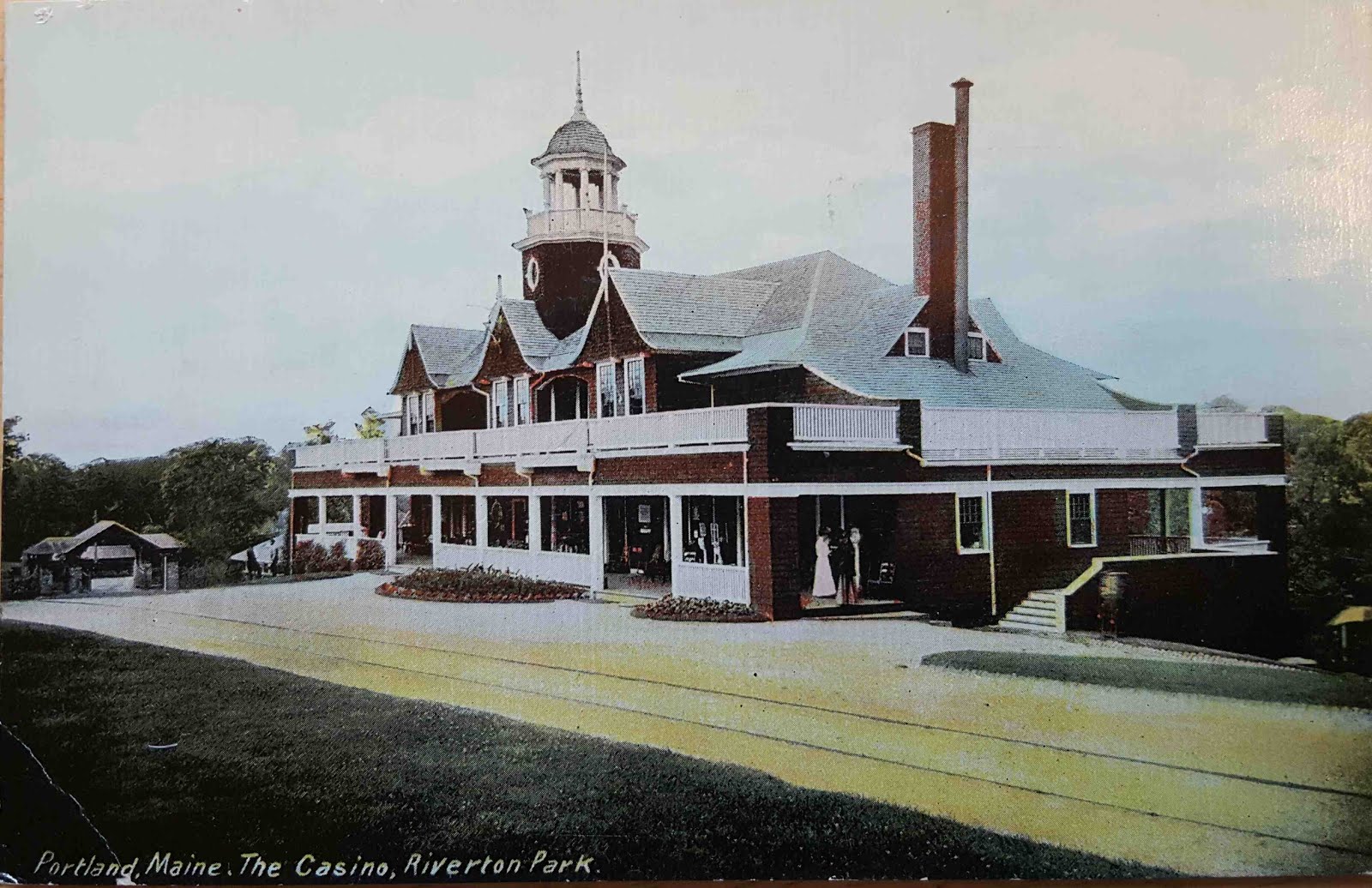
     The party proceeded directly to Portland, circled Monument Square, and then the car was run to Riverton Park, where at 1:30 P M, a fine banquet was served in one of the private dining rooms at the Casino under the personal direction of the manager, Dan Smith. The tables were decorated with cut flowers, including a large bouquet of Feverfew. A pink lay next to each plate. As a closing and touching feature of the banquet, at the suggestion of President Dingley, all arose and drank a cold water toast. After a stroll about the Park observing points of particular interest and posing for a group picture, the return trip to Lewiston was made, the running time being in perfect accord with the proposed schedule. The car reached  Lewiston at about 5 P M.

Casino at Riverton Park, Portland, Maine
PWM Collection

     While the exact date of opening the road for regular traffic has not been fixed, the officials state that barring disappointments, it will probably be the latter part of next week. Six cars will be used in the service: the Arbutus, Narcissus, Gladiolus, Magnolia, Azalea, and Clematis, one of which will leave hourly from either terminal, the running time, probably, about one hour and 40 minutes, and the fare from Lewiston to Portland is 75 cents.
  The use of names other than numbers to designate the different cars was the idea of Mr. Libbey, the builder of the road. He desired that each car be given a personality, and as he was a great lover of flowers. It was suggested by one of his daughters that the names of cars should be those of Mr. Libbey's favorite flowers. Thus, with his approval, they were named in the order given.

No. 10 Arbutus interior. Collection of O. R. Cummings

     These cars are truly flowers of their species. Each car has a seating capacity of 52. This includes the smoking compartment. There is a baggage rack completely around the top of each car. This is for use and is not ornamentation. They are finished in mahogany, with ebony and holly inlaid as decorations. The windows are of plate glass, arranged, as are those of a Pullman, with art glass overhead. The upholstered seats are green plush in the main car and leather in the smoking car. All metalwork is bronze. The vestibules have trap doors that drop down over the car steps when the car is in motion, after the design of the standard steam road cars. The advantage of this is that the car steps can be made sufficiently low for easy access by patrons of the road. It surely will be appreciated by lady passengers who wear dresses of the prevailing style.
     Each car has motors of 300 H. P. (actually, each had four, 90 H.P. motors. PWM) guaranteed to give a speed up to 70 miles an hour when desired. The wheels, 31 inches in diameter, are of pressed steel with a steel rim shrunk on. They have roller bearings, and all cars are fully equipped with searchlights and air brakes.
     Another feature of these cars is the end door in the vestibules. These open from the outside. They are designed exclusively for the use of conductors when more than one car is run in a train. The conductor, having a key, can pass from one car to another, but passengers cannot.
     The construction of the road began in April 1910 under the supervision of Sam Ferguson, and since that time, its progress has been steady. The roadbed is said to be one of the best in New England. The heaviest grade is a fraction over four percent, and the shortest curve has a radius of 700 feet, and the cars can safely take it at a 40-mile-an-hour clip. The average radius of curves is 1100 feet.
     Between the junction with the L. A. & W. rails on Minot Avenue, Auburn, and those of the Portland Railroad at Deering Jct., there are 12 bridges. Ten of those are concrete, reinforced with 3/4 inch steel rods, a much heavier reinforcement than is usually employed. There are two steel bridges. One of these is where it passes over the Rumford Falls line. The other is where it passes under the Grand Trunk.

The interurban tracks burrowed under the Grand Trunk Railway's mainline
Portland to Canada, a short distance east of Danville Station.
O. R. Cummings Collection

     There are two types of culverts: concrete and corrugated tubular iron, according to the conditions that have to be met.
     Along the line, there are 50 cattle passes. These are concrete, reinforced, and have an eight-foot clearance. 
     Open hearth steel rails, 70 pounds to the yard, are used on the road.
     The method of hanging the trolley wire is new to Maine. It is known as the Catenary system. It reduces the danger of the trolley wheel leaving the wire to a minimum. Under this method, the trolley wire is not attached directly to the arm from the pole. A five-strand copper wire rope hangs from the arm. From this rope drop similar wires, about a foot in length, on which are suspended the trolley wire proper.
     The electric current to operate the road is supplied by the Deer Rips with transformers at Danville Junction, Gray, and West Falmouth. A convenient waiting room has been provided at each of the three transformer stations. (Ends Here)

Map of PLI Collection of O R Cummings
__________

     The six original cars (there were only nine cars in total ever owned by the PLI; 7 were interurban), No. 10, Arbutus, No. 12, Gladiolus, No. 14, Narcissus, and No. 16, Clematis, were built by the Laconia Car Company. No. 18, Azalea, and No. 20, Magnolia, were built by the Wason Manufacturing Company. Except for some differences in the shapes of the windows and doors, they were essentially identical. 

No. 16 Clematis prepared for shipment from the Laconia Car Company plant
to Port-Lewiston Interurban. Notice the difference in ornate windows above
the passenger windows, compared to the Azalea in the image above.
Collection of O. R. Cummings

As we pause to reflect on this one-hundred-and-second anniversary of the end of an era in Maine and the loss of so much of our electric railway history, there is cause to be hopeful and to give Thanks!

We are restoring the only surviving interurban from the Finest and Fastest Electric Railroad in Maine.
~~~~~~~~~~~~~~~
We continue the restoration work on the 1912 Narcissus, the only surviving high-speed, luxury interurban coach of the Portland-Lewiston Interurban. 

Click Here: Narcissus Restoration-Related Posts

More than a century old, the stately "Elegant Ride," Narcissus, is a gem.  This shimmering precious stone of Maine transportation history is brilliantly resplendent as it emanates so many elements of history, including time, places, people, and events, that it was coupled to, that when just a smattering of its seemingly innumerable stories are shared, the contents first captivate, fascinate, then generate interest to learn more 🙋. The majestic Narcissus is listed in the National Register of Historic Places.

Please consider joining the epic journey to complete the Narcissus Project by donating today!

Click Here: Donation Options

The restoration of this majestic icon of Maine's electric railway history is but one in a series of captivating stories containing an abundance of incredible coalition narratives.

Click Here: History-Related Posts - Narcissus and Portland-Lewiston Interurban

     The Narcissus is featured in the national Gold Award-winning novel, Teddy Roosevelt, Millie, and the Elegant Ride. The "Elegant Ride" is the Narcissus. Theodore Roosevelt was a passenger on the Narcissus on August 18, 1914, between Lewiston and Portland, Maine, while campaigning for the Progressive Party candidates.

Click Here: Bookstores and Businesses promoting the Narcissus Project

Independent book publisher Phil Morse, holding
Gold Book Award Winner plaque for
 Middle Reader category for The Eric
Hoffer Book Award. Congratulations to
award-winning Maine author,
Jean M. Flahive