Wednesday, July 17, 2019

Narcissus Brass - The Beauty of Brass One Hundred Years Later

Polished original Brass window latches for the right lower section of each
sash for the 1912 Portland-Lewiston Interurban No. 14, Narcissus. The
Seashore Trolley Museum in Kennebunkport, Maine. All images,
unless otherwise noted, are from PWM

I originally released this blog post on December 28, 2015. I reposted it after a server that I originally used to store images in 2015 is now offline. So, all the images in all the blog posts that were released in the first 15 months were disconnected from the posts. And little by little, I'm rebuilding each of those early posts. This is now redone and re-released :)

     Restoration work on the exterior of the 1912 Narcissus is moving along nicely.  For these large restoration projects, it is important to be working at the moment. However, you must also be planning for the months of work ahead. With this in mind, the brass components for the Narcissus were removed from storage, photographed, assessed, and inventoried. Some of these components had been cleaned and polished nearly twenty years ago! Other components needed had to be cleaned and will be polished later. This post is brass-specific :) Not all brass components are pictured here. These pieces are more evidence of the sheer beauty of this high-speed luxury interurban. Add in the forty ornate leaded stained glass windows, and the Santo Domingo mahogany interior, with inlay, and you have an unbelievable riding experience....and, at up to 80mph! Narcissus represented Maine beautifully to its most prestigious passenger, Colo. Theodore Roosevelt, on August 18, 1914. The 26th President of the United States traveled from Lewiston, ME, to Portland, ME in luxury that day!

Polished original Brass window lift latches for passenger windows.

A polished brass window guide for the Narcissus.
This is one of the "short" guides.
Pat. Pending date 6.16.1908. 

Polished brass window guides for the Narcissus. Interestingly, the
"longer" guides have two Pat. Pending dates. 6.16.1908 and
5.12.1914. The Narcissus was built by the Laconia Car Company
Works, plant in 1912. The longer "1914" window guides
must have been added later in the interurban's life.

Polished brass door handles

A few of the brass hinges for the clerestory.

Brass door handles.

Large brass door hinges.

Door guides that were cleaned and polished in
December 1996 by the late
Museum member/volunteer Lee Johnson.

One of four large latches.

One of the many door components.

Door latch.

Vestibule component.

Four of these door latches

Light socket component Pat.
Pending date November 26, 1907.

Light socket components. Brass covers for the
porcelain base of the sockets.

Light socket components

Door bumper components.

A few of the hundreds of brass screws. Flatheads, oval heads, and round
heads. All slotted. No Phillips's heads :
~~~~~~~~~~~~~~~
Click Here: For the list of links to Theodore Roosevelt Maine Heritage Trail Posts in Easy Order to View

We continue the restoration work on the 1912 Narcissus, the only surviving high-speed, luxury interurban coach of the Portland-Lewiston Interurban. 

Click Here: Narcissus Restoration-Related Posts

Being more than a century old, the stately, "Elegant Ride," Narcissus, is a gem.  This shimmering precious stone of Maine transportation history is brilliantly resplendent as it emanates so many elements of history, including time, places, people, and events, that it was coupled to, that when just a smattering of its seemingly innumerable stories are shared, the contents first captivates, fascinates, then generates interest to learn more 🙋. The majestic Narcissus is listed in the National Register of Historic Places.

Please consider joining the epic journey to complete the Narcissus Project by making a donation today!

Click Here: Donation Options

The restoration of this majestic icon of Maine's electric railway history is but one in a series of captivating stories containing an abundance of incredible coalition of narratives.

Click Here: History-Related Posts - Narcissus and Portland-Lewiston Interurban

     The Narcissus is featured in the national Gold Award-winning novel, Teddy Roosevelt, Millie, and the Elegant Ride. The "Elegant Ride" is the Narcissus. Theodore Roosevelt was a passenger on the Narcissus on August 18, 1914, between Lewiston and Portland, Maine, while campaigning for the Progressive Party candidates.

Click Here: Bookstores and Businesses promoting the Narcissus Project

Independent book publisher, Phil Morse, holding
the Gold Book Award Winner plaque for
 Middle Reader category for The Eric
Hoffer Book Award. Congratulations to
award-winning Maine author,
Jean M. Flahive

Monday, July 8, 2019

80th Anniversary Trolley Parade at Seashore Trolley Museum

Best Seat in the House for a parade!
Seashore Trolley Museum's 80th Anniversary Trolley Parade on July 6, 1919, also had a locomotive :) Above, Theodore Roosevelt is seated left on a specially designed...fender...in 1909
(Two years earlier, while TR was still President, the surveyors
TR, 110 years ago, steamed westward out of Mombasa and into
the plains of Africa that teemed with impala, wildebeest, ostrich,
and monkeys. The seating arrangement effects on TR may have
led him to find an elegant ride, with plush seats, when he was a passenger on the Narcissus in 1914?
TRC 560.61-185 Houghton Library, Harvard University

     80 years ago on July 5, 1939, a deposit of $108 was made to the Biddeford & Saco Railroad for car 31. The balance of $42 was made in short order, and the work proceeded on moving the then 39-year-old 60-passenger J.G. Brill Company-built open car to the original ten acres at what is now the entrance to Seashore Trolley Museum. Car 31 arrived on July 15, 1939. Car 31 is listed in the National Register of Historic Places and is an official Save America's Treasures Project. As part of the 80th Anniversary celebration activities, on July 6, 2019, a trolley parade took place at the Museum to commemorate the event from 80 years ago and to have visitors see some of the vehicles that have been acquired. This post will include some photos and some video clips from my position on campus, and does not include photos or videos of all the vehicles that participated in the event. Nor are the images/videos in order by which they were presented. Twenty years ago, we took Car 31 home for a visit for the first time in 60 years! To hear the story of how the Museum acquired its first cars, watch Ted Santarelli tell it first-hand, see the video link below :)

A BIG, THANK YOU to all the volunteers and staff who made the parade a Success!

The Birth of Seashore Trolley Museum
by Ted Santarelli. Interviewed and recorded
by Ed Dooks in 1987.

Car 31 from the Biddeford & Saco Railroad.
Built in 1900 by the J. G. Brill Company,
Philadelphia, PA

Car 31 is heading back to the Highwood exhibit barn
after the parade.

Car 38 from Manchester, NH, was built in 1906
by the Laconia Car Company and in 1940,
was the second complete electric vehicle
acquired by the Museum.

1906 wooden steeple cap electric locomotive No. 100
from the Atlantic Shore Line Railway. On the National Register of Historic Places is one of eleven vehicles on campus built by the Laconia Car Company. 

Electric locomotive No. 100, is heading to
Highwood, in preparation for the parade.

No. 396 was built in 1900 by the St. Louis Car Company
for the Boston Elevated Railway. Acquired in 1954.

396 heading back to Highwood exhibit barn.

The City of Manchester is the name of this parlor car.
The Manchester Street Railway placed the order to be built in 1897 by
the Briggs Carriage Company, Amesbury, MA. In 1952, the "City" became the first trolley anywhere acquired
by a Museum from a source (Malcolm Bustin) other
than a streetcar company. Of course, this practice
became more the norm in the years to follow.

City of Manchester heading back to Highwood

No. 434 (left) from Dallas, TX was built in 1914 by
the American Car Co. of St. Louis, arrived
at the Museum in 1954, and has operated every year in public
service since. And all the way to the right, peeking out of the South Boston exhibit barn is 5821. 5821, also arrived at the
Museum in 1954. It was built in 1921 by the J. G. Brill Co.
and operated on the Boston Elevated Railway.

The Golden Chariot, No. 2, was built in 1906 by the Montreal Street Railway as a sightseeing observation car
for use during summer tours in Montreal, Ontario, Canada.

The Golden Chariot exits the Riverside exhibit barn in advance of entering the trolley parade.

Passengers board No. 1227 at Morrison Hill Station. 1227,
along with 4387 and 1267 went on a mainline trip after the
parade. 1227 will now return to the visitor center. 1227 was
built in 1914 by G. C. Kuhlman Car Co., Cleveland, OH,
  for the Cleveland Railway

1227 departs the visitor center loop on a mainline
trip following the parade.

1227 arrives at Morrison Hill Station

1227 waits at Morrison Hill Station as 4387
moves forward on the shop lead, making room
for 1267 to also advance onto the shop lead. 1227 then departs for the visitor center loop.

No. 639, a Cincinnati Car Company-"curved-side"
built in 1924 for West Virginia's Wheeling Traction Company.
Here it awaits outside the Riverside exhibit barn for
its turn to enter the parade.

No. 1267 was the very first car to operate at the Museum
via electricity generated by the Museum's own service in 1953.
The "gate car" was built by the Transit Supply Company in
1907 and operated in the city of Minneapolis, MN, and St. Paul, MN areas.

1267 departs the visitor center loop on a mainline
trip after the parade ended.

1267 arriving at Morrison Hill Station.

1267 departs Morrison Hill Station for the
visitor center loop.

Earlier in the morning, No. 4387 basks in the
sunshine outside the restoration shop, while
2890 (the faint headlight on the right inside the
shop) finished the work that will
allow it to make its operating debut following
major motor work.

And 2890 peeks out of the shop into the welcoming rays of the morning sun.

The "youngest" member of the Museum's Laconia Car Company
family is No. 4387, a semi-convertible, built in 1918 for the Eastern Massachusetts Street Railway.
4387 is here, on the shop lead, awaiting its turn to enter the
parade. At the controls is Donald Stephenson, with many of
the Stephenson family members in the car. Donald's
grandfather, Lester Stephenson, Sr., was an early member of
the Museum. Lester, Sr., was the last motorman to
operate No. 4387 when it finished its public service for
Eastern Mass Rwy in 1946. Les, Sr. brokered the deal
that brought 4387 to the Museum in 1946. Donald's lineage
of Museum membership included his father, Lester
Stephenson, Jr., and now extends to a 5th generation!

4387 had been out of service for more than four
years. Here, squeezing by 2890 to the shop lead.

Donald Stephenson at the controls of 4387
as it departs the shop...lead...to enter the parade
and receive the applause of the visitors in
attendance to see this wonderful car reenter
the operating fleet.

4387 departs the visitor center loop for a mainline
trip following the parade.

4387 arrives at Morrison Hill Station.

4387 departs Morrison Hill Station for the
visitor center loop.

No. 2890 arrived at the Museum twenty years ago following a swap
of railway equipment with a museum in Ontario, Canada. Jim Schantz,
seen here at the controls of 2890 at the shop lead stop sign, with
Director of Shop Operations, Randy Leclair, standing in the doorway. Jim has been
the leader of the 2890 project over the years, which included regauging the
trucks to fit standard gauge track, restoration of the car, and the
recent overhauling of the four motors. 

2890 approaches the shop stop sign.
It would await its turn to enter the parade.

2890 is a Peter Witt-designed, center-entrance car, built in 1923 by the Ottawa Car Company, Ontario, Canada for use in Toronto.

The Blue Line train of rapid transit cars 0622 and 0623,
built in 1978 by Hawker-Siddeley Canada for Massachusetts
Bay Transportation Authority rolls to a stop during the parade.

The Blue Line train makes a grand entrance.
     BONUS VIDEOS

The Golden Chariot leaves the visitor center loop
on July 2, 2019

The Golden Chariot arrives at Morrison Hill
Station after its mainline trip to Talbott Park
July 2, 2019

No. 1160  was in the parade. I just didn't capture
an image of it during the parade. Here is
1160 departing the visitor center loop on
July 2, 2019. 1160 was built in 1906 by the
John Stephenson Car Company for the
Connecticut Company in New Haven, CT.

Electric locomotive No. 300 was built by
Baldwin Motor Works, Philadelphia, PA\ in 1920
for the Oshawa Railway in Ontario, Canada.
Here it is on June 29, 2019, as it was used to
shift vehicles in preparation for the parade.
In the background, No. 434 from Dallas, TX,
departs the visitor center loop for a mainline trip.
~~~~~~~~~~~~~~~
Click Here: For the list of links to Theodore Roosevelt Maine Heritage Trail Posts in Easy Order to View

We continue the restoration work on the 1912 Narcissus, the only surviving high-speed, luxury interurban coach of the Portland-Lewiston Interurban. 

Click Here: Narcissus Restoration-Related Posts

Being more than a century old, the stately, "Elegant Ride," Narcissus, is a gem.  This shimmering precious stone of Maine transportation history is brilliantly resplendent as it emanates so many elements of history, including time, places, people, and events, that it was coupled to, that when just a smattering of its seemingly innumerable stories are shared, the contents first captivates, fascinates, then generates interest to learn more 🙋. The majestic Narcissus is listed in the National Register of Historic Places.

Please consider joining the epic journey to complete the Narcissus Project by making a donation today!

Click Here: Donation Options

The restoration of this majestic icon of Maine's electric railway history is but one in a series of captivating stories containing an abundance of incredible coalition of narratives.

Click Here: History-Related Posts - Narcissus and Portland-Lewiston Interurban

     The Narcissus is featured in the national Gold Award-winning novel, Teddy Roosevelt, Millie, and the Elegant Ride. The "Elegant Ride" is the Narcissus. Theodore Roosevelt was a passenger on the Narcissus on August 18, 1914, between Lewiston and Portland, Maine, while campaigning for the Progressive Party candidates.

Click Here: Bookstores and Businesses promoting the Narcissus Project

Independent book publisher, Phil Morse, holding
the Gold Book Award Winner plaque for
 Middle Reader category for The Eric
Hoffer Book Award. Congratulations to
award-winning Maine author,
Jean M. Flahive

Tuesday, June 18, 2019

Narcissus Restoration Update - June 18, 2019

The casting of the first of twenty bronze handles for
up from the Brass Foundry in West Rockport, ME.
  It was inspected and approved. The owner of the foundry,
Richard Remsen will make some pattern adjustments
to improve consistency. Take a look, it is self-evident
as to why it's a slow piece to mold, cast, and finish.
PWM image

     As 2019 rolls along, later in the year, on October 31st, the Narcissus will be celebrating the fiftieth anniversary of its arrival at Seashore Trolley Museum in Kennebunkport, Maine. The Narcissus is currently in the Donald G. Curry Town House Restoration Shop, in the midst of a complete restoration to operating condition. Once the restoration is complete, the Narcissus will be on display for the visiting public, and for special occasions will be operated on the Museum's Heritage Electric Railway. The ribbon-cutting ceremony celebration is being planned for the fall of 2021.

     Scrolling down any of the Narcissus blog posts you will find the listing of the various generous organizations that have made donations to the Narcissus Project. Also listed are organizations whose members may have also contributed individually to the Narcissus Project. We are grateful to you all. Thank you!

     This post will be an update on various restoration tasks. While restoration is ongoing daily, other important work continues off-campus that also is critical to the Narcissus Project. In preparation for the ribbon-cutting celebration, we are planning the interpretation programming. We research the Seashore Trolley Museum archives and many other historical societies, libraries, etc., for materials that will be important in helping us create exhibits, displays, and online education programming for all ages. Once artifacts, photographs, and related ephemera are identified, they are added to a spreadsheet. Once the data is collected, then the inventory can be considered for use in any number of interesting, engaging ways in the interpretation programming. In some cases, the photographs and other ephemera materials identified need to be photographed and have a digital file created. Then that digital file can be used in the programming.
    One such incredible find in our research was the original surveyors' map from January 1910, of the Portland, Gray, and Lewiston Railroad (PG&LRR became the Portland-Lewiston Interurban in 1914). The owner, Paul Libbey, grandson of the builder of the PG&LRR, W. S. Libbey, gifted the historic electric railway map to the Seashore Trolley Museum. It would be a cornerstone exhibit piece for the Narcissus ribbon-cutting celebration, however, it was in desperate need of conservation. Once cleaned, repaired, conserved, and photographed, we would have the original safely stored away and have the digital files available to use in the interpretation programming.
     First, we had to raise the funds to have the above conservation work, etc., done. It took eight months, but we raised the funds and now have the original safely stored and we have the exciting digital files....oh, and a 28.5-foot copy of the original map too!

Mr. David Joyall, Senior Collections Photographer at Northeast
Document Conservation Center in Andover, MA at the far
end starting to roll up the facsimile while Collections
Photographers, while Amelia Murphy and Katelyn Legacy,
hold the reproduction map steady before rolling it up.
Photo by Tim Gurczak, Collections Photographer.

     There are more important photographs and ephemera that have been identified within Seashore's collection, that will be invaluable to the Narcissus interpretation programming, these too must first undergo cleaning, repairs, conservation, and being photographed to create digital files.

Eighty-eight pages of irreplaceable photos,
original poetry, newspaper clippings with
personal notes, and other ephemera that
need our help to be cleaned, repaired,
conserved, and scanned to digital files can be
available to help tell the incredible story of the
Narcissus and the PLI. PWM image

     We have time on our side to have the work done in time for the creation of Narcissus programming. What we need is your help in raising the funds required to have the conservation work done. Please scroll down this post to find the various ways you might consider making a donation to the Narcissus Project to make this conservation work happen. Thank you!

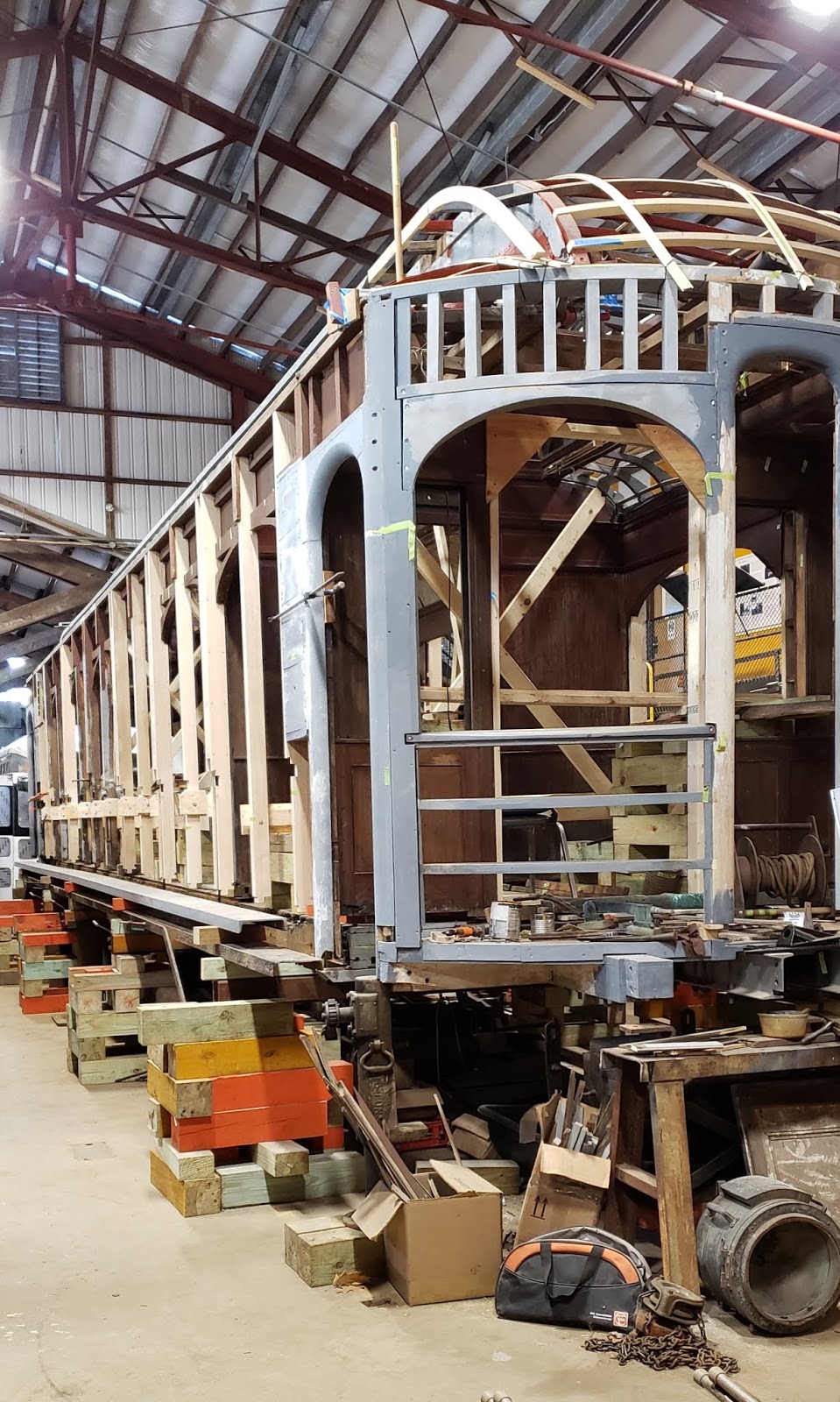
Narcissus work -

One by one, the vertical window posts that
are assessed as being structurally unacceptable,
are replaced with new posts made in the shop.
The replacement of a single post requires
lifting the posts on either side of the 
replacement candidate to relieve the weight
enough from the post being replaced,
so the replacement process can
take place safely. PWM image.

The new replacement window posts await their turn.
PWM image

The left side of the Narcissus is seen on June 12. We will
retain the original window posts that pass
the structural integrity assessment. PWM image

The right side of the Narcissus is seen on June 4, 2019.
PWM image

Seth is working on the left side beltline
that runs the whole length of the passenger
compartment and in part provides
horizontal support for the window posts
and ultimately a place for the  bottom of the
passenger window sash to rest when closed.
This left-side beltline is much better
condition than the right side. During its
at Sabattus Pond, the right side
received all the weather elements, unprotected.
The left side faced inland and benefitted
from the protection. PWM

The right-side belt line needed lots of attention.
As mentioned in an earlier post, there were clear
and very interesting signs of having had several

More "Friend or Foe" trading card shims were found when repair
segments were removed...see the segment of one card?
PWM image

Here are the backs
PWM image

 Here are the fronts
PWM image

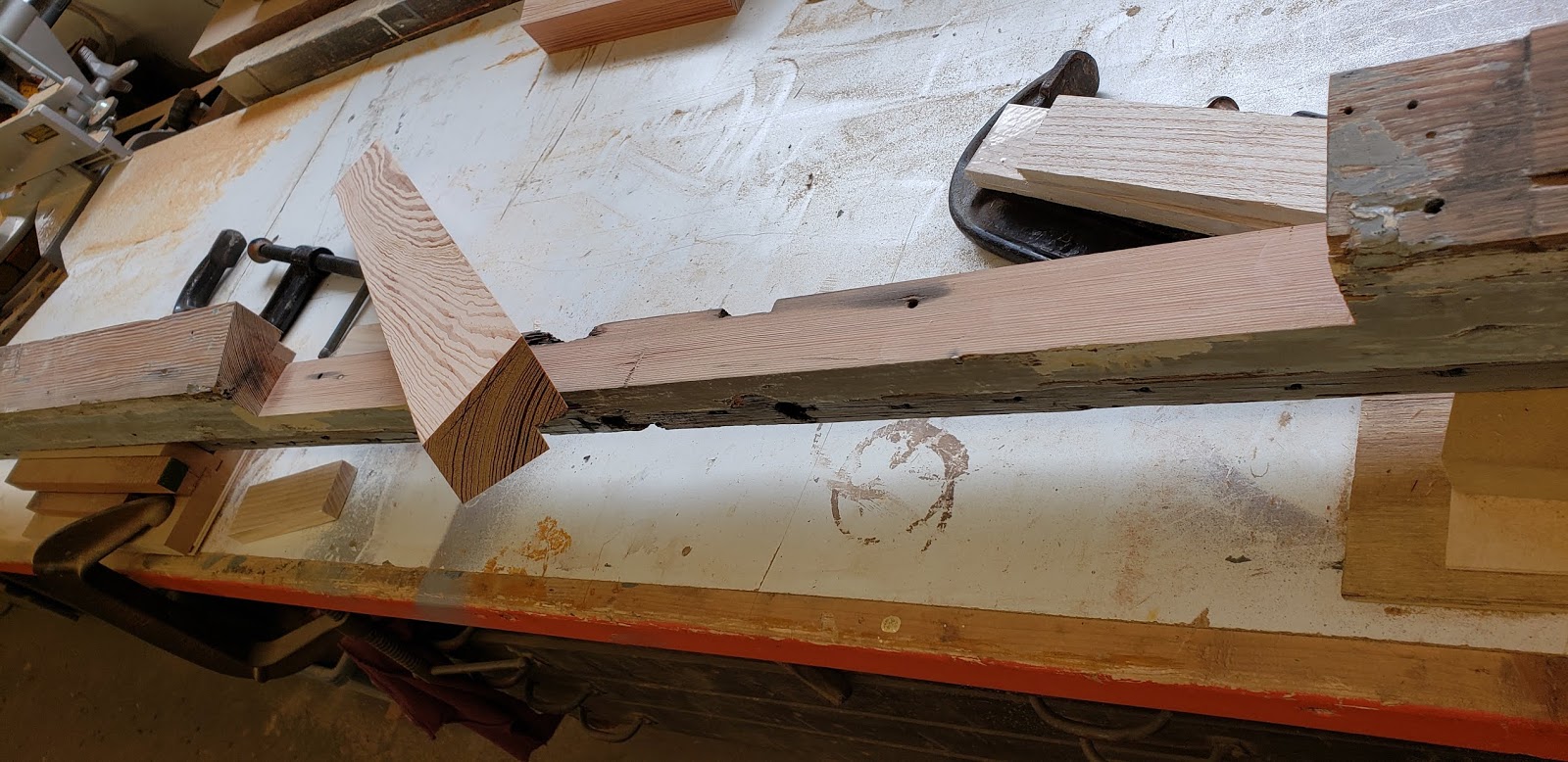
The previous repairs were removed. PWM image

Once the repairs from 70 years ago were removed, and the
other areas that had condition problems were also removed,
it was determined that enough of the original southern yellow
pine of the right side beltline was structurally sound and the
appropriate repairs would move forward. A very time-
consuming project. PWM image

Love the old-growth southern yellow pine :)
Look at the number of growth rings per inch
in this beautiful old-growth timber.
PWM image

Seth found some old-growth southern yellow pine leftover
from a since completed project and the sizing was just right
for the pieces needed for the repairs. PWM image

Repairs pieces in place and ready to become permanent.
PWM image

Seth begins the process of permanently
attaching the repair pieces. PWM image

Piece by piece. PWM image

l-r - Tom Hughes, Donald Curry, and Ernie
Eaton. Tom Hughes was the Narcissus Project
manager for several years starting in
the mid-1990s. His attention to detail in
documenting the condition of the
Narcissus in those early years, through
photographs and sketches, has provided
Ernie, as the leader of the Narcissus
restoration in the shop, invaluable
resources for piecing together the
Narcissus planning. Thank you, Tom!
PWM

During Tom's visit, he was able to get
reacquainted with his old friend, Narcissus.
Tom also had the opportunity to meet the shop staff
member, Seth Reed. Seth is the self-proclaimed,
"wood guy," providing his perfectly suited
woodworking skills from years in the historic
restoration field to the Narcissus. PWM

No. 16, Clematis, is a Laconia-built coach from the same
order in 1912, as Narcissus. The four Laconia-built coaches
originally all had brass "peanut" whistles, as seen here on the
clerestory roof of the Clematis. We needed a couple of these
whistles for the Narcissus. Photo from O.R. Cummings Coll.

This spring, a peanut whistle was offered
to the Museum. We acquired the whistle
and feel the base whistle will be one less
we need to find for the Narcissus :) 

Morrison Hill Station had two more benches added this
spring. We added four more - In Memoriam plaques in 2019.
While visitors wait for a trolley ride at Morrison Hill Station,
they have an opportunity to learn about some of the people
 in the life of the Narcissus. The
Narcissus traveled by and occasionally stopped at this
station when it was in service in West Cumberland, ME 
along the PLI from 1915 until 1933.  PWM image

J. Henri Vallee  - In Memoriam plaque - new in 2019 PWM

Bill Dox, Jr. - In Memoriam plaque - new in 2019 PWM

W. S. Libbey -In Memoriam plaque - new in 2019 PWM

O. R. Cummings - In Memoriam plaque - new in 2019 PWM

I was invited to speak at the Gray Historical Society's annual
meeting. The mid-April gathering had 50-plus in attendance.
The presentation focused on the  Narcissus Project and the PLI.
PWM image 

Gray Historical Society had an open house on 
Saturday, June 8, 2019. A feature display was
the extensive collection of Portland-Lewiston
Interurban artifacts and memorabilia. PWM 

Photo in the PLI Employees Scrapbook of No. 10,
Arbutus, in Mrs. Anthony's yard in 1941. In 1933,
Mrs. Gertrude Libbey Anthony purchased the fully
complete, ready-to-operate, No. 10, Arbutus, and had it
moved from Lewiston to her property in Saco, ME.
There it was placed on a short section of track, as a
the builder of the PLI.

Sadly, Mrs. Anthony had the Arbutus scrapped in the mid-40s.
She did, however, have some components and pieces of the
Arbutus removed and donated them to various organizations,
such as the Maine Historical Society and Gray Historical
Society. Here is a mahogany panel from No. 10, Arbutus,
on display at the Gray Historical Society's open house.
PWM image.
~~~~~~~~~~~~~~~
Click Here: For the list of links to Theodore Roosevelt Maine Heritage Trail Posts in Easy Order to View

We continue the restoration work on the 1912 Narcissus, the only surviving high-speed, luxury interurban coach of the Portland-Lewiston Interurban. 

Click Here: Narcissus Restoration-Related Posts

Being more than a century old, the stately, "Elegant Ride," Narcissus, is a gem.  This shimmering precious stone of Maine transportation history is brilliantly resplendent as it emanates so many elements of history, including time, places, people, and events, that it was coupled to, that when just a smattering of its seemingly innumerable stories are shared, the contents first captivates, fascinates, then generates interest to learn more 🙋. The majestic Narcissus is listed in the National Register of Historic Places.

Please consider joining the epic journey to complete the Narcissus Project by making a donation today!

Click Here: Donation Options

The restoration of this majestic icon of Maine's electric railway history is but one in a series of captivating stories containing an abundance of incredible coalition of narratives.

Click Here: History-Related Posts - Narcissus and Portland-Lewiston Interurban

     The Narcissus is featured in the national Gold Award-winning novel, Teddy Roosevelt, Millie, and the Elegant Ride. The "Elegant Ride" is the Narcissus. Theodore Roosevelt was a passenger on the Narcissus on August 18, 1914, between Lewiston and Portland, Maine, while campaigning for the Progressive Party candidates.

Click Here: Bookstores and Businesses promoting the Narcissus Project

Independent book publisher, Phil Morse, holding
the Gold Book Award Winner plaque for
 Middle Reader category for The Eric
Hoffer Book Award. Congratulations to
award-winning Maine author,
Jean M. Flahive