President Theodore Roosevelt received the 1906 Nobel Prize
for Peace for his efforts to have Russia and Japan participate
in negotiations toward peace. That culminated in
the signing of the Treaty of Portsmouth Peace Treaty
on September 5, 1905. It was signed in Kittery, Maine,
at the naval general stores building at the Portsmouth
Naval Shipyard. PWM Postcard Collection
Update 7-11-2026
May 31, 2026, Joe Banavige released this wonderful American 250 Tribute to William W " Bill" Sewall, TR's Maine guide (along with Wilmot Dow, Bill's nephew)
Click here to view President Theodore Roosevelt's acceptance speech for the 1906 Nobel Peace Prize.
I first started researching Theodore Roosevelt in 2010. As a volunteer at Seashore Trolley Museum in Kennebunkport, Maine, I oversaw the Narcissus Project (Roosevelt was a passenger on the Narcissus on August 18, 1914). This initial research piqued my curious nature. I wanted to learn more about Theodore Roosevelt and his various visits to Maine.
Twelve years later, that seed of curiosity has taken root and blossomed into the development of what is the Theodore Roosevelt Maine Heritage Trail: Connecting Maine Communities.Insight throughout the State of Maine is what this trail provides by tracing and describing Theodore Roosevelt's connections with each of these communities.
Each community is identified with a star with a number or
a moose with a letter. The key to the logo landmarks is below.
Each moose represents a community that has an indirect
connection with Roosevelt, meaning he may not have paid the
community a visit, and there is a meaningful connection to Roosevelt
in that community. The stars indicate a community
that Roosevelt visited and probably engaged with the people.
And/or the local geography. As research continues, other
Today, we describe Moose A - shown on the list (key) above - Kittery 1905
The postcard at the top of this page is a souvenir commemorating the August 1905 Peace Conference hosted by Portsmouth, New Hampshire. The official first meeting took place on August 9, 1905, at the general store building at the Portsmouth Naval Shipyard in Kittery, Maine. This building is where many of the negotiations between Japan and Russia took place and, ultimately, where the treaty was signed on September 5, 1905.
Postcard of the Japanese and Russian envoys meeting in a
room at the General Stores building at the Portsmouth Navy
Portsmouth, NH, hosted the Centennial Celebration of the Russo-Japanese Peace Treaty with a major exhibit and online presence. Portsmouth Peace Treaty Trail Maps housed online include Maine sites that envoys and other treaty representatives visited during their free time in the greater Portsmouth area.
A wonderful resource with many terrific photographs.
A portion of my collection of TR-related books :)
~~~~~~~~~~~~~~~
Click Here: For the list of links to Theodore Roosevelt Maine Heritage Trail Posts in Easy Order to View
We continue the restoration work on the 1912 Narcissus, the only surviving high-speed, luxury interurban coach of the Portland-Lewiston Interurban.
More than a century old, the stately "Elegant Ride," Narcissus, is a gem. This shimmering precious stone of Maine transportation history is brilliantly resplendent as it emanates so many elements of history, including time, places, people, and events, that it was coupled to, that when just a smattering of its seemingly innumerable stories are shared, the contents first captivate, fascinate, and then generate interest to learn more 🙋. The majestic Narcissus is listed in the National Register of Historic Places.
Please consider joining the epic journey to complete the Narcissus Project by donating today!
The restoration of this majestic icon of Maine's electric railway history is but one in a series of captivating stories containing an abundance of incredible coalition narratives.
Click Here: History-Related Posts - Narcissus and Portland-Lewiston Interurban
The Narcissus is featured in the national Gold Award-winning novel, Teddy Roosevelt, Millie, and the Elegant Ride. The "Elegant Ride" is the Narcissus. Theodore Roosevelt was a passenger on the Narcissus on August 18, 1914, between Lewiston and Portland, Maine, while campaigning for the Progressive Party candidates.
Click Here: Bookstores and Businesses promoting the Narcissus Project
TRC 560.12-109 Houghton Library, Harvard University
Update 7-11-2026
May 31, 2026, Joe Banavige released this wonderful American 250 Tribute to William W " Bill" Sewall, TR's Maine guide (along with Wilmot Dow, Bill's nephew)
I first started researching Theodore Roosevelt in 2010. As a volunteer at the Seashore Trolley Museum in Kennebunkport, Maine, I oversaw the Narcissus project (Roosevelt was a passenger on the Narcissus on August 18, 1914). This initial research piqued my curious nature. I wanted to learn more about Theodore Roosevelt and his various visits to Maine.
Twelve years later, that seed of curiosity has taken root and blossomed into the development of what is the Theodore Roosevelt Maine Heritage Trail: Connecting Maine Communities.Insight throughout the State of Maine is what this trail provides by tracing and describing Theodore Roosevelt's connections with each of these communities.
Each community is identified with a star with a number or
a moose with a letter. The key to the logo landmarks is below.
Each moose represents a community that has an indirect
connection with Roosevelt, meaning he may not have paid the
community a visit, and there is a meaningful connection to Roosevelt
in that community. The stars indicate a community
that Roosevelt visited and probably engaged with the people.
And/or the local geography. As research continues, other
TRC 560.12-079 Houghton Library, Harvard University
I first learned of Bible Point in Island Falls (ME) from Maine author Andrew Vietze. Andrew's 2010 book, Becoming Teddy Roosevelt: How a Maine Guide Inspired America's 26th President.
Theodore Roosevelt's first trip to Island Falls was in September 1878. His father, Theodore Sr, had died earlier that year, and TR was still feeling the loss when he arrived in Island Falls. In TR's personal diary, he mentions reading his Bible while in Island Falls. And, on occasion, would take his Bible on treks into the woods to read.
A great resource for TR's diaries 1877-1886 - A Most Glorious Ride
Edited by Edward P. Kohn
In Becoming Teddy Roosevelt: How a Maine Guide Inspired America's 26th President. Author Andrew Vietze, through TR's entry in his diary, addresses how Roosevelt used the site while in the Maine woods in the Island Falls area on Sunday, March 2, 1879. (paragraph on page 48).
Hardcover first edition copy of Andrew Vietze's "Becoming Teddy
Roosevelt - PWM
On Sunday, he read his Bible, as was his custom, though he didn't allow himself to be housebound by his habit. He trudged out to a point near the south end of the Mattawamkeag Lake, near the confluence of the West Branch of the Mattawamkeag River and First Brook, where the huge water body narrows back into a river. Roosevelt found this lakeside grove, sloping down to the water, especially picturesque and peaceful, and he returned there so many times during his stays in Island Falls that it has been designated a Maine Historic Site called Bible Point.
A few years back, I headed up to Island Falls to check out Bible Point for myself. Bible Point is mostly in the South Aroostook boundaries, just outside the property lines of Island Falls.
Below is a YouTube video, or click here. The video of the adventure along Merriman Road and the mile hike to reach the site. A total of just under ten miles.
This video story is made up of stills and video clips of the trek to the site. The description below fails to mention that Merriman Road was a gravel road with an active logging harvest at the time. The permits for the harvest were posted along Merriman Road. This made for a very interesting expedition to Bible Point.
The description of the site at Maine.gov:
Location: From Island Falls, take the Merriman Road to its end, then follow the hiking trail along the western shore of the West Branch of the Mattawamkeag River for approximately one mile.
Bible Point, a 27-acre property near the south end of Mattawamkeag Lake, was made famous by Teddy Roosevelt, who visited the area beginning in 1878. As a young man under the guidance of his lifelong friend and guide, Bill Sewall, Roosevelt camped at the southern end of Mattawamkeag Lake and hunted and fished throughout the area. It is reported that each day, Roosevelt would take his Bible and hike to a beautiful point of land at the confluence of the West Branch of the Mattawamkeag River and First Brook, where he would read the bible. A plaque was erected in 1921 by Roosevelt's biographer Hermann Hagedorn, and it reads:
Within this kiosk is a copy of Theodore Roosevelt's letter,
dated March 20, 1918, titled My Debt to Maine.
To see the entire text of TR's letter, Click Here.
The buttons were removed after photo ops. PWM image
This plaque commemorates Theodore Roosevelt's love for the area.
PWM image
"This place, to which a great man in his youth liked to come to commune with God and with the wonder and beauty of the visible world, is dedicated to the happy memory of THEODORE ROOSEVELT. Stranger, rest here and consider what one man, having faith in the right and love for his fellow man, was able to do for his country." Hermann Hagedorn (TR biographer)
Below, or click here for a video walk-around at Bible Point.
Walk around Bible Point video
Straight ahead to the point where First Brook
(on the right, just out of sight) merges with the West Branch
of the Mattawamkeag River (seen on the right). PWM image
Bible Point. PWM image
William Sewall is sitting on the chair between two tree trunks.
Looks like at Bible Point Photo by Hermann Hagedorn
TRC 560.12-076 Houghton Library, Harvard University
Notice the pair of trees with a seat between them :) I believe it's in
the same spot as the above photo. Bible Point. PWM image
PWM image
Mattawamkeag River. PWM image
Bible Point. PWM image
The seat between the trees. Bible Point. PWM image
Blogger selfie at Bible Point along the Mattawamkeag River.
PWM image
First Brook as it enters the Bible Point area. PWM image
Along the walking trail to/from Bible Point. PWM image
Evidence that a Pileated Woodpecker paid a visit? PWM image
Along the walking trail to/from Bible Point. PWM 10-6-2015
Along the walking trail to/from Bible Point. PWM image
Some images along Merriman Road
PWM image 10-6-2015
The left arrow had black letters has Bible Point written on it. PWM image
Collection area for harvested logs. Logs that have been delivered
by a skidder are then stacked by the machine seen in the
background here. PWM image
Harvested logs are stacked in a collection area. PWM image
Starting at the top, the first star is in Island Falls.
The star below Island Falls is the beginning of Merriman Road.
It is about 7 miles along Merriman Road, heading southeast, that you
come to the next star. This represents where you turn left and travel
for about a mile. At the next star, Merriman "Road" ends, and a trail
for ATVs or Snowmobiles begins. Follow this trail for about a mile,
and you come upon Bible Point, the final star. The only time I saw any
signs of Bible Point was when turning left, about 7 miles in, there were
a couple of plastic signs with an arrow and Bible Point handwritten on
the sign. - Screenshot 10-9-2015
After having traveled along Merriman Road, these "veins" and small,
cleared areas along the road are known. The veins are trails made by
a skidder as it harvests and drags trees to the collection areas along
the road. These collection areas are cleared areas along the road where
the trees are stacked for loading. Screenshot 10-9-2015
An expanded view of harvesting trails and collection areas.
Screenshot 10-9-2015
Sign in the yard at the original Sewall homestead in Island Falls,
where Theodore Roosevelt stayed during his three visits in 1878/79.
PWM image
The original Sewall homestead, where Theodore Roosevelt stayed during his three
visits to Island Falls in 1878/79. PWM image
A portion of my collection of TR-related books :)
~~~~~~~~~~~~~~~
Click Here: For the list of links to Theodore Roosevelt Maine Heritage Trail Posts in Easy Order to View
We continue the restoration work on the 1912 Narcissus, the only surviving high-speed, luxury interurban coach of the Portland-Lewiston Interurban.
More than a century old, the stately "Elegant Ride," Narcissus, is a gem. This shimmering precious stone of Maine transportation history is brilliantly resplendent as it emanates so many elements of history, including time, places, people, and events, that it was coupled to, that when just a smattering of its seemingly innumerable stories are shared, the contents first captivate, fascinate, then generate interest to learn more 🙋. The majestic Narcissus is listed in the National Register of Historic Places.
Please consider joining the epic journey to complete the Narcissus Project by donating today!
The restoration of this majestic icon of Maine's electric railway history is but one in a series of captivating stories containing an abundance of incredible coalition narratives.
Click Here: History-Related Posts - Narcissus and Portland-Lewiston Interurban
The Narcissus is featured in the national Gold Award-winning novel, Teddy Roosevelt, Millie, and the Elegant Ride. The "Elegant Ride" is the Narcissus. Theodore Roosevelt was a passenger on the Narcissus on August 18, 1914, between Lewiston and Portland, Maine, while campaigning for the Progressive Party candidates.
Click Here: Bookstores and Businesses promoting the Narcissus Project
President Theodore Roosevelt speaks to the crowd at the Old Orchard Beach
train station, from the back platform of the "Mayflower", on August 26, 1902.
The white-haired man next to TR is Congressman Amos Allen.
Courtesy McArthur Library Item #1701
Updated 7-11-2026
May 31, 2026, Joe Banavige released this wonderful American 250 Tribute to William W " Bill" Sewall, TR's Maine guide (along with Wilmot Dow, Bill's nephew)
I first started researching Theodore Roosevelt in 2010. As a volunteer at Seashore Trolley Museum in Kennebunkport, Maine, I oversaw the Narcissus project (Roosevelt was a passenger on the Narcissus on August 18, 1914). This initial research piqued my curious nature. I wanted to learn more about Theodore Roosevelt and his various visits to Maine.
Twelve years later, that seed of curiosity has taken root and blossomed into the development of what is the Theodore Roosevelt Maine Heritage Trail: Connecting Maine Communities.Insight throughout the State of Maine is what this trail provides by tracing and describing Theodore Roosevelt's connections with each of these communities.
Each community is identified with a star with a number or
a moose with a letter. The key to the logo landmarks is below.
Each moose represents a community that has an indirect
connection with Roosevelt, meaning he may not have paid the
community a visit, and there is a meaningful connection to Roosevelt
in that community. The stars indicate a community
that Roosevelt visited and probably engaged with the people.
And/or the local geography. As research continues, other
While researching President Roosevelt's schedule for his two-day Maine visit during his 1902 tour of New England states, up popped the photo of TR on the platform of a train coach. The caption stating TR was addressing the crowd at the Biddeford train station caught my attention, as Biddeford was not listed in the itinerary of Maine stops in the presidential schedule for August 26 and 27, 1902.
Itinerary of scheduled visits for day one, August 26, 1902,
of President Roosevelt's train tour that included communities
in Maine. A stop in Biddeford was not listed. August 26, 1902,
issue of the Lewiston Evening Journal EXTRA 8:30 p.m.
So, I visited Biddeford's McArthur Public Library to search through their extensive microfilm collection of vintage local newspapers. I located the story of the president's train, unplanned stop, and brief speech, and in addition, read a feature story about a local Biddeford resident, Fred C. Watson, who was a cowboy working for Roosevelt in the Dakotas between 1884 and 1885. With much help from Renée L. Burkett, Archivist/Special Collections Librarian, more intriguing information about Fred. C. Watson was learned.
In addition to the Watson materials, Renée showed me the photo that is the first image at the beginning of this post. It is an original photograph within the McArthur Library archives. Written on the back of the photo, Theodore Roosevelt with Congressman Amos Allen in Sanford, 1912. This photo of President Roosevelt standing on the platform of a train coach with several others, including a gentleman with a white beard, who is identified as the Maine U S Congressman from Alfred, Amos Allen.
I'm somewhat familiar with the train stations in the Sanford-Springvale area. I looked at the photo and replied to Renée that Sanford didn't have a railroad station. Springvale has the railroad station for servicing Sanford and Springvale, and the background in the photo did not look anything like the area surrounding the Springvale railroad station, even back in the early 1900s. I didn't think that photo was taken in 1912 either. I said I would reach out to Harland Eastman at the Sanford-Springvale Historical Society and see what he has to say.
I did share a copy of the digital photo with Harland and explained the caption. Harland replied no.
TR had never visited the Sanford-Springvale area. That he was aware of. And the photo was definitely not taken at the Springvale train station.
I compared the photo with other photos from TR's two-day presidential Maine tour and came to the conclusion that the train coach platform was unique and matched perfectly with other photos of the coach platform TR used while in Maine for those two days in August 1902. Further research found that Congressman Allen died early in the year 1911. So, clearly, he could not be in a photo taken in 1912. In addition, I looked at period photos of the other train stations that TR's presidential train stopped at during his 1902 tour. The background in the McArthur Library photo was a solid match for the buildings next to the old Orchard Beach train station.
I shared my findings with Renée. She had done research and also felt the Old Orchard Beach Station was indeed the station in the TR photo with Congressman Allen. Renée then changed the description to what was now identified as the correct information on the file for the photo in the archives.
President Theodore Roosevelt was touring New England states during the summer of 1902. Before his train entered Maine for two days, it stopped in Dover, New Hampshire, on Tuesday morning, August 26, 1902. Following the local activities in Dover, members of the Maine delegation would board the president's train to be with him as the train entered Maine, traveling toward its first scheduled stop in Old Orchard Beach. Here is the accounting from August 29, 1902, Biddeford Weekly Journal, Friday Morning publication.
Biddeford Weekly Journal, August 29, 1902
The Presidential train of five beautiful cars makes a scheduled
stop at Old Orchard Beach, Maine, during the New England
Tour on August 26, 1902. President Theodore Roosevelt on the
end platform of the "Mayflower." He engaged with a crowd
of approximately 10,000. Photo courtesy of Ralph Duquette
Excerpts Ibid (autocorrect disconnected - kept as written:) :
Half an hour after noon, the special train bearing President Roosevelt and party crossed the line between Maine and New Hampshire and began its trip down through the Pine Tree state. The weather still held perfect, though a trifle warm, and the brilliant sun falling on the long stretches of green fields and pine woods enabled Maine to present herself at her best.
At Dover, the presidential train was boarded by Congressman Amos L. Allen of the First District, Adjutant General N. B. Farnham, Colonel E. B. Sangers, Col. E. C. Dill, and Lieutenant Colonel Francie Keefe, all of the staff of Governor John F. Hill. Accompanying the governor's official representatives was Captain Parker of the United States Army.
The first stop of the train in Maine was scheduled for Old Orchard Beach at 1:15, but owing to a hot box on the engine, a stop was made at Biddeford, which was reached about one o'clock.
Although it was not part of the programme to include North Berwick in the itinerary of the tour, the residents had occasion to feel honored even though a stop that was incidental to the train service only was made. The station platform was covered with men, women, and children, while nearby board piles and boxes, shed roofs, and other points were dotted with those who had gathered for the privilege of waving hats, handkerchiefs, and parasols.
Answers and updates on the Biddeford portion of TR's two-day presidential Maine tour are in the post:
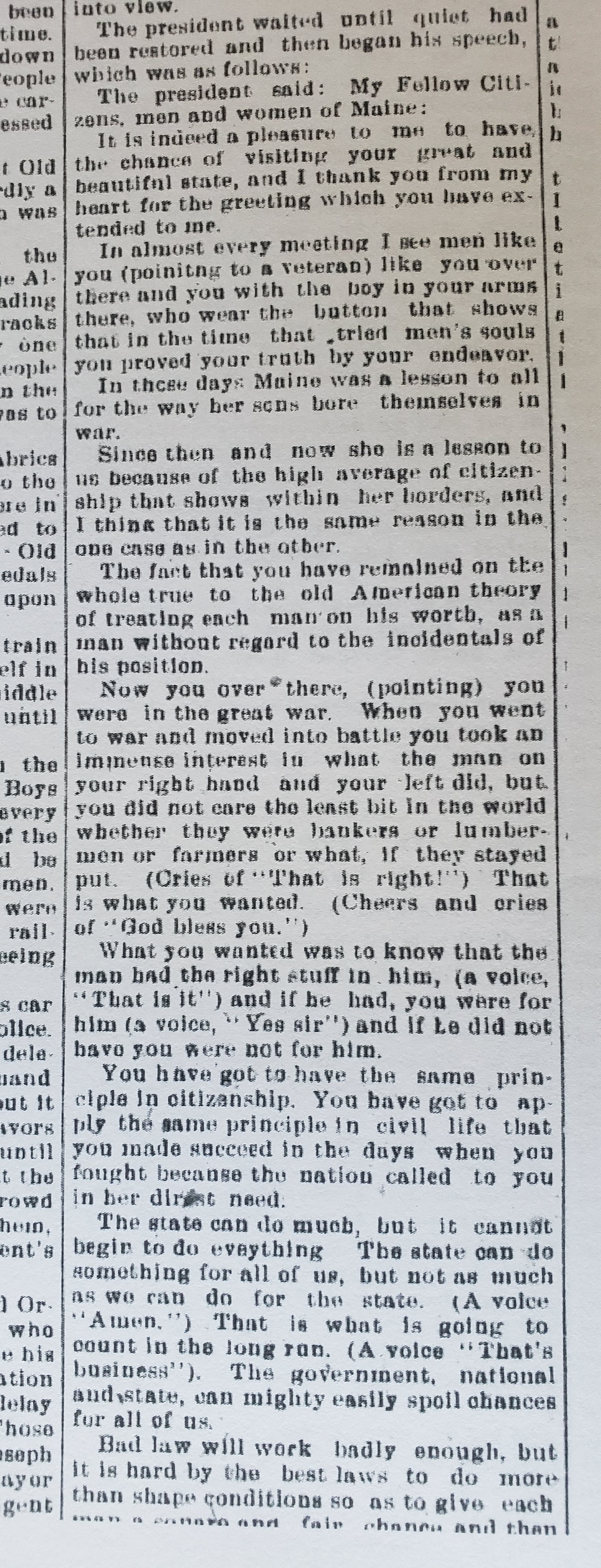
The Old Orchard visit was published on August 29, 1902, in the Biddeford Weekly Journal, Friday Morning publication.
Ibid
Ibid
Ibid
Ibid
Ibid
Ibid
Ibid
Ibid
Fred C. Watson was born in North Saco and was a
Biddeford resident. As mentioned, Watson worked for TR at
TR's Elkhorn Ranch in the Dakotas in 1884 and 1885. Ibid
More on Fred C. Watson's life and relationship with TR is here in the Star #1 - Biddeford 1902 post.
Roosevelt's presidential train tour moved on to Portland.
The Biddeford Daily Journal’s President’s speech in Old Orchard Beach on August 26. 1902:
(autocorrect disconnected - kept as written:) :
My Fellow Citizens, men and women of Maine:
Of course, we are not to be excused if we do not get through the nation the best laws that can be obtained. Good laws can do some good, but we must never deceive ourselves into the belief that the law will do more than let the man after the law has been put upon the statute books work out his own salvation.
It is indeed a pleasure to me to have the chance of visiting your great and beautiful state, and I thank you from my heart for the greeting which you have extended to me.
In almost every meeting, I see veterans like you (pointing to a veteran) like you over there and you with the boy in your arms there, who wear the button that shows that in the time that tried men's souls, you proved your truth by your endeavor.
In those days, Maine was a lesson to all for the way her sons bore themselves in war.
Since then and now, she is a lesson to us because of the high average of citizenship that shows within her borders, and I think that it is the same reason in the one case as in the other.
The fact that here you have remained on the whole true to the Old American theory of treating each man on his worth as a man without regard to the incidentals of his position.
Now you over there (pointing), you were in the Great War. When you went to war and moved into battle, you took an immense interest in what the man on your right hand and your left did, but you did not care the least bit in the world whether they were bankers or lumbermen or farmers or what, if they stayed put. (cries of “That is right!”) That is what you wanted. (Cheers and cries of “God bless you.”)
What you wanted was to know that the man had the right stuff in him (a voice, “That is it”) and if he had, you were for him (a voice, “Yes sir”) and if he did not have, you were not for him.
You can have got to have the same principle in citizenship. You have got to apply the same principle in civil life that you made succeed in the days when you fought because the nation called to you in her direst need.
The state can do much, but it cannot begin to do everything. The state can do something for all of us, but not as much as we can do for the state. (A voice “Amen”) That is what is going to count in the long run. (A voice “That’s business). The government, national and state, can mighty easily spoil chances for all of us.
Bad law will work badly enough, but it is hard by the best laws to do more than shape conditions so as to give each man a square and fair chance, and then he has got to work out his future for himself.
It is a much easier thing to tell people that you have got a patent recipe that will save them from having to take trouble themselves than it is to tell them perfectly plain, homely truths.
It is an easier thing to make the promise, but it is a much uglier thing afterwards to carry out the promise, and on the whole, it is not worthwhile making a promise if you have got to feel ashamed of yourself for breaking it afterwards. (Cries of “Good.”)
August 14, 1914
Theodore Roosevelt made a brief stop at the Old Orchard Beach train station on August 18, 1914. He was campaigning for the Progressive Party candidates during this trip to Maine. He made a brief speech in OOB from the train platform. Then left for the Auburn train station. Where he would then speak in Lewiston before boarding the high-speed luxury interurban, Narcissus, en route back to Portland.
Click hereto access the August 18, 1914, online issue of the Lewiston Evening Journal through Google News Archive Search.
Lewiston Evening Journal, August 18, 1914 -
page 9
Ibid
Newspaper clipping from the Lewiston Daily Sun,
August 19, 1914.
Biddeford Weekly Journal August 21, 1914, pg 7
A portion of my collection of TR-related books :)
~~~~~~~~~~~~~~~
Click Here: For the list of links to Theodore Roosevelt Maine Heritage Trail Posts in Easy Order to View
We continue the restoration work on the 1912 Narcissus, the only surviving high-speed, luxury interurban coach of the Portland-Lewiston Interurban.
More than a century old, the stately "Elegant Ride," Narcissus, is a gem. This shimmering precious stone of Maine transportation history is brilliantly resplendent as it emanates so many elements of history, including time, places, people, and events, that it was coupled to, that when just a smattering of its seemingly innumerable stories are shared, the contents first captivate, fascinate, then generate interest to learn more 🙋. The majestic Narcissus is listed in the National Register of Historic Places.
Please consider joining the epic journey to complete the Narcissus Project by donating today!
The restoration of this majestic icon of Maine's electric railway history is but one in a series of captivating stories containing an abundance of incredible coalition narratives.
Click Here: History-Related Posts - Narcissus and Portland-Lewiston Interurban
The Narcissus is featured in the national Gold Award-winning novel, Teddy Roosevelt, Millie, and the Elegant Ride. The "Elegant Ride" is the Narcissus. Theodore Roosevelt was a passenger on the Narcissus on August 18, 1914, between Lewiston and Portland, Maine, while campaigning for the Progressive Party candidates.
Click Here: Bookstores and Businesses promoting the Narcissus Project