Wednesday, June 14, 2017

No. 4387 - Seashore Trolley Museum's Laconia Car Company-built Collection

In the hands of Seashore Trolley Museum members/volunteers,
Ed Dooks and his granddaughter Chelsey Pino, carefully
peel away the paper from the newly applied Laconia Car
Company decal on the side sill of the Laconia Car
Company-built, and then newly restored,
1906 electric locomotive from the Atlantic Shore Line Railway,
No. 100. Image by PWM 6-30-2009

The Laconia Car Company was located in the center of
Laconia, NH. Over the years, it expanded and took up 7 acres
of land. There were woodworking shops, foundries, set-up
shops, storehouses, and paint shops. The extensive four-story brick
building was dedicated to the iron foundry, which was
connected with the car fabrication business.

     Laconia Car Company was one of the important electric railway streetcar manufacturing companies at the turn of the 20th century. This builder was the only industry in the New Hampshire town of the same name. The community problems faced by the townspeople following the company's collapse in 1928 have been the subject of several important economic studies. (1) Seashore Trolley Museum has ten accessioned electric railway representatives from the Laconia Car Company among its collections. The Laconia collection at Seashore Trolley Museum is diverse. Starting with two early single-truck models from 1895, with monitor roofs and a seating capacity of 26 passengers, up to a 1918 semi-convertible, with a seating capacity of 44. The collection includes a 1904, double-truck, 15-bench, open car with a railroad roof, wooden interurbans, a postal service car, and a wooden steeple cab locomotive.

     Three of these Laconia vehicles in Seashore's collection are listed in the National Register of Historic Places1904 Portsmouth Dover & York Street Railway, No. 108, wooden Railway Post Office/Express, 1906 Atlantic Shore Line, No. 100, wooden Steeple Cab Locomotive, and 1912 Portland-Lewiston Interurban, No. 14 - Narcissus, wooden Interurban Coach.

(1) p. 6, 1954 "Historic Cars of the Seashore Electric Railway, 1st edition

1918 - No. 4387 - Eastern Massachusetts Street Railway
Semi-Convertible - Double/Air
Laconia Car Company - Seats: 44   L: 43' 3"   W: 8' 10"    H: 12' "  Wt: 44,880
Acquired on August 29, 1946
No. 4387 in the Talbott Park loop at Seashore Trolley Museum
August 28, 2004. PWM

No. 4387, a somewhat improved version of Bay State Street Railway semi-convertible No. 4175, is one of 200 cars built for the Bay State Street Railway by the Laconia Car Co. in 1918. It has large platforms and extremely large three-sash windows, of which the lowermost drop into pockets in the sides. The frame is of composite steel and wood construction and the car is equipped with both transverse and longitudinal seats, having been designed for operation on both city and suburban lines. They were widely used throughout the vast Bay State system.
No. 4387 at Franklin Square, Melrose, MA 1925.
From the 1946 annual report of the N.E.E.R.H.S.

Including those sold to the Boston Elevated in 1936, along with the Chelsea and Revere car lines, many of this fleet survived until the late 1940s. Car 4387 last was used on an Eastern Mass. line running between the Sullivan Square elevated terminal in Charlestown and the town of Stoneham. It was acquired by the museum in 1946. Although No. 4387 was in fairly good condition when acquired, a poorly executed roof repair of the 1938 Hurricane damage had failed to hold up. There were numerous electrical problems, and general fraying over the years, but a total restoration has made 4387 another particular jewel of the Seashore fleet. Historic Cars: The National Collection at the Seashore Trolley Museum by Ben Minnich


The video below has No. 4387 in operation during the July 5, 2014, Seashore Trolley Museum 75th Anniversary Trolley Parade. Thanks go to Andy Dolph for giving his permission to draw the 4387 clip from his full video.


Edward Dooks, a long-time Seashore Trolley Museum member/volunteer, conducted, recorded, and transcribed, recollections of  Seashore Trolley Museum members' experiences involving the Museum. In addition, Ed recorded, collected, and transcribed recollections of local neighbors for the Seashore Trolley Museum. Here are some of those transcriptions, as they relate to 4387.

Transcripts from 1988 interviews conducted by Ed Dooks. Interviewees:
A = John Amlaw, one of Seashore's original members
B = Henry Brainerd, one of Seashore's earliest members

A: They quit in August 1946. The last car ran then, so what they told me in Boston was that the reason for it was that the cars were getting old and that they had wanted to modernize the line and put the seven-thousands up there instead of selling them but people up there objected to it and they wanted buses. So they said, "All right if you want buses, we'll give them to you." And that's what they did.

B: They had a farewell ride about midnight the night before (abandonment) and then sort of a ceremony where the Selectmen rode a car up to Stoneham Square and then rode back again to the town line in a bus. The car that did the farewell with the Selectmen  was 4387 and the motorman was Les Stephenson (Sr.) Is that right?

A: Right. They had the 4387 all fixed up. It was taken to the shops and they checked all the mechanical portions of it. They gave it a good wash job and inside they cleaned it all up and it looked as though it had just come out of the builder's shops. 

B: I believe Les commented he picked that because it was the one that was in the best condition of the surviving Eastern Massachusetts 4300s.

Mr. and Mrs. Lester Stephenson, Sr., on July 28, 1946, with
Les's favorite car, No. 4387. Les was the individual who brokered the
deal to have 4387 become the property of the fledgling
Seashore Trolley Museum the very next month.
From the 1946 annual report of the N.E.E.R.H.S.

A: I know that the 4300 was originally a much faster car than it is today. It had a 17:61 gear ratio with 31-inch wheels and they were later changed over to a 15:63 gear ratio, still 31-inch wheel, and slowed down from 42 mph to 35.

A: 4387 is another car I ran off the property. I ran it at Salem Street Carhouse (Medford, MA ed.). Wally Goddard and I went out there one day to take some pictures and, at the time, I had a Chrysler. So, we pulled into the yard and there's the office building out front. It was in the summertime. The windows were open so I stopped and blew the horn in the car and a fellow came to the window. Wally said, "Uh-oh, that was a bad mistake you just made." I said, "No, no, Wally." So, the fellow looked out and I waved to him, didn't say anything, and started up again, so then I got in the yard, went over to the yard office and there were two cars in the way. We wanted to take one of the 4300s.

We wanted a nice picture of 4387 for use for the heading of the publicity we were putting out to raise funds to move it. But it was in the yard that day and there were two type 5's in front of it so we couldn't get a picture of it. I went to the yard office and asked, "Is the head shifter on duty?" He said, "Yes, Mike Shea." So, he came out and I said, "Mike, I'm here with a photographer to take pictures of 4387. We came out from Boston." I didn't say we were sent out. I said, "So, I wonder if you could move Type 5's out of the way?" "Oh, sure." so, he pulled them up and I said, " That's fine. I'll let you know when we're through so you can move them back again." so, Wally took the pictures and I went back to the office and said, "Will you tell Mike Shea that we're all set now?" And he said, "Yes, he's right here." So, he came out and I said, "Mike, we got the pictures. We're all set. Thanks a lot now, and if you want to move the 5's back, go ahead." So, I got up to the front office, blew the horn again and the fellow came to the window again and waved. "Okay?" I said, "Yes. everything is fine. Thanks for your cooperation." and off we went. Wally said, "Boy, what nerve you've got." I said, "Look, if I had driven in there without stopping to call that fellow in the office, they would have sent out someone to know who I was and what I was doing. that's why they didn't dare ask me who I was because I was driving a big car like all their executives and they don't want to admit they don't know me." That's exactly right.

A: Another place where they had a lot of fun was when they first bought the 7000s. Five of them were assigned to Fall River for use on the Taunton run and the track was pretty rough down there. The 7000s have swing-link bolsters, which means that the car body just sways back and forth and the motormen were afraid to run them at full speed because they were jumping around so much. So they used to joke about it that when they got up to Taunton, some of the passengers would get out and lie on the grass to recover their balance again, which is a story. I don't know how much truth there is to it but the 7000s were only on that run for a couple of weeks. The 4100's went back. The 41 of course, had Bay State trucks under them (as does 4387, ed) so they used to bang over those ends of the rail joints and such things, but they'd bang over them but they didn't sway. So, nobody got sick riding them. 

July 1, 2004. PWM

September 13, 2003. PWM
The video below is the full video of Andy Dolph's recording of the July 5, 2014, Seashore Trolley Museum 75th Anniversary Trolley Parade


Click Here: Video of Theodore Santarelli de Brasch explaining the "Birth" of Seashore Trolley - 1939  

Additional blog posts on Seashore Trolley Museum's Laconia Car Company-built collection:
Click Here: No. 14 - 1912 Laconia Car Company-built Collection
Click Here: No. 38 - 1907 Laconia Car Company-built Collection
Click Here: No. 60 - 1895 Laconia Car Company-built Collection
Click Here: No. 100 - 1906 Laconia Car Company-built Collection
Click Here: No. 108 - 1904 Laconia Car Company-built Collection
Click Here: No. 235, No. 50 & No. 9 - 1895, 1902, & 1904 Laconia Car Company-built Collection
Click Here: No 4175 - 1914 Laconia Car Company-built Collection
Click Here: No 4387 - 1918 Laconia Car Company-built Collection
~~~~~~~~~~~~~~~
We continue the restoration work on the 1912 Narcissus, the only surviving high-speed, luxury interurban coach of the Portland-Lewiston Interurban. 

Click Here: Narcissus Restoration-Related Posts

Being more than a century old, the stately, "Elegant Ride," Narcissus, is a gem.  This shimmering precious stone of Maine transportation history is brilliantly resplendent as it emanates so many elements of history, including; time, places, people, and events, that it was coupled to, that when just a smattering of its seemingly innumerable stories are shared, the contents captivates, fascinates, then generates, interest to learn more 🙋. The majestic Narcissus is listed in the National Register of Historic Places.

Please consider joining the epic journey to complete the Narcissus Project by making a donation today!

Click Here: Donation Options

The restoration of this majestic icon of Maine's electric railway history is but one in a series of captivating stories containing an abundance of incredible coalition of narratives.

Click Here: History-Related Posts - Narcissus and Portland-Lewiston Interurban

     The Narcissus is featured in the national Gold Award-winning novel, Teddy Roosevelt, Millie, and the Elegant Ride. The "Elegant Ride" is the Narcissus. Theodore Roosevelt was a passenger on the Narcissus on August 18, 1914, between Lewiston and Portland, Maine, while campaigning for the Progressive Party candidates.

Click Here: Bookstores and Businesses promoting the Narcissus Project

Independent book publisher Phil Morse, holding
Gold Book Award Winner plaque for
 Middle Reader category for The Eric
Hoffer Book Award. Congratulations to
award-winning Maine author,
Jean M. Flahive

Thursday, June 8, 2017

No. 4175 - Seashore Trolley Museum's Laconia Car Company-built Collection

In the hands of Seashore Trolley Museum members/volunteers,
Ed Dooks and his granddaughter Chelsey Pino, carefully
peel away the paper from the newly applied Laconia Car
Company decal on the side sill of the Laconia Car
Company-built, and then newly restored,
1906 electric locomotive from the Atlantic Shore Line Railway,
No. 100. Image by PWM 6-30-2009

The Laconia Car Company was located in the center of
Laconia, NH. Over the years, it expanded and took up 7 acres
of land. There were woodworking shops, foundries, set-up
shops, storehouses, and paint shops. The extensive
four-story brick building was dedicated to the iron foundry, which was
connected with the car fabrication business.

     Laconia Car Company was one of the important electric railway streetcar manufacturing companies at the turn of the 20th century. This builder was the only industry in the New Hampshire town of the same name. The community problems faced by the townspeople following the company's collapse in 1928 have been the subject of several important economic studies. (1) Seashore Trolley Museum has ten accessioned electric railway representatives from the Laconia Car Company among its collections. The Laconia collection at Seashore Trolley Museum is diverse. Starting with two early single-truck models from 1895, with monitor roofs and a seating capacity of 26 passengers, up to a 1918 semi-convertible, with a seating capacity of 44. The collection includes a 1904, double-truck, 15-bench, open car with a railroad roof, wooden interurbans, a postal service car, and a wooden steeple cab locomotive.

     Three of these Laconia vehicles in Seashore's collection are listed in the National Register of Historic Places; 1904 Portsmouth Dover & York Street Railway, No. 108, wooden Railway Post Office/Express, 1906 Atlantic Shore Line, No. 100, wooden Steeple Cab Locomotive, and 1912 Portland-Lewiston Interurban, No. 14 - Narcissus, wooden Interurban Coach.

(1) p. 6, 1954 "Historic Cars of the Seashore Electric Railway, 1st edition

1914 - No. 4175 - Bay State Street Railway
Semi-Convertible - Double/Air
Laconia Car Company - Seats: 40   L: 39' 8"   W: 8' 3"   H: 12' 11"  Wt: 43,800
Acquired in 1976

No. 4175 at Seashore Trolley Museum's Town House Restoration Shop
Its restoration is approaching the finish line....needs $10-$15K to complete.
Click Here: to make a donation to Fund 528 - Bay State Street Railway 4175

     No. 4175, was built by Laconia in 1914 and came to Seashore in 1974 as a body that had been used for a summer camp in New Jersey. On July 1, 1919, the Bay State was reorganized with public assistance from the Commonwealth of Massachusetts. Part of the deal called for the termination of operations in other states. Some of the 4100 series cars were assigned to Newport, Rhode Island, and were later sold off to operate on the Coast Cities Railway in Asbury Park, New Jersey, from 1925 until 1929.
     No. 4175, which carried the number 703 in New Jersey, is being restored to its 1914 Bay State Street Railway configuration and appearance. The complete restoration is nearly finished (another 
$10-$15K is needed - Donations to Fund 528, Bay State St. Railway 4175. PWM) and will be a splendid example of the success of the reclamation of a stripped car body into an outstandingly restored electric railway car. This car was also used as a prototype for a replica at the Lowell National Historic ParkHistoric Cars: The National Collection at the Seashore Trolley Museum by Ben Minnich

     Edward Dooks, a long-time Seashore Trolley Museum member/volunteer, conducted, recorded, and transcribed, recollections of  Seashore Trolley Museum members' experiences involving the Museum. In addition, Ed recorded, collected, and transcribed recollections of local neighbors to the Seashore Trolley Museum. Here are some of those transcriptions, as they relate to the acquisition of No. 60 in 1941.

Transcripts from 1988 interviews conducted by Ed Dooks. Interviewees:
A = John Amlaw, one of Seashore's original members

A: Another place where they had a lot of fun was when they first bought the 7000s. Five of them were assigned to Fall River for use on the Taunton run and the track was pretty rough down there. The 7000s have swing-link bolsters, which means that the car body just sways back and forth and the motormen were afraid to run them at full speed because they were jumping around so much. So they used to joke about it that when they got up to Taunton, some of the passengers would get out and lie on the grass to recover their balance again, which is a story. I don't know how much truth there is to it but the 7000s were only on that run for a couple of weeks. The 4100's went back. The 41, of course, had Bay State trucks under them (as does 4387, ed) so they used to bang over those ends of the rail joints and such things, but they'd bang over them but they didn't sway. So, nobody got sick riding them. 
FYI - Seashore Trolley Museum volunteers, at its satellite operation, The National Streetcar Museum in Lowell, MA, operate the Museum's 1924 New Orleans Public Service car, No. 966, on the Lowell National Historic Park line.

4131 operating at the Lowell National Historical Park in Lowell, MA
on June 5, 2017. Seashore Trolley Museum's recognized founder, Theodore
Santarelli de Brasch, help make building the replica 4131 possible.
Replicas from the same pattern were built for Portland, OR.
Story below. Photo courtesy of Mike de la Vega

During one of his frequent visits to Ida Grove, IA,
Ted stands on the front platform of the nearly complete
Eastern Mass. replica 4131 for Lowell.
Seashore Trolley Museum, NEERHS annual report
1987, pg. 8.

     From the 1987 NEERHS Annual Report (with some minor edits)
Theodore Santarelli, the recognized founder of Seashore Trolley Museum, spent several years in the mid-1980s assisting the Lowell (MA) Historic Preservation Commission with their plans for expanding their historic trolley line, most notably in constructing a replica closed car. Engaged first as a consultant, then as a part-time employee, Ted suggested the construction of a 4100, virtually identical to Seashore's 4175. The contract was awarded to Gomaco, of Ida Grove, Iowa, the constructor of Lowell's two open cars. On frequent trips to Iowa, Ted ensured the historical accuracy of the semi-convertible, researching even the finest details through historical documents and the memories of Eastern Mass. fans, plus via careful measuring and probing of 4175 at Seashore. Ted worked closely with Gomaco founder Harold Godberson, a dedicated craftsman, until his untimely death in 1986. Ted's dedication to this project and Gomaco's responsive craftsmanship resulted in a beautifully finished car plus the fabrication of numerous parts for Seashore's 4175. Lowell's car was delivered just a month before Ted passed away (1987).

The commemorative brass plate plaque inside Lowell's 4131
officially states the car is dedicated in memory of
Theodore Santarelli de Brasch.
James D. Schantz photo from 1988 NEERHS annual report

     From the 1988 NEERHS Annual Report (with some minor edits)
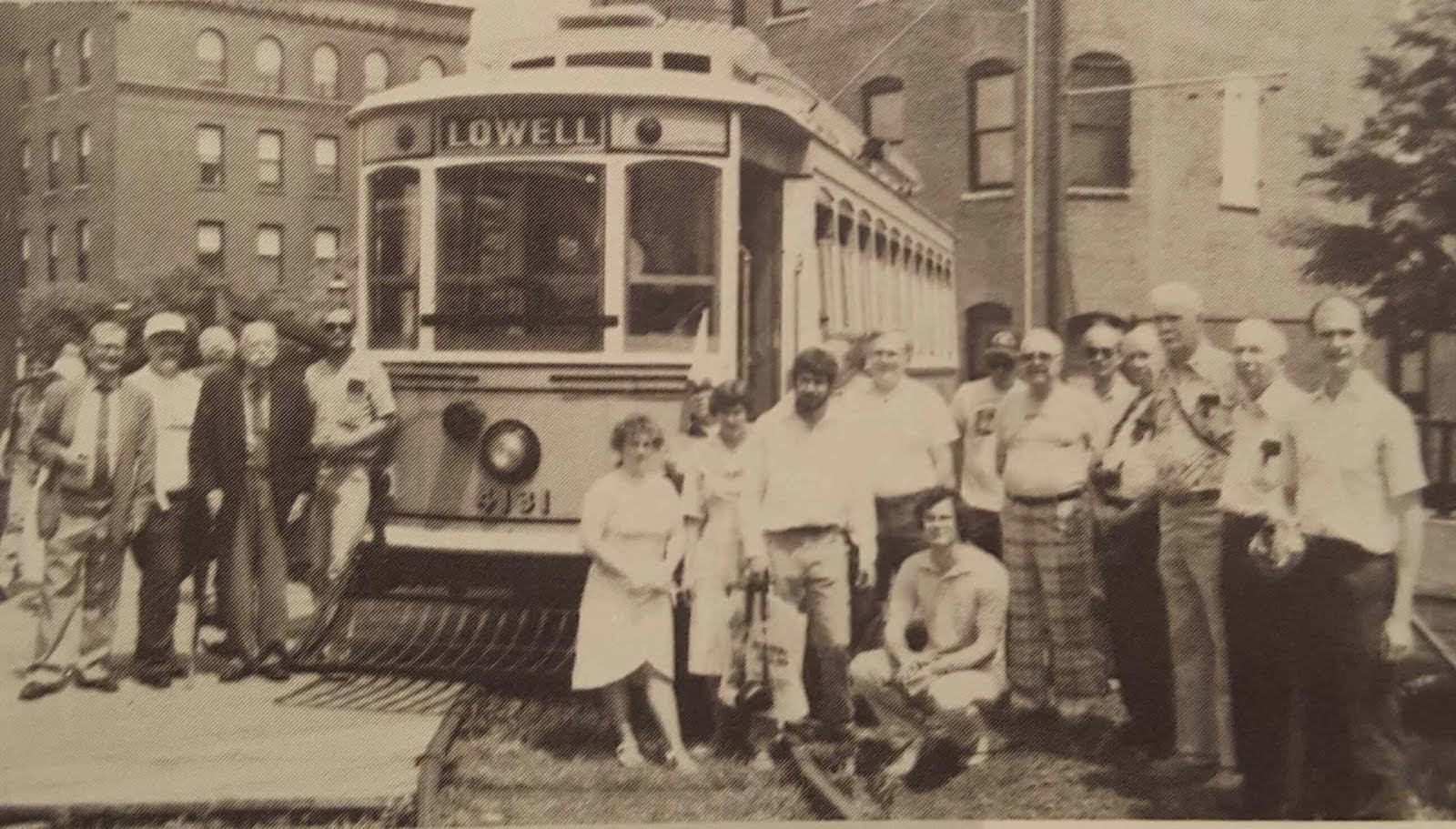
4131 was delivered to Lowell, MA in November 1987. Ted was on hand in Lowell to welcome it only a few weeks before his untimely death. A ceremony in Lowell on June 18, 1988, was held to dedicate 4131 to Ted's memory.

A large contingent of Seashore representatives attended the dedication
ceremony of 4131 in Lowell, on June 18, 1988. James D. Schantz photo.

Click Here: Video of Theodore Santarelli de Brasch explaining the "Birth" of Seashore Trolley -1939 

Additional blog posts on Seashore Trolley Museum's Laconia Car Company-built Collection:
Click Here: No. 14 - 1912 Laconia Car Company-built Collection
Click Here: No. 38 - 1907 Laconia Car Company-built Collection
Click Here: No. 60 - 1895 Laconia Car Company-built Collection
Click Here: No. 100 - 1906 Laconia Car Company-built Collection
Click Here: No. 108 - 1904 Laconia Car Company-built Collection
Click Here: No. 235 & No. 50 - 1895 & 1902 - Laconia Car Company-built Collection
Click Here: No. 4175 - 1914 Laconia Car Company-built Collection
Click Here: No. 4387 - 1918 Laconia Car Company-built Collection
~~~~~~~~~~~~~~~
We continue the restoration work on the 1912 Narcissus, the only surviving high-speed, luxury interurban coach of the Portland-Lewiston Interurban. 

Click Here: Narcissus Restoration-Related Posts

Being more than a century old, the stately, "Elegant Ride," Narcissus, is a gem.  This shimmering precious stone of Maine transportation history is brilliantly resplendent as it emanates so many elements of history, including; time, places, people, and events, that it was coupled to, that when just a smattering of its seemingly innumerable stories are shared, the contents captivates, fascinates, then generates, interest to learn more 🙋. The majestic Narcissus is listed in the National Register of Historic Places.

Please consider joining the epic journey to complete the Narcissus Project by making a donation today!

Click Here: Donation Options

The restoration of this majestic icon of Maine's electric railway history is but one in a series of captivating stories containing an abundance of incredible coalition of narratives.

Click Here: History-Related Posts - Narcissus and Portland-Lewiston Interurban

     The Narcissus is featured in the national Gold Award-winning novel, Teddy Roosevelt, Millie, and the Elegant Ride. The "Elegant Ride" is the Narcissus. Theodore Roosevelt was a passenger on the Narcissus on August 18, 1914, between Lewiston and Portland, Maine, while campaigning for the Progressive Party candidates.

Click Here: Bookstores and Businesses promoting the Narcissus Project

Independent book publisher Phil Morse, holding
Gold Book Award Winner plaque for
 Middle Reader category for The Eric
Hoffer Book Award. Congratulations to
award-winning Maine author,
Jean M. Flahive

No. 235, No. 50, and No. 9 - Seashore Trolley Museum's Laconia Car Company-built Collection

In the hands of Seashore Trolley Museum members/volunteers,
Ed Dooks and his granddaughter Chelsey Pino, carefully
peel away the paper from the newly applied Laconia Car
Company decal on the side sill of the Laconia Car
Company-built, and then newly restored,
1906 electric locomotive from the Atlantic Shore Line Railways,
No. 100. Image by PWM 6-30-2009

The Laconia Car Company was located in the center of
Laconia, NH. Over the years, it expanded and took up 7 acres
of land. There were woodworking shops, foundries, set-up
shops, storehouses, and paint shops. The extensive
four-story brick building was dedicated to the iron foundry, which was
connected with the car fabrication business.

     Laconia Car Company was one of the important electric railway streetcar manufacturing companies at the turn of the 20th century. This builder was the only industry in the New Hampshire town of the same name. The community problems faced by the townspeople following the company's collapse in 1928 have been the subject of several important economic studies. (1) Seashore Trolley Museum has ten accessioned electric railway representatives from the Laconia Car Company among its collections. The Laconia collection at Seashore Trolley Museum is diverse. Starting with two early single-truck models from 1895, with monitor roofs and a seating capacity of 26 passengers, up to a 1918 semi-convertible, with a seating capacity of 44. The collection includes a 1904, double-truck, 15-bench, open car with a railroad roof, wooden interurbans, a postal service car, and a wooden steeple cab locomotive.

     Three of these Laconia vehicles in Seashore's collection are listed in the National Register of Historic Places; 1904 Portsmouth Dover & York Street Railway, No. 108, wooden Railway Post Office/Express, 1906 Atlantic Shore Line, No. 100, wooden Steeple Cab Locomotive, and 1912 Portland-Lewiston Interurban, No. 14 - Narcissus, wooden Interurban Coach.

(1) p. 6, 1954 "Historic Cars of the Seashore Electric Railway, 1st edition

     Searching for details on the Laconia Car Company-built vehicles within the Museum's collection sometimes uncovers some interesting tidbits. The poem below is one:

Seashore Trolley Museum member 444, Anthony F. Tieuli had his poem published in the
July 1958, Volume 1, Number 3 issue of "The Trolley Museum Dispatch". The first year
of the Museum's newsletter was published monthly for its members. PWM

1895 - No. 235 - West End Street Railway of Boston
City & Suburban Streetcar - Single/Hand
Laconia  Car Company - Seats: 26 - L: 29' 8" - W: 7' 8" Ht: 11' 5" Wt: 19,077
Acquired in 1967

No. 235 as a rail grinder at Egleston Square, Boston, MA
5th Edition, 2nd printing of Historic Cars of Seashore Trolley Museum
pg. S-1 - Charles Duncan Photo

     With open platforms originally, the vestibules were enclosed sometime between 1901 and 1905 with the 1900 act of the Massachusetts Legislature. This required all cars regularly operated in the state during December, January, February, and March to have enclosed platform vestibules for the protection of motormen. The type of enclosure adopted by the West End was known as the "West End Front" and consisted of one small window on either side of the large center sash, fabricated with a "bay window" effect to allow for the swing of the hand brake handle. Folding doors replaced the swinging gates that were previously used. Converted to a rail maintenance car, first to a sand car, then to a rail grinder in 1935, it came to Seashore from George King, a private collector, in 1967. Cars like these inspired the late Fontaine Fox to create his famous "Toonerville Folks" comic strips and cartoons, which were widely published during the waning years of the trolley era. Historic Cars: The National Collection at the Seashore Trolley Museum by Ben Minnich

Operated in Dorchester, MA during its passenger-carrying days. No. 235 must be extensively restored.

1902 - No. 50 - Massachusetts Northeastern Street Railway
City & Suburban Streetcar - Double/
Laconia Car Company - Seats: 32 - L: 34' 4"    W:       Ht:          Wt: 
Acquired 1957


     Operated by the Massachusetts Northeastern Street Railway and its predecessors from 1902 to 1927, and ran most of the time between Haverhill and Amesbury, Massachusetts, via Plaistow and Newton, New Hampshire. It has curved panel sides and drop sash windows, but has a railroad roof instead of a rectangular monitor roof. When built, it had both transverse and longitudinal seats as it was to be used largely in suburban service, where passengers rode longer distances than in the city, and where comfort was of more importance.
 The body of No. 50 was purchased and donated to Seashore by Historian O. R. Cummings and it must be extensively restored. Historic Cars: The National Collection at the Seashore Trolley Museum by Ben Minnich

No. 50 being lowered onto trucks and heading for a carbarn at
Seashore Trolley Museum after surviving 40 years of outdoor storage.
Photo James E. Tebbetts

      An excerpt from the 1954 Annual Report of the New England Electric Railway Historical Society (Seashore Trolley Museum) states No. 50; Massachusetts Northeastern Street Railway No. 50 acquired in the fall, is our first from this famous system. It is of an interesting early Laconia design, one of the first with a railroad roof.

1904 - No. 9 - Rhode Island Newport & Providence Railway
15 Bench Open Car - Double/
Laconia Car Company - Seats: 75 - L: 43' 0"   W: 8' 0"    Ht:       Wt:
Acquired in 1990

No. 9 when new. D. O'Hanley collection

     Larger open bench cars quickly became popular, and 15 benches became almost the standard. The Brill Company had a patent on the one-piece cast seat bench end. No. 9, built by Laconia in 1904 for Rhode Island's Newport & Providence Railway, uses a different bench-end configuration to avoid paying the Brill loyalty.
It survived as part of a home in Newport until it was rescued by the Fall River and Old Colony Railroad Museum in Massachusetts, which subsequently gave the car body to Seashore in 1990.
Historic Cars: The National Collection at the Seashore Trolley Museum by Ben Minnich

No. 9 will need extensive work to restore.

On West Main Street, Providence, two boys pause to watch
the new trolley passing as the conductor has a word with
N & P Superintendent Jones.
D. O'Hanley collection

Click Here: Video of Theodore Santarelli de Brasch explaining the "Birth" of Seashore Trolley - 1939

Additional blog posts on Seashore Trolley Museum's Laconia Car Company-built Collection:
Click Here: No. 14 - 1912 Laconia Car Company-built Collection
Click Here: No. 38 - 1907 Laconia Car Company-built Collection
Click Here: No. 60 - 1895 Laconia Car Company-built Collection
Click Here: No. 100 - 1906 Laconia Car Company-built Collection
Click Here: No. 108 - 1904 Laconia Car Company-built Collection
Click Here: No. 235 & No. 50 - 1895 & 1902 - Laconia Car Company-built Collection
Click Here: No. 4175 - 1914 Laconia Car Company-built Collection
Click Here: No. 4387 - 1918 Laconia Car Company-built Collection
~~~~~~~~~~~~~~~
We continue the restoration work on the 1912 Narcissus, the only surviving high-speed, luxury interurban coach of the Portland-Lewiston Interurban. 

Click Here: Narcissus Restoration-Related Posts

Being more than a century old, the stately, "Elegant Ride," Narcissus, is a gem.  This shimmering precious stone of Maine transportation history is brilliantly resplendent as it emanates so many elements of history, including; time, places, people, and events, that it was coupled to, that when just a smattering of its seemingly innumerable stories are shared, the contents captivates, fascinates, then generates, interest to learn more 🙋. The majestic Narcissus is listed in the National Register of Historic Places.

Please consider joining the epic journey to complete the Narcissus Project by making a donation today!

Click Here: Donation Options

The restoration of this majestic icon of Maine's electric railway history is but one in a series of captivating stories containing an abundance of incredible coalition of narratives.

Click Here: History-Related Posts - Narcissus and Portland-Lewiston Interurban

     The Narcissus is featured in the national Gold Award-winning novel, Teddy Roosevelt, Millie, and the Elegant Ride. The "Elegant Ride" is the Narcissus. Theodore Roosevelt was a passenger on the Narcissus on August 18, 1914, between Lewiston and Portland, Maine, while campaigning for the Progressive Party candidates.

Click Here: Bookstores and Businesses promoting the Narcissus Project

Independent book publisher Phil Morse, holding
Gold Book Award Winner plaque for
 Middle Reader category for The Eric
Hoffer Book Award. Congratulations to
award-winning Maine author,
Jean M. Flahive

Tuesday, June 6, 2017

No. 60 - Seashore Trolley Museum's Laconia Car Company-built Collection

In the hands of Seashore Trolley Museum members/volunteers,
Ed Dooks and his granddaughter Chelsey Pino, carefully
peel away the paper from the newly applied Laconia Car
Company decal on the side sill of the Laconia Car
Company-built, and then newly restored,
1906 electric locomotive from the Atlantic Shore Line Railways,
No. 100. Image by PWM 6-30-2009

The Laconia Car Company was located in the center of
Laconia, NH. Over the years, it expanded and took up 7 acres
of land. There were woodworking shops, foundries, set-up
shops, storehouses, and paint shops. The extensive
four-story brick building was dedicated to the iron foundry, which was
connected with the car fabrication business.

     Laconia Car Company was one of the important electric railway streetcar manufacturing companies at the turn of the 20th century. This builder was the only industry in the New Hampshire town of the same name. The community problems faced by the townspeople following the company's collapse in 1928 have been the subject of several important economic studies. (1) Seashore Trolley Museum has ten accessioned electric railway representatives from the Laconia Car Company among its collections. The Laconia collection at Seashore Trolley Museum is diverse. Starting with two early single-truck models from 1895, with monitor roofs and a seating capacity of 26 passengers, up to a 1918 semi-convertible, with a seating capacity of 44. The collection includes a 1904, double-truck, 15-bench, open car with a railroad roof, wooden interurbans, a postal service car, and a wooden steeple cab locomotive.

     Three of these Laconia vehicles in Seashore's collection are listed in the National Register of Historic Places; 1904 Portsmouth Dover & York Street Railway, No. 108, wooden Railway Post Office/Express, 1906 Atlantic Shore Line, No. 100, wooden Steeple Cab Locomotive, and 1912 Portland-Lewiston Interurban, No. 14 - Narcissus, wooden Interurban Coach.

(1) p. 6, 1954 "Historic Cars of the Seashore Electric Railway, 1st edition

     This post will focus on the 1941 acquisition of the fourth car (body) acquired by the founders of the fledgling Seashore Trolley Museum:

1895 - No. 60 - Manchester Street Railway
City & Suburban Streetcar - Single motor/Handbrake
Laconia Car Company - Seats: 26 - L: 29' 6"   W:        Ht:              Wt:
Date Purchased: April 11, 1941

Seashore Trolley Museum's, 1895 Laconia Car Company-built,
Manchester Street Railway No. 60 enclosed vestibules.

     One of the first trolleys in New Hampshire, it had a twenty-foot body and it originally had longitudinal plush upholstered seats and open platforms; vestibules were enclosed in 1899. After being withdrawn from passenger service, No. 60 was kept as a railway maintenance car to sand rails for many years and its body was acquired by Seashore in 1941. Historic Cars: The National Collection at the Seashore Trolley Museum by Ben Minnich. 

A truck for No. 60 was acquired from a scrapped Portland Railroad car. See and hear the founder of Seashore Trolley Museum, Ted Santarelli, talk briefly about how No. 60 was transported to Maine and the process of acquiring its truck. The opening is a brief account of how the Seashore Trolley Museum was started.


A drawing on No. 60 in its original configuration with the open vestibules.
Image from the book, Historic Cars of the
Seashore Electric Railway, 1st Edition, 1954.

     The cars of the 1890s were very much like the earlier horse cars but were larger and heavier. They had monitor roofs (without the eyebrow-style ends), yellow-belly sides, and open platforms (vestibules). (1)

June 1941 report of the fledgling
Seashore Electric Railway makes no mention
of acquiring No. 60 earlier that year.
The deadline for printing may have been the reason?
PWM

The 1945 report was in this
February 1946 NEERHS - Seashore Electric Railway Annual Report.
Notice the W. F. Goddard drawing of No. 60 is
prominent at the top. PWM

Page 2 of the February 1946 Annual Report
has a photo of the Brill 21E trucks being
"acquired" from the Portland Railroad car.
See the story below. PWM

Page 3 of the February 1946 annual Report
has images of No. 60 with and without its
trucks. 1940 having some paint applied and 1944, a
couple of images of it on the rails :) PWM

     Edward Dooks, a long-time Seashore Trolley Museum member/volunteer, conducted, recorded, and transcribed, recollections of  Seashore Trolley Museum members' experiences involving the Museum. In addition, Ed recorded, collected, and transcribed recollections of local neighbors for the Seashore Trolley Museum. Here are some of those transcriptions, as they relate to the acquisition of No. 60 in 1941.

Transcripts from 1988 interviews conducted by Ed Dooks. Interviewees:
A = John Amlaw, one of Seashore's original members
B = Henry Brainerd, one of Seashore's earliest members

No. 60

A: We talked to Mr. Goodman (the junk man) for the better part of an hour and I asked him how much he wanted for the car. He was trying to get me to name a price and I said, "Well, Mr. Goodman, it's your property. So, how can I name a price for your property?" He finally said, "$100."

It was at this point that I told him that as far as I was concerned, it was worth nothing; that I'd give him $5 just to pay him for putting it on the books, but that the car was all wood; the only metal in it were the screws and nuts and bolts which was practically nothing as far as junk value was concerned. He would have to move it out of Manchester, down to Bedford.

In fact, he would have to move it down to Bedford to scrap it because he couldn't do it under Manchester City limits and it would cost him more to move that car down there and time, effort, and wages that he would never get back from scrapping it. So, we finally got down to the point where he said $25 and that was as low as he would go. Well, I had a $10 bill wrapped up, folded up in my (wallet) and I said, "Well, I guess I'll put this away." So, as soon as I started to unfold the $10, he reached out and grabbed my hand and he said, "Wait a minute. We're not done talking yet." So we kept on, and he said $10, well, all right. that's fairly close to $25." So we told him there were some things wrong with no. 60. Some things missing, but there was another car there, 58, which was the same kind of car, and if we could have the parts from 58 to fix up 60, then I would pay him the $10. so he agreed to this.

So we paid him the money for it and got the car and he subsequently came over to the barn when we were working on the cars and he came in and looked at it and he said, "Oh, I didn't know this was the car, I'm sorry I charged you the $10 for it. I didn't realize what it was. Look, come down here." So, we went down to another car that had new upholstery and new curtains in it and I don't know how it came about, because Manchester wasn't noted for putting new equipment in the cars, but maybe it was in the stock room and they figured they'd use it before they went out of business. "Take anything out of this car. These are nice new curtains, new seats. Take them to fix up the other car and anything else you want. Just don't take any brass." So, I said, "Mr. Goodman, if we need something and it's brass, would it be all right with you if we take it and show it to you and set a price on it?" "Yes, yes, that'll be fine," he said. So we did get one or two of the window bars on the bulkhead, not the outside window gratings which were iron. When he saw them he said, "Oh, that doesn't amount to anything, just take them."

So, we got 60 fixed up, and the way we had it was to hire a couple of fellows in Manchester. They got a pair of wagon wheels about 4 ft. in diameter on a long axle and put it under the middle of the car, just back of the middle, but the front end of it onto the back of a Model A Ford coupe, and drove the 80 miles from Manchester to Seashore in that manner.

D: Do you remember the guys' names?

A: No, I don't. Unfortunately, they were typical French names, and I can't for the life of me remember them.

B: It seems to me that we did something like enrolling them as members so they could say they were members doing some volunteer. We did pay them something but that was off the record and, if anyone tried to stop them for commercial trucking without proper permits, or anything, they could show something to prove they were members.

You didn't say anything about going up and painting 60 before we moved it. that's the day I was with you, so I remember. We were in a Model A Ford coupe with a rumble seat that was one of Earl Bacon's better buys, you know, "Better buy it before it falls apart." and you were driving. I was in the middle of the front seat, and we synchronized our actions so when you put the clutch down, I'd shift the gear to whatever was needed. I think Ted, Horton, and Lou Phinney, were with us. They had gallon cans of paint around their feet and we painted it red on the upper side panel and yellow on the lower. I think we painted some numbers so that they looked something like they should have. I remember I went around picking up all the old mica washers for the resistor grids and everyone else thought I was foolish, but it struck me they'd be very valuable if we ever had to change resistor grids.
We spent the full day and so when the car was moved, it had reasonably good-looking paint.

60 was on a truck that John and some others got from a work car in Portland and couldn't afford motors.

A: As I recall it, when Portland went out, we were just about broke and just barely managing to keep up with the firms we owed and we just didn't want to try it (getting a car from Portland). What we did get from (Portland) was a (Brill 21E) truck. I guess it was from the Deering Carbarn. They had a little
single-truck car.--- One thing about Portland--they kept the same design for many of their cars. So, these little single-truck box cars, the last of them were all steel, but they were still built to exactly the same standards as the wooden ones were in the beginning. That's where we got the truck for no. 60. We took the body off and dumped it down in that little ravine beside the barn. I remember Ted was saying at the time that was too bad that we had to junk this car because it was a beautiful little car but we just couldn't afford it. So, we didn't dare take a chance.

A: I remember 60 was painted white during the War. We painted it with white lead prime. A group of hunters came down one night just to gossip and they thought they were getting a little too much nose paint when they came through the woods and saw a white streetcar facing them. The colors were almost identical to those used by First National Stores. So we used to joke that it was the First National's Auxiliary car.

Transcripts from July 4, 1989, interviews conducted by Ed Dooks. Interviewees:
B = Charlie Brown, one of Seashore's original members
C = Jerry Cunningham, one of Seashore's original members
P = Lucien Phinney, one of Seashore's original members

P: What I want to know is, when did we go to Portland to strip the truck from the Portland car, the Portland Railroad car that was being dismantled? Because I was there and I remember what a bombastic thing it was when we cut the last bolt loose and the truck fell loose from the car, which was on its side. That was preparation for having the truck moved to Kennebunk for, they tell me now, the City of Manchester.

B: The body from Manchester, of number 60 came over here on two big wagon wheels pulled by a pickup truck. Had had no truck. Had no steel streetcar truck. To obtain a suitable truck steel streetcar truck, for that car body we went to Portland and dismantled a work car, I think 316 or 318, which had an identical truck in good condition, and that was placed under Manchester 60 and so we had a composite car if you will. but I believe that is what happened. We have a photograph of the car body from a Portland car being tipped off its truck. And the body was scrapped; it was in such bad shape. The truck, I think is a Brill 21E, fit perfectly under the Manchester car. So we had one good car.

1895 Manchester Street Railway Car No. 60 is awaiting a project manager to lead its full restoration.

Click Here: Complete Video of Theodore Santarelli explaining the "Birth" of Seashore Trolley - 1939

Additional blog posts on Seashore Trolley Museum's Laconia Car Company-built Collection:
Click Here: No. 14 - 1912 Laconia Car Company-built Collection
Click Here: No. 38 - 1907 Laconia Car Company-built Collection
Click Here: No. 60 - 1895 Laconia Car Company-built Collection
Click Here: No. 100 - 1906 Laconia Car Company-built Collection
Click Here: No. 108 - 1904 Laconia Car Company-built Collection
Click Here: No. 235 & No. 50 - 1895 & 1902 Laconia Car Company-built Collection
Click Here: No. 4175 - 1914 Laconia Car Company-built Collection
Click Here: No. 4387 - 1918 Laconia Car Company-built Collection
~~~~~~~~~~~~~~~
We continue the restoration work on the 1912 Narcissus, the only surviving high-speed, luxury interurban coach of the Portland-Lewiston Interurban. 

Click Here: Narcissus Restoration-Related Posts

Being more than a century old, the stately, "Elegant Ride," Narcissus, is a gem.  This shimmering precious stone of Maine transportation history is brilliantly resplendent as it emanates so many elements of history, including; time, places, people, and events, that it was coupled to, that when just a smattering of its seemingly innumerable stories are shared, the contents captivates, fascinates, then generates, interest to learn more 🙋. The majestic Narcissus is listed in the National Register of Historic Places.

Please consider joining the epic journey to complete the Narcissus Project by making a donation today!

Click Here: Donation Options

The restoration of this majestic icon of Maine's electric railway history is but one in a series of captivating stories containing an abundance of incredible coalition of narratives.

Click Here: History-Related Posts - Narcissus and Portland-Lewiston Interurban

     The Narcissus is featured in the national Gold Award-winning novel, Teddy Roosevelt, Millie, and the Elegant Ride. The "Elegant Ride" is the Narcissus. Theodore Roosevelt was a passenger on the Narcissus on August 18, 1914, between Lewiston and Portland, Maine, while campaigning for the Progressive Party candidates.

Click Here: Bookstores and Businesses promoting the Narcissus Project

Independent book publisher Phil Morse, holding
Gold Book Award Winner plaque for
 Middle Reader category for The Eric
Hoffer Book Award. Congratulations to
award-winning Maine author,
Jean M. Flahive