Saturday, June 3, 2017

No. 100 - Seashore Trolley Museum's Laconia Car Company-built Collection

In the hands of Seashore Trolley Museum members/volunteers,
Ed Dooks and his granddaughter Chelsey Pino, as they work
in unison to carefully peel away the paper from the newly
applied, Laconia Car Company decal on the side sill of the
Laconia Car Company-built, and then newly restored,
1906 electric locomotive from the Atlantic Shore Line Railways,
No. 100. Image by PWM 6-30-2009

The Laconia Car Company was located in the center of
Laconia, NH. Over the years, it expanded and took up 7 acres
of land. There were woodworking shops, foundries, set-up
shops, storehouses, and paint shops. The extensive
four-story brick building was dedicated to the iron foundry, which was
connected with the car fabrication business.

     This blog is all about the Portland-Lewiston Interurban, No. 14, Narcissus.....which was built in 1912 by the Laconia Car Company. From time to time, a blog post will extend its coverage of related information to include electric railway topics that enhance understanding of the collection of the Seashore Trolley Museum. This post will be one, in a series, that digs deeper into the Museum's collection of Laconia Car Company-built vehicles.

     Laconia Car Company was one of the important electric railway streetcar manufacturing companies at the turn of the 20th century. Seashore Trolley Museum has ten accessioned electric railway representatives from the Laconia Car Company among its collections. The Laconia collection at Seashore Trolley Museum is diverse. Starting with two early single-truck models from 1895, with a 1902, double-truck, streetcar, and, a 1904, double-truck, 15-bench, open car, a 1904 postal service/express car, a 1906 wooden interurban, a 1906 wooden steeple cab locomotive, a 1912 wooden interurban, a 1914 semi-convertible, and a 1918 semi-convertible.  Not all of these vehicles have been restored yet.

     Three of these Laconia vehicles in Seashore's collection are listed in the National Register of Historic Places; 1904 Portsmouth Dover & York Street Railway, No. 108, wooden Railway Post Office/Express, 1906 Atlantic Shore Line, No. 100, wooden Steeple Cab Locomotive, and 1912 Portland-Lewiston Interurban, No. 14 - Narcissus, wooden Interurban Coach.

     This post will focus on one of the cars acquired in 1949, by Seashore Trolley Museum, from York Utilities Company in Sanford, Maine:

1906 - No. 100 - Atlantic Shore Line Railway
Steeple Cab Locomotive - Double/Air
Laconia Car Company - Seats:       L: 34' 0"    W:      Ht:     Wt: 45,000
Date purchased: 1949

No. 100 on Seashore Trolley Museum's Town House Restoration Shop lead.
Fresh from a complete restoration in September 2009. PWM

     Three identical double-truck freight locomotives of wood construction, Nos. 100-102, were ordered by the Atlantic Shore Line Railway from the Laconia (NH) Car Company Works in 1906 and all were on hand by the end of the year. Of the so-called "cab-on-raft" variety, each was 34 feet long overall and was mounted on what was described in a 1908 ASLRy roster as Laconia "Special" trucks with a wheelbase of 5 ft. 6 in.. Other initial equipment of each locomotive included four General Electric 80 (40-hp) motors, K-28F platform controllers, and General Electric automatic air brakes. There were knuckle couplers of the MCB type, and, wooden bar pilots at the ends, and single trolley poles on the cab roofs.


No. 100 in its original configuration in Sanford at the Goodall Mills in 1907
Seashore Trolley Museum collection

     An early picture suggests they were painted green with white trim and carried the company name on their side sills. No. 101 was rebuilt into a box express car in 1908 and at about the same time the cab on No. 102 was enlarged to almost double its original size. No. 100, however, remained in its original configuration and became the property of the Atlantic Shore Railway on Jan. 1, 1911, and of the York Utilities Company on Feb. 1, 1923.

Coal Pier at Bickford's Island, Cape Porpoise, ME
Schooners would have their coal cargo unloaded into coal
gondolas and 100 would haul the train of coal to the coal
pocket in Kennebunkport or to the mills in Sanford.

Postcard PWM

Coal pocket in Kennebunkport.

Seashore Trolley Museum Collection

     Geared for power rather than for speed, Nos. 100 and 102 were used primarily to haul standard steam railroad freight cars to and from physical connections with the Boston and Maine RR at Springvale Village in Sanford, West Kennebunk, and Kennebunk. Beginning about 1913, one of them also moved carload lots of cordwood from Harris siding, near the present entrance to the Seashore Trolley Museum, to the Kennebunk interchange for forwarding to destinations via the B&M. (The wood was harvested on both sides of the ASLRy-ASRy-YUCo private right-of-way between Log Cabin Road, Kennebunkport, and Granite Street Extension, Biddeford.)

     After the York Utilities Company abandoned its trackage between Sanford and Biddeford via Kennebunk and Kennebunkport on Sept. 15, 1927, Nos. 100 and 102 were based in Sanford and the former was active until the end of trolley freight service between the Springvale interchange and various industries in Sanford village in June 1949. It was acquired by the Seashore Trolley Museum later the same year but received little attention there during the ensuing half-century. ASL-100 was fully restored, to operating condition, over the years 2006-2009. 

     The only known serious accident involving No. 100 occurred Friday, June 11, 1915, when it collided with the 15-bench open passenger car No. 47 in Sanford. The force of the impact was so great that the roof supports of No. 47 were snapped off and the roof came crashing down on the passengers, injuring a number of them. (The most seriously hurt was Morris Gampert, 25, of Sanford, who had his left foot amputated after suffering multiple fractures when he jumped from the open car.) No. 47 was scrapped but minor damage to the locomotive was quickly repaired and No. 100 soldiered on for another 34 years. ASL-100 has been listed in the National Register of Historic Places since 1980.
History by O. R. Cummings, Historian, New England Electric Railway Historical Society

1949, No. 100 travels to its new home,
Seashore Trolley Museum.
Seashore Trolley Museum Collection

The Video below features ASL-100 before restoration and after.


The video below of ASL-100 receiving one of its Laconia Car Company Decals in 2009.


No. 100, very tired, but operating under its own power - September 17, 2005
as it makes its way to Town House Restoration Shop.
Initial restoration would begin late in the year. PWM

No. 100 on September 1, 2009. The first trip out of the Seashore Trolley
Museum's Town House Restoration Shop to check clearances, brakes, etc.,
through switches and around the visitor center loop. The $135K restoration
 was a combination of Federal and State Funds through
the TEA-21program, local matching funds, including major grants through Massachusetts
Bay Railroad Enthusiasts, H. Albert Webb Memorial Railroad Award and
Amherst Railway Society Heritage Awards. Many thousands of hours
of restoration work were provided by many volunteers. PWM

     This full restoration was my first as the volunteer project manager. Initially, in 1999, a group of us identified the Portland-Lewiston Interurban, No. 14, Narcissus, as a prospect for possible TEA-21 funding. We had second thoughts on having our first TEA-21 application be for such a complicated, multi-year restoration, as Narcissus, so, it was determined that we should choose a less complicated complete restoration as our "practice" applicant to TEA-21. The 1906 wooden electric locomotive, No. 100, with a total of $55(!) in its restoration fund, was our choice. Listed on the National Register of Historic Places, our research led us to believe that 100 was one of only two in all of North America to be of this type and in its original configuration. The first application was made in 2000 and was not approved. The 2002 application was not approved either. Persistency and more than 40 letters of support for the 2004 application tipped the scales in our favor and the project was approved. Contracts, public hearings, state project manager assignments, etc., took some time before restoration work began in earnest in November 2006. The ribbon-cutting ceremony for the completion of the project was held in September 2009. The $185,000 project included the complete restoration of 100, a beautiful 40' x 40' exhibit in the Museum's display room, and an online curriculum. Many videos of the restoration work were posted on YouTube. Search ASL-100 and any number of clips will present themselves. Below is the very first video on September 17, 2005.


Click Here: Video of Theodore Santarelli de Brasch explaining the "Birth" of Seashore Trolley - 1939

Additional blog posts on Seashore Trolley Museum's Laconia Car Company-built Collection:
Click Here: No. 14 - 1912 Laconia Car Company-built Collection
Click Here: No. 38 - 1907 Laconia Car Company-built Collection
Click Here: No 60 - 1895 Laconia Car Company-built Collection
Click Here: No. 100 - 1906 Laconia Car Company-built Collection
Click Here: No. 108 - 1904 Laconia Car Company-built Collection
Click Here: No. 235 & No. 50 - 1895 & 1902 Laconia Car Company-built Collection
Click Here: No. 4175 - 1914 Laconia Car Company-built Collection
Click Here: No. 4387 - 1918 Laconia Car Company-built Collection
~~~~~~~~~~~~~~~
We continue the restoration work on the 1912 Narcissus, the only surviving high-speed, luxury interurban coach of the Portland-Lewiston Interurban. 

Click Here: Narcissus Restoration-Related Posts

Being more than a century old, the stately, "Elegant Ride," Narcissus, is a gem.  This shimmering precious stone of Maine transportation history is brilliantly resplendent as it emanates so many elements of history, including; time, places, people, and events, that it was coupled to, that when just a smattering of its seemingly innumerable stories are shared, the contents captivates, fascinates, then generates, interest to learn more 🙋. The majestic Narcissus is listed in the National Register of Historic Places.

Please consider joining the epic journey to complete the Narcissus Project by making a donation today!

Click Here: Donation Options

The restoration of this majestic icon of Maine's electric railway history is but one in a series of captivating stories containing an abundance of incredible coalition of narratives.

Click Here: History-Related Posts - Narcissus and Portland-Lewiston Interurban

     The Narcissus is featured in the national Gold Award-winning novel, Teddy Roosevelt, Millie, and the Elegant Ride. The "Elegant Ride" is the Narcissus. Theodore Roosevelt was a passenger on the Narcissus on August 18, 1914, between Lewiston and Portland, Maine, while campaigning for the Progressive Party candidates.

Click Here: Bookstores and Businesses promoting the Narcissus Project

Independent book publisher Phil Morse, holding
Gold Book Award Winner plaque for
 Middle Reader category for The Eric
Hoffer Book Award. Congratulations to
award-winning Maine author,
Jean M. Flahive

Thursday, June 1, 2017

Next Stop: Mount Katahdin, then The Oxbow, Aroostook River, Munsungan Lake, and more...

Joe Banavige trekked an estimated 200 or more miles by canoe
and, on foot, to retrace the steps of Theodore Roosevelt through
North Dakota  Wilderness, eventually concluding his journey
at the Stark County Courthouse, Thursday morning. Photo by
Ellie Porter/The Dickinson Press

May 31, 2026, Joe Banavige released this wonderful American 250 Tribute to William W " Bill" Sewall, TR's Maine guide (along with Wilmot Dow, Bill's nephew) 
Click Here to see Joe's Substack post

How appropriate that I should receive this email of introduction from Sharon Kilzer, project manager at the Theodore Roosevelt Center, on Friday, and kick off the Memorial Day Weekend. 

"Phil Morse, meet Joe Banavige via a copy of this email. I am introducing the two of you. Phil, Joe has undertaken a new project to reproduce many of Theodore Roosevelt's adventures. You can read about his journey down the Little Missouri River and overland to Dickinson, retracing the capture of the boat thieves, in today's Dickinson Presshttp://www.thedickinsonpress.com/news/local/4273427-beautiful-brutal-badlands-man-retraces-roosevelts-journey

Joe's next adventure will be in Maine, canoeing the Aroostook River and Munsungan Lake. Joe has already connected with Bill Sewall's descendants, and I thought you might be helpful to him, based on your research on TR's journeys in that region."

Best regards to you both,
Sharon
BusCardSK

I clicked on the newspaper story link. Read the story and then click on the link to learn Joe's Story.
I replied to Sharon's email and shared my eagerness to help Joe in any way he might need my help in making contacts for his trek here in Maine. Joe responded to my email on Monday. We hit it off right from the start:) When he told me that his brother-in-law, a retired Maine State Trooper from Palermo, ME, would be joining him on the trek here in Maine, I checked in with Thornton Academy's Chief of Campus Safety, Jim Trask (a retired Maine State Trooper). I asked Jim if he happened to know Gerard Madden, also a retired MST? Jim's response was, "Hi Phil, I know Gerry very well. We were classmates in the SP Academy of 1984. He is a friend. You will like him, he has a great sense of humor. Give him my best. Jim. Through Joe, I have passed on Jim's salutation. Here is more info and some links to what Joe is about. I hope you will consider making a donation to help Joe and the Semper Fi Fund he is dedicating his heroic efforts to support:

It was quite a strenuous adventure, and I really characterize it
as brutal. I've confirmed three of my upcoming events 
(Lake Wanonia half-marathon (June 3), Tough Mudder (July)
and World's Toughest Mudder (August).
See the full schedule of 2017 events here

Joe is retracing "The Terrain of Theodore Roosevelt" and redoing many of TR's lifelong adventures. "I started a little while back and have recently completed activities in the White Mountains and also just completed a 200-mile Dakota Territory trek that focused on following the story where TR chased thieves over the Little Missouri River, caught them, and then drove them overland back down to Dickinson, North Dakota. An overview of my project, as well as a press article on the Dakota Territory piece below."

Click Here: For an overview of my project 

Click Here: For Dakota Territory News Story

Click Here: For My Facebook Page. It is somewhat of a blog for the overall effort

Click Here: Semper Fi Fund and Joe's Story

"I am now turning to Maine in mid-June and will be retracing many of TR's steps in the area around Mount Katahdin and Island Falls. I'll be focused on TR's August-September 1879 adventures and will summit Katahdin, canoe from Oxbow to Munsungan Lake, and also do some canoeing around Island Falls. One interesting point is that TR was guided by William Sewall on these trips, and Sewall went to Dakota with TR and was one of the men on the Dakota boat chase adventure. Sewall was basically a mentor to TR and a lifelong friend. I'm also getting assistance in Maine (Phil Morse is a great example and is a member of the Maine Theodore Roosevelt Association), and I'll be completing the adventures with my brother-in-law, who is a retired Maine State Trooper. I've also been coordinating with Bart DeWolfe (Maine Woods Forever), Donna Davidge (Island Falls, Sewall House), and others. Our family is also an owner of a house in Maine (Palermo), so we have had long ties to the area."

Joe Banavige 

Followers of the Narcissus Project Blog may recall that I have released several posts on Theodore Roosevelt and his connections here in Maine, including those that Joe will be retracing. For more on those particular posts, here are the links:

This first link probably summarizes TR's Maine visits and connections to Maine most comprehensively.

Click Here: - Theodore Roosevelt and the Narcissus - Connecting Maine Communities
Click Here: - Theodore Roosevelt First Visited Maine as a young teenager
Click Here: - Two Accomplished Writers and a National Park Service Ranger from Sagamore Hill
Click Here: - Longfellow Square is Where the Theodore Roosevelt International Highway Begins
Click Here: - Theodore Roosevelt Artifacts Here in Maine
Click Here: - Bible Point - Island Falls, Maine & Theodore Roosevelt
Click Here: - Theodore Roosevelt Grieved in Dark Harbor on Islesboro, Maine
Click Here: - Theodore Roosevelt Maine Conservation Award - Maine Woods Forever 4-15-2016
Click Here: - Teddy Roosevelt Days 2016 - Michael Canfield: "Theodore Roosevelt Field Notes"
Click Here: - Teddy Roosevelt Days 2016 - TR Artifacts and a Successful Event
Click Here: - A President Has Ridden in My House!
Click Here: - A Previously Unknown Image of Theodore Roosevelt in Maine - Resolved:)
Click Here: - 2017 Theodore Roosevelt Maine Conservation Award - Maine Woods Forever 4-7-2017
~~~~~~~~~~~~~~~
Click Here: For the list of links to Theodore Roosevelt Maine Heritage Trail Posts in Easy Order to View

We continue the restoration work on the 1912 Narcissus, the only surviving high-speed, luxury interurban coach of the Portland-Lewiston Interurban. 

Click Here: Narcissus Restoration-Related Posts

Being more than a century old, the stately "Elegant Ride," Narcissus, is a gem.  This shimmering precious stone of Maine transportation history is brilliantly resplendent as it emanates so many elements of history, including time, places, people, and events, that it was coupled to, that when just a smattering of its seemingly innumerable stories are shared, the contents first captivate, fascinate, then generate interest to learn more 🙋. The majestic Narcissus is listed in the National Register of Historic Places.

Please consider joining the epic journey to complete the Narcissus Project by making a donation today!

Click Here: Donation Options

The restoration of this majestic icon of Maine's electric railway history is but one in a series of captivating stories containing an abundance of incredible coalition narratives.

Click Here: History-Related Posts - Narcissus and Portland-Lewiston Interurban

     The Narcissus is featured in the national Gold Award-winning novel, Teddy Roosevelt, Millie, and the Elegant Ride. The "Elegant Ride" is the Narcissus. Theodore Roosevelt was a passenger on the Narcissus on August 18, 1914, between Lewiston and Portland, Maine, while campaigning for the Progressive Party candidates.

Click Here: Bookstores and Businesses promoting the Narcissus Project

Independent book publisher Phil Morse, holding
Gold Book Award Winner plaque for
 Middle Reader category for The Eric
Hoffer Book Award. Congratulations to
award-winning Maine author,
Jean M. Flahive

Thursday, May 25, 2017

No. 108 - Seashore Trolley Museum's Laconia Car Company-built Collection

In the hands of Seashore Trolley Museum members/volunteers,
Ed Dooks and his granddaughter Chelsey Pino, as they work
in unison to carefully peel away the paper from the newly
applied the Laconia Car Company decal on the side sill of the
Laconia Car Company-built, and then newly restored,
1906 electric locomotive from the Atlantic Shore Line Railways,
No. 100. Image by PWM 6-30-2009

The Laconia Car Company was located in the center of
Laconia, NH. Over the years, it expanded and took up 7 acres
of land. There were woodworking shops, foundries, set-up
shops, storehouses, and paint shops. The extensive
four-story brick building was dedicated to the iron foundry, which was
connected with the car fabrication business.

     This blog is all about the Portland-Lewiston Interurban, No. 14, Narcissus.....which was built in 1912 by the Laconia Car Company. From time to time, a blog post will extend its coverage of related information to include electric railway topics that enhance understanding of the collection of the Seashore Trolley Museum. This post will be one, in a series, that digs deeper into the Museum's collection of Laconia Car Company-built vehicles.

     Laconia Car Company was one of the important electric railway streetcar manufacturing companies at the turn of the 20th century. Seashore Trolley Museum has ten accessioned electric railway representatives from the Laconia Car Company among its collections. The Laconia collection at Seashore Trolley Museum is diverse. Starting with two early single-truck models from 1895, with a 1902, double-truck, streetcar, and, a 1904, double-truck, 15-bench, open car, a 1904 postal service/express car, a 1906 wooden interurban, a 1906 wooden steeple cab locomotive, a 1912 wooden interurban, a 1914 semi-convertible, and a 1918 semi-convertible.  Not all of these vehicles have been restored yet.

     Three of these Laconia vehicles in Seashore's collection are listed in the National Register of Historic Places; 1904 Portsmouth Dover & York Street Railway, No. 108, wooden Railway Post Office/Express, 1906 Atlantic Shore Line, No. 100, wooden Steeple Cab Locomotive, and 1912 Portland-Lewiston Interurban, No. 14 - Narcissus, wooden Interurban Coach.

     This post will focus on one of the cars acquired in 1949, by Seashore Trolley Museum, from York Utilities Company in Sanford, Maine:

1904 - No. 108 - Portsmouth, Dover & York Street Railway - Railway Post Office/Express
Combination Car: Railway Post Office/Express - Double/Air
Laconia Car Company - Seats:         L: 36' 8"  W: 8' 4"  Ht: 13' 0"  Wt:
Date Purchased: 1949


Laconia Car Company-built, PD & Y mail car No. 108
shown at York Beach about 1905.
Courtesy of O. R. Cummings Collection

Charles Preston, mail clerk sorting letters inside mail car 108. 
Courtesy of O. R. Cummings Collection 

     No. 108 was constructed as a Railway Post Office car, and carried the mail in closed pouches and sacks, similar to those operated on the steam railroads, with additional space provided for baggage and express. Built by Laconia in 1904 for the Portsmouth, Dover & York Street Railway, which was part of the Atlantic Shore system from 1906 until 1917, it was regularly operated on the York Beach-Portsmouth RPO route until 1918 when the mail contract was canceled.

     With New Bedford RPO Car 34, No. 108 was used in the first-day cover release of streetcar commemorative stamps at Seashore in 1983, officiated by then-Vice President George Bush and Postmaster General William Bolger. P D & Y No. 108 has been listed on the National Register of Historic Places since 1980. 

One of the many special envelopes that were part of the 150th
Anniversary of Street Railways first day covers that were canceled
at Seashore Trolley Museum on  October 1, 1983.
Laconia Car Company-built, 1904 P D & Y No. 108 is featured here
PWM 

1904 Portsmouth Dover & York Street Railway No, 108 is portrayed in
this York County Stamp Club envelope and special cancellation stamp
September 24, 1983 - PWM

Vice-President George Prescott Bush was present at the Seashore Trolley
Museum when No. 108 was used in the first-day cover release of
streetcar commemorative stamps in 1983. PWM


     Converted to a railway maintenance line car to maintain overhead trolley wires in 1919, it was sold to the York Utilities Company in 1925. Used regularly as a line car and occasionally as a substitute locomotive by York Utilities, it was acquired by Seashore in 1949. Car 108 was used for many years as a line car at the Museum before being restored to its original configuration, mostly by volunteers.
Historic Cars: The National Collection at the Seashore Trolley Museum by Ben Minnich

No. 108 on its side in January 1918. Having read in the above text that the
U.S. Mail contract was canceled in 1918. This is probably why :) Read
the newspaper accounting below. 108 would later be converted to
an overhead line work car.
Image from O. R. Cummings' book, Atlantic Shore Line 1-1-1966

This newspaper account refers to the collapse of a small bridge. The image
above taken at the scene in January 1918 shows little of said collapse?
A typed account from the O. R. Cummings Collection

108 (left) as a line car in Sanford in 1947. Laconia Car Company-built
electric locomotive Nos. 100 (center) and 102 (far right). No. 100 also was
acquired by the Seashore Trolley Museum. 100 was completely restored
over three years 2007-2009.
Image from O. R. Cummings' book, Atlantic Shore Line 1-1-1966

Image from O. R. Cummings' book, Atlantic Shore Line 1-1-1966

The video below of No. 108 is in service at the Seashore Trolley Museum.


Click Here: Video of Theodore Santarelli de Brasch explaining the "Birth" of Seashore Trolley - 1939

Additional blog posts on Seashore Trolley Museum's Laconia Car Company-built Collection:
Click Here: No. 14 - 1912 Laconia Car Company-built Collection
Click Here: No. 38 - 1907 Laconia Car Company-built Collection
Click Here: No. 60 - 1895 Laconia Car Company-built Collection
Click Here: No. 100 - 1906 Laconia Car Company-built Collection
Click Here: No. 108 - 1904 Laconia Car Company-built Collection
Click Here: No. 235 & No. 50 - 1895 & 1902 Laconia Car Company-built Collection
Click Here: No. 4175 - 1914 Laconia Car Company-built Collection
Click Here: No. 4387 - 1918 Laconia Car Company-built Collection
~~~~~~~~~~~~~~~
We continue the restoration work on the 1912 Narcissus, the only surviving high-speed, luxury interurban coach of the Portland-Lewiston Interurban. 

Click Here: Narcissus Restoration-Related Posts

Being more than a century old, the stately, "Elegant Ride," Narcissus, is a gem.  This shimmering precious stone of Maine transportation history is brilliantly resplendent as it emanates so many elements of history, including; time, places, people, and events, that it was coupled to, that when just a smattering of its seemingly innumerable stories are shared, the contents captivates, fascinates, then generates, interest to learn more 🙋. The majestic Narcissus is listed in the National Register of Historic Places.

Please consider joining the epic journey to complete the Narcissus Project by making a donation today!

Click Here: Donation Options

The restoration of this majestic icon of Maine's electric railway history is but one in a series of captivating stories containing an abundance of incredible coalition of narratives.

Click Here: History-Related Posts - Narcissus and Portland-Lewiston Interurban

     The Narcissus is featured in the national Gold Award-winning novel, Teddy Roosevelt, Millie, and the Elegant Ride. The "Elegant Ride" is the Narcissus. Theodore Roosevelt was a passenger on the Narcissus on August 18, 1914, between Lewiston and Portland, Maine, while campaigning for the Progressive Party candidates.

Click Here: Bookstores and Businesses promoting the Narcissus Project

Independent book publisher Phil Morse, holding
Gold Book Award Winner plaque for
 Middle Reader category for The Eric
Hoffer Book Award. Congratulations to
award-winning Maine author,
Jean M. Flahive

Sunday, May 14, 2017

Car 38 - Seashore Trolley Museum's Laconia Car Company-built Collection

In the hands of Seashore Trolley Museum member volunteers,
Ed Dooks and his granddaughter Chelsey Pino, as they work
in unison to carefully peel away the paper from the newly
applied the Laconia Car Company decal on the side sill of the
Laconia Car Company-built, and then newly restored,
1906 electric locomotive from the Atlantic Shore Line Railways,
No. 100. Image by PWM 6-30-2009

The Laconia Car Company was located in the center of
Laconia, NH. Over the years, it expanded and took up 7 acres
of land. There were woodworking shops, foundries, and set-up
shops, storehouses, and paint shops. The extensive
four-story brick building was dedicated to the iron foundry,
which was connected with the car fabrication business

     This blog is all about the Portland-Lewiston Interurban, No. 14, Narcissus, which was built in 1912 by the Laconia Car Company. From time to time, a blog post will extend its coverage of related information to include electric railway topics that enhance understanding of the collection of the Seashore Trolley Museum. This post will be one in a series that digs deeper into the Museum's collection of Laconia Car Company-built vehicles.

     Laconia Car Company was one of the important electric railway streetcar manufacturing companies at the turn of the 20th century. Seashore Trolley Museum has ten accessioned electric railway representatives from the Laconia Car Company among its collections. The Laconia collection at Seashore Trolley Museum is diverse. Starting with two early single-truck models from 1895, with a 1902 double-truck streetcar, a 1904 double-truck 15-bench open car, a 1904 postal service/express car, a 1906 wooden interurban, a 1906 wooden steeple cab locomotive, a 1912 wooden interurban, a 1914 semi-convertible, and a 1918 semi-convertible.  Not all of these vehicles have been restored yet.

Three of these Laconia vehicles in Seashore's collection are listed in the National Register of Historic Places: 1904 Portsmouth Dover & York Street Railway, No. 108, wooden Railway Post Office/Express; 1906 Atlantic Shore Line, No. 100, wooden Steeple Cab Locomotive; and 1912 Portland-Lewiston Interurban, No. 14 - Narcissus, wooden Interurban Coach.

     This post will focus on the second car acquired by the early members of what has become the Seashore Trolley Museum.

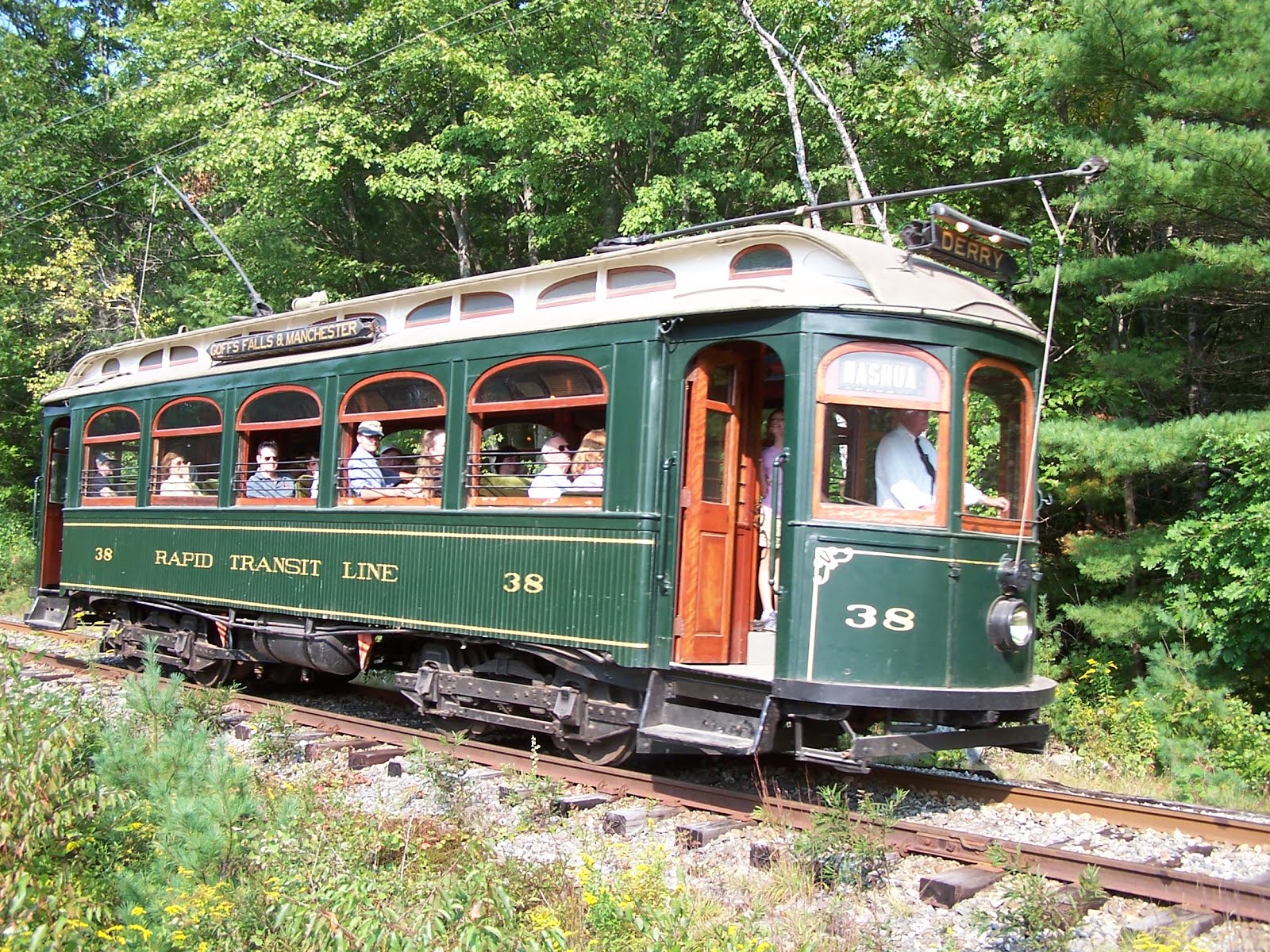
1906 - No. 38 - Manchester & Nashua Street Railway
Wood Interurban (Suburban) - Double/Air
Laconia Car Company - Seats: 40   L: 41' 0"  W: 8' 5"  Ht: 12' 1"  Wt:
Date Purchased: March 21, 1940

No. 38 - Seashore Trolley Museum's mainline 9-16-2006
PWM image

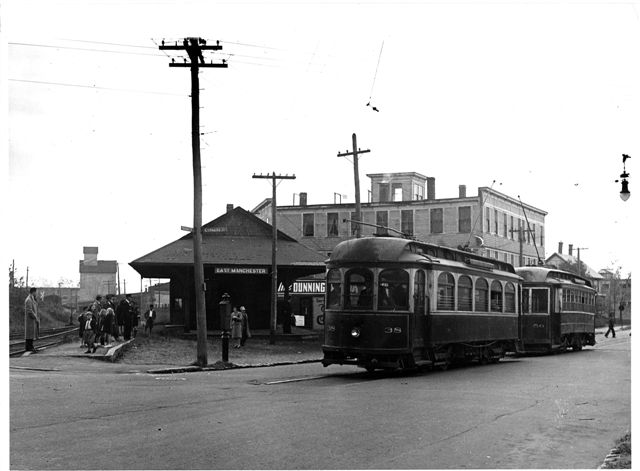
     The second car ever acquired by Seashore was No. 38, built by the Laconia Car Company in 1906 for the 18-mile run between the Merrimack Valley cities of Manchester and Nashua, New Hampshire. It also saw considerable service between Manchester and Derry, and later was operated on the suburban run from Manchester to Goffstown. Car 38 has a railroad roof and double-width windows, an early forerunner of today's picture windows, and seats with green plush upholstery.
Acquired by Seashore when the rail lines in the Queen City were motorized in 1940, No. 38 has been thoroughly restored with polished cherry woodwork and new upholstery. The rather poorly designed and desperately battered Laconia 9B trucks have been extensively rebuilt, thanks to a generous grant from the Norcross Wildlife Foundation, which also supports historic preservation. Worn surfaces were built up, oval bolt holes were filled in and redrilled, and new bolts and other fasteners were installed, though most of the original fabric was faithfully retained. Historic Cars: The National Collection at the Seashore Trolley Museum by Ben Minnich. 

     The video below is a short clip of No. 38 operating on Seashore Trolley Museum's mainline on September 25, 2009.


     From a 1987 interview conducted by Edward Dooks, see and hear the founder of Seashore Trolley Museum, Theodore Santarelli de Brasch, talk about how No. 38 was acquired and brought to Seashore Trolley Museum in 1940. The first minute of the video below is an intro, then he tells the story of acquiring No. 38.
To watch the full interview of the beginning of Seashore Trolley Museum by Theodore Santarelli de Brasch - Click Here


     Edward Dooks, a long-time Seashore Trolley Museum member/volunteer, conducted, recorded, and transcribed recollections of  Seashore Trolley Museum members' experiences involving the Museum. In addition, Ed recorded, collected, and transcribed recollections of local neighbors to the Seashore Trolley Museum. Here are some of those transcriptions, as they relate to the acquisition of No. 38 in 1940.

Transcripts from 1988 interviews conducted by Ed Dooks. Interviewees:
A = John Amlaw, one of Seashore's original members
B = Henry Brainerd, one of Seashore's earliest members

A: We were on a fan trip over to Manchester, and everybody liked those "rapid cars".  There were 2 sets of them. There were 12 altogether: 6 long ones and 6 short ones, and the long ones had been retired. They were up at Lake Massabesic as summer camps.

38 was originally numbered No. 4. It was renumbered in the '30s as 32. 38 had had a bad accident. The newspaper up in Manchester came out with quite an editorial about the miserable conditions of the cars and the terrific damage that had been done to this car. The MSR had 32 in the shops at the time being overhauled. They renumbered it to 38 and put it out in the street and said, "Now the newspaper is telling about all the damage that was done. How come it was the car out in the street today?" It was a different car, and if you opened the inside panel on the left side of the doors on 38, in the body itself (bulkhead), you'll see the old number 4, the new number 32, and nothing about 38.

No. 32 disguised as No. 38

Fan trip 1939 - Seashore Trolley Museum Collection

Dooks: How did you get 38?

There was another trolley fan trip, and several people had seen what we had done with 31, and they said, "Well, suppose we buy 38. Can you take it over with 31?" And we said, "Sure."  That originally started as a separate group led by Gordon Pilkington (from Danbury, CT, and Roger Borrup, who came to us and said, "It hardly seems worthwhile to have two competing groups when we could pool our assets and thereby have twice as much track and wire and other supplies for the same amount of money instead of having two separate locations." (They also found how much was entailed in paying for it, moving it, and finding a place to keep it and all the details involved.) Some of his people were members of Seashore, so everyone agreed it was a much better idea if we made it a cooperative effort and just had one group. (The other group was mostly from NH and CT)

Gordon Pilkington had not at that time even gone to the Manchester people to buy the car or to arrange for buying it, so we took over that end of it and went up to see Roger Moscroft, who was the Executive Assistant of the Manchester Street Railway, or the Power Company which owned the Street Railway.

Dooks: To get to Manchester Public Service, my understanding from Ted (Santarelli de Brasch) was that you had a big problem trying to get the people to talk to you. They kept putting you off, and he mentioned a way that they were able to get to the President of the company.

A: All I remember is that Roger Moscroft was sympathetic to us, and I think he was the one who interceded. Their offices were up at (I think) 1000 Elm Street and they were in the same building, the same set of offices and a different floor as the power company up there, and the manager, as I recall was probably 70 years old at the time, wouldn't see anybody, but as I said, Roger Moscroft saw him for us and arranged for an interview for us to go up and talk to him.

We agreed we would buy one of the cars. The only drawback was that they were afraid that if there were a bad accident or fire and the car was destroyed, we would then hold them liable and want them to replace the car. So I told them that we would take in order either car No. 38, or 36, or 42, or 44, or if by any
ill fortune, none of them were available, simply return our deposit. Under those conditions, the company gave us the contract, and the price was $75 for the car body plus trucks and $50 for each of the (4) motors. We were not able to raise enough money to buy the motors, so we agreed to buy the car itself and the two trucks.

(When questioned about some difference in figures for the cost of 38 he said, "That was 48 years ago, and the original books I think were lost when Eliot Sterling took them out to his house because we had a nice dairy. It was a beautiful book, about 'that thick" and about 'so big' with plush covers on it and leather bindings, but he lost that completely and that gave all the story of the first days of Seashore; who went up there and what they did on those trips. It would have been worth its weight in gold today.")

At the time, the company went out of the streetcar business and went to buses. Goodman, the junkman (later A said he ran a second-hand place and junk shop in Manchester), who bought the cars (to break them up), was at the car barn. Roger Moscroft came down and said, "You've got everything in this building and the ones across the street except car 38." And Goodman asked him, "Now, how about this car? Isn't this the one I don't get?" And Moscroft said, "That's right, this car and everything in it was bought by these people, and they're going to take it over to Maine to preserve it, so don't touch anything on it." (Later, A says Moscroft said, "That car is theirs, everything just the way it stands." So he gave us the motors.) There were 3 or 4 of us there at the time, looking over 38 to see what needed doing to it.

A: Incidentally, he offered us car 18 for nothing if we wanted to take it. It was a work car, and he was just saying that it was so well built and maintained that he hated to burn it up, but we couldn't afford to move it at that time.

We used to go over there occasionally and work on the car even before they did away with the streetcars. They put the car on the track at the back of the barn where we could get to it and wouldn't interfere with anything, and we would clean it, paint it, and repair it. At the time, 36 was going to be scrapped, so we transferred the better stuff from it over to 38, such as cracked windows we replaced, torn seat cushions, broken panes of glass, and things like this, and afterward, someone bought 36 and took it down to Bedford, NH.

B: I think I heard he wanted to buy all three of them and make them into one long dinner or something, and he was a bit unhappy that we got one of them.

Dooks: When 38 was moved, we turned on the power, and you say whoever was the operating man or power man when he threw the switch in to energize the trolley wire, he hoped that people that might be stealing the trolley wire would be on it and get the jolt. (His name was McFarland) 

A: Yes, they had stolen quite a bit of the wire, apparently for 5 or 6 nights, and the police were unable to catch them, at least they didn't, and they didn't want to leave the power on. I remember there was a big switch-up on the pole, and that switch was off. McFarland came over to us and said, "We'll turn the power on so you can run 38 down to the railroad station." So on this particular occasion, he said, "I just hope they're up there right now!!" They weren't, and we didn't read anything about a fellow being hit by electricity and killed. Dan Twomey and Ted Santarelli were on board.

38 on the siding in Manchester 1940
Seashore Trolley Museum Collection

B: He ran the car down from the barn, down to the railroad crossing in the freight yards, derailed it, then rerail it on the railroad. In other words, rode down the pavement and derailed it and rerailed it on the railroad, ran it about a few hundred feet to where he had the flatcar, and then jacked it up and ran the flatcar under it/ It was unloaded in Kennebunk on a siding. (The body was moved to Seashore but) The trucks remained in Manchester. Chase Transfer supplied a little bit of a trailer and moved it from the railroad to Seashore and set it on blocks more or less over the end of the track, but partly blocking the road on the ASL roadbed. As it went by the Kennebunk Inn, two ladies from Manchester were sitting on the front porch, and one of them said to the other, "Oh, there's one of our Manchester trolley cars coming by.

38 being jacked up for placement on the flat car in Manchester,
1940 - Seashore Trolley Museum Collection

No. 38 on the rails - destination Kennebunk, Maine train station.
Then a trip to the Seashore Trolley Museum in Kennebunkport.
1940 image from the collection of Seashore Trolley Museum

Loaded at the Kennebunk railroad station siding, 38 traveling
to its new home, the Seashore Trolley Museum, 1940
Seashore Trolley Museum Collection

We got to the Log Cabin Crossing. (It was called Biddeford Road but was renamed Log Cabin Road later because there were one or two other streets called Biddeford Road or Old Biddeford Road, and it was confusing. There was a tourist cabin with fake log cabins that was called "The Log Cabin," and so the road was named for that."

(I wasn't there) And then we got to the railroad crossing. At the time, the only protection was the train's whistling, and someone had checked with the B & M dispatcher and found no trains were expected, and we got over the crossing. It barely cleared the crossing when a freight train came by, and then I think they had to use something to lift the telephone cable to get the car under it.

The next time I got back to Seashore, the car was standing on blocks, lined up over the end of the track, and it stayed there a year too. I think it was the 4th of July weekend of '41. I remember I found sleeping in that was much more comfortable than sleeping on the bench of 31, and I found you could take a seat cushion and prop it up in the aisle on a wooden soapbox. It was much more comfortable sleeping than out in the chill of 31.

That summer of '40, there was a forest fire, and I think the fire engines cut slightly, having to detour around where 38 stuck out over the roadway. The right-of-way belonged to the power company, then Cumberland County Power and Light, before it became part of Central Maine Power. Sometime in '41, they said, "We damn well had to stop blocking the roadway any longer."

I think I remember that I was in on negotiating the trucks brought over, and we had to make a deal with somebody and had to enroll him temporarily as a member to make it legal for him to bring them. We got them over there, and they were placed right way round, lined up at either end, one on the track out on the roadway. I was there. Well, the day we actually did it, we had barely enough blocking (materials), and we first jacked up the end that was over the track, and we had to get it damn high, and we didn't really have enough blocking to follow up the jack, so we had it way up in the air and just on the jack with no protective blocking. The jack was pretty well extended, and we could just about get the truck under the low platforms. (They stepped lower than the main body.) We got it under and let it down and put the kingpin in.....We got it down on July 4, 1941. I remember I was crawling under the car and the car not actually swaying but up pretty precariously on an extended jack, and I remember sort of thinking, "Well, if anything happens, I'm a goner." Nothing happened, thank goodness...We got it up on the permanent track and took up the temporary rail that we laid, then we had it on our land, clear of the roadway.


No. 38 at Seashore Electric Railway (Seashore Trolley Museum)
- top image circa 1946. lower image-probably
earlier. Images from the collection of Seashore Trolley Museum

No. 38 outside of Shop #1. Circa 1956
Collection of the Seashore Trolley Museum

No. 38 on the Town House Restoration shop lead at Seashore Trolley
Museum 3-29-2003 - Donald Curry image

Click Here: Video of Theodore Santarelli de Brasch explaining the "Birth" of Seashore Trolley - 1939

Additional blog posts on Seashore Trolley Museum's Laconia Car Company-built Collection:
Click Here: No. 14 - Laconia Car Company-built Collection
Click Here: No. 38 - 1907 Laconia Car Company-built Collection
Click Here: No. 60 - 1895 Laconia Car Company-built Collection
Click Here: No. 100 - 1906 Laconia Car Company-built Collection
Click Here: No. 108 - 1904 Laconia Car Company-built Collection
Click Here: No. 235 & No. 50 - 1895 & 1902 Laconia Car Company-built Collection
Click Here: No. 4175 - 1914 Laconia Car Company-built Collection
Click Here: No. 4387 - 1918 Laconia Car Company-built Collection
~~~~~~~~~~~~~~~
We continue the restoration work on the 1912 Narcissus, the only surviving high-speed, luxury interurban coach of the Portland-Lewiston Interurban. 

Click Here: Narcissus Restoration-Related Posts

Being more than a century old, the stately "Elegant Ride," Narcissus, is a gem.  This shimmering precious stone of Maine transportation history is brilliantly resplendent as it emanates so many elements of history, including time, places, people, and events that it was coupled to, that when just a smattering of its seemingly innumerable stories are shared, the contents captivate, fascinate, and then generate interest to learn more 🙋. The majestic Narcissus is listed in the National Register of Historic Places.

Please consider joining the epic journey to complete the Narcissus Project by making a donation today!

Click Here: Donation Options

The restoration of this majestic icon of Maine's electric railway history is but one in a series of captivating stories containing an abundance of incredible coalition narratives.

Click Here: History-Related Posts - Narcissus and Portland-Lewiston Interurban

     The Narcissus is featured in the national Gold Award-winning novel, Teddy Roosevelt, Millie, and the Elegant Ride. The "Elegant Ride" is the Narcissus. Theodore Roosevelt was a passenger on the Narcissus on August 18, 1914, between Lewiston and Portland, Maine, while campaigning for the Progressive Party candidates.

Click Here: Bookstores and Businesses promoting the Narcissus Project

Independent book publisher Phil Morse, holding
Gold Book Award Winner plaque for
 Middle Reader category for The Eric
Hoffer Book Award. Congratulations to
award-winning Maine author,
Jean M. Flahive