Showing posts with label Bangor Maine. Show all posts

Tuesday, August 23, 2022

Theodore Roosevelt Maine Heritage Trail - Start #19 - Bangor 1902

President Roosevelt at the Bangor train station
August 27, 1902. TRC 560.51 1902-079
Houghton Library, Harvard University

 Updated 7-12-2026

May 31, 2026, Joe Banavige released this wonderful American 250 Tribute to William W " Bill" Sewall, TR's Maine guide (along with Wilmot Dow, Bill's nephew) 
Click here to see Joe's Substack post

    I first started researching Theodore Roosevelt in 2010. As a volunteer at Seashore Trolley Museum in Kennebunkport, Maine, overseeing the Narcissus project (Roosevelt was a passenger on the Narcissus on August 18, 1914), I felt the need to learn more about Roosevelt's visit to Maine. This initial research piqued my curious nature. I wanted to learn more about Theodore Roosevelt and his various visits to Maine.

    Twelve years later, that seed of curiosity has taken root and blossomed into the development of what is the Theodore Roosevelt Maine Heritage TrailConnecting Maine Communities. Insight throughout the State of Maine is what this trail provides by tracing and describing Theodore Roosevelt's connections with each of these communities.

Each community is identified with a star with a number or
a moose with a letter. The key to the logo landmarks is below.
Each moose represents a community that has an indirect
connection with Roosevelt, meaning he may not have paid the
community a visit, and there is a meaningful connection to Roosevelt
in that community. The stars indicate a community
that Roosevelt visited and probably engaged with the people.
And/or the local geography. As research continues, other
communities will be added to the logo.
Logo: "Designs by Reece" - Reece Saunders

Over the ensuing weeks, each of these
communities/landmarks with its Roosevelt
connections will have a separate page describing
details of TR's connections. Each will also
have a link or links to local resources/venues.
Key by "Designs by Reece" - Reece Saunders

Today, we describe "Star 19" shown on the list (key) above - Auburn 1902

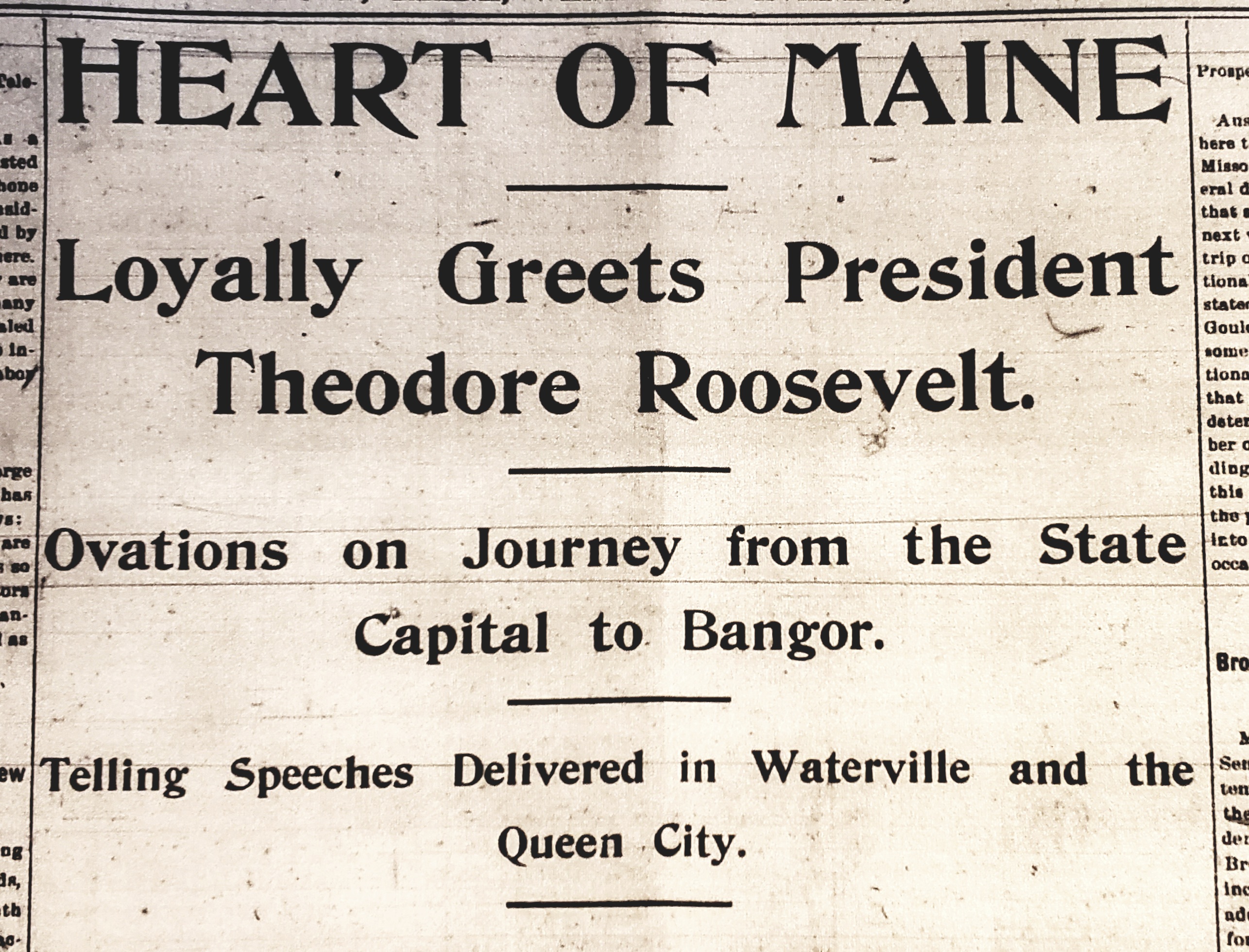
Biddeford Daily Journal - Evening - August 27, 1902

Many details of President Roosevelt's visit
 - front page of the Daily Kennebec Journal -
August 28, 1902 - Library of Congress

Hundreds of people would be at the
various train stations along the route
to see the Presidential train passing through their
community. This was the scene at every Maine depot.

A brief summary of the President's Day in Bangor. Newspaper estimates of the number of people attending the President's speech at the fairgrounds - 30,000 to 50,000.

Biddeford Weekend Journal, August 29, 1902

The Bangor House c 1895-1900 

Details of the President's visit to Bangor.

Library of Congress

Ibid

Ibid

Ibid

Ibid


The Daily Kennebec Journal, August 28, 1902. Publication of the President’s speech in Bangor at the Bangor House on August 27. 1902:
(autocorrect disconnected - text is as written)

My fellow citizens, my fellow countrymen:

It is indeed a great pleasure to be greeted by you today, as it has been to be greeted by people all over Maine. I can see by your faces that the old American spirit still burns as freely as ever. Driving through the thronged streets, I see men who wear the button which tells that they fought in the great struggle. As soon as I saw the mounted policemen, I knew that some of them were old cavalrymen.

You men who fought in that war did the greatest deed which men have ever done. You preserved for us a united country and showed the world that it was ever to be united.

While modes of fighting were different in the time of Lincoln from that of Washington, and still more different today, the spirit that wins is just the same.

The soldier of today who is worth his salt must have the same spirit which won at Appomattox. The only way to obtain good government is for each man to do his own share.

Now, my friends, let me interrupt just for a moment. I have a friend here who is lost in the crowd somewhere. He is Bill Sewall, of Island Falls, Aroostook County, and if anyone sees him, please say to him that I want him to come to lunch with me here and now.


(Daily Kennebec Journal, Augusta, Maine, August 28, 1902)
The Daily Kennebec Journal article describes the end of Roosevelt's speech from
Bangor House balcony, and his accounts during the rest of the day in Bangor.


Daily Kennebec Journal, Morning -
Library of Congress


Ibid

Ibid

Ibid


Ibid

President Theodore Roosevelt's speech made at the Bangor Fairgrounds (Bass Park) on August 27, 1902:

My fellow citizens:

I am glad to greet the farmers of Maine. During the century that had closed, the growth of industrialism has necessarily meant that cities and towns have increased in population more rapidly than the country districts. And yet it remains true now, as it always has been, that in the last resort the country districts are those in which we are surest to find the old American spirit, the old American habits of thought and ways of living. Conditions have changed in the country far less than they have changed in the cities, and in consequences, there has been little breaking away from the methods of life which have produced the great majority of the leaders of the Republic in the past. Almost aloof our great Presidents have been brought up in the country, and most of them worked hard on the farms in their youth and got their early mental training in the healthy democracy of farm life.

The forces which made these farm-bred boys leaders of men when they had come to their full manhood are still at work in our country districts. Self-help and individual initiative remain to a peculiar degree typical of life in the country, life on a farm, in the lumbering camp, on a ranch. Neither the farmers nor their hired hands can work through combinations as readily as the capitalists or the wage-workers of cities can work.

It must not be understood from this that there has been no change in farming and farm life. The contrary is the case. There has been much change, much progress. The granges and similar organizations, the farmers’ institutes, and all the agencies which promote intelligent cooperation and give opportunity for social and intellectual intercourse among the farmers have played a large part in raising the level of life and work in the country districts. In the domain of government, the Department of Agriculture, since its foundation, has accomplished results as striking as those obtained under any other branch of the national administration. By scientific study of all matters connected with the advancement of farm life; by experimental stations; by the use of trained agents, sent to the uttermost countries of the globe; by the practical application of anything which in theory has been demonstrated to be efficient; in these ways, and in many others, great good has been accomplished in raising the standard of productiveness in farm work throughout the country. We live in an era when the best results can only be achieved if to individual self-help we add the mutual self-help which comes by combination, both of citizens in their individual capacity and of the citizens working through the state as an instrument. The farmers of the country have grown more and more to realize this, and farming has tended more and more to take its place as an applied science - though, as with everything else, the theory must be tested in practical work, and can avail only when applied in practical fashion.

But after all this has been said, it remains true that the countryman - the man on the farm, more than any other of our citizens today, is called upon continually to exercise the qualities which we like to think of as typical of the United States throughout its history - the qualities of rugged independence, masterful resolution, and individual energy and resourcefulness. He works hard (for which no man is to be pitied), and often he lives hard (which may not be pleasant); but his life is passed in healthy surroundings, surroundings which tend to develop a fine type of citizenship. In the country, moreover, the conditions are fortunately such as to allow a closer touch between man and man than, too often, we find to be the case in the city. Men feel more vividly the underlying sense of brotherhood, of community of interest. I do not mean by this that there are not plenty of problems connected with life in our rural districts. There are many problems, and great wisdom and earnest disinterestedness in effort are needed for their solution.

After all, we are one people, with the same fundamental characteristics, whether we live in the city or in the country, in the East or in the West, in the North or in the South. Each of us, unless he is contented to be a cumberer of the earth’s surface, must strive to do his life-work with his whole heart. Each must remember that, while he will be noxious to everyone unless he first do his duty by himself, he must also strive ever to do his duty by his fellow. The problem of how to do these duties is acute everywhere. It is most acute in great cities, but it exists in the country, too. A man, to be a good citizen, must first be a good bread-winner, a good husband, a good father - I hope the father of many healthy children; just as a woman’s first duty is to be a good housewife and mother. The business duties, the home duties, the duties to one’s family come first. The couple who bring up plenty of healthy children, who leave behind them many sons and daughters fitted in their turn to be good citizens, emphatically deserve well of the State.

But duty to one’s self and one’s family does not exclude duty to one’s neighbor. Each of us, rich or poor, can help his neighbor at times; and to do this, he must be brought into touch with him, into sympathy with him. Any effort is to be welcomed that brings people closer together, so as to secure a better understanding among those whose walks of life are in ordinary circumstances far apart. Probably the good done is almost equally great on both sides, no matter which one may seem to be helping the other. But it must be kept in mind that no good will be accomplished at all by any philanthropic or charitable work unless it is done along certain definite lines. In the first place, if the work is done in a spirit of condescension, it would be better never to attempt it. It is almost as irritating to be patronized as to be wronged. The only safe way of working is to try to find out some scheme by which it is possible to make a common effort for the common good. Each of us needs at times to have a helping hand stretched out to him or her. Every one of us slips on some occasion, and shame to the fellow who then refuses to stretch out the hand that should always be ready to help the man who stumbles. It is our duty to lift him up, but it is also our duty to remember that there is no earthly use in trying to carry him. If a man will submit to being carried, that is sufficient to show that he is not worth carrying. In the long run, the only kind of help that really avails is the help which teaches a man to help himself. Such help every man who has been blessed in life should try to give to those who are less fortunate, and such help can be accepted with entire self-respect.

The aim to set before ourselves in trying to aid one another is to give that aid under conditions which will harm no man’s self-respect, and which will teach the less fortunate how to help themselves as their stronger brothers do. To give such aid, it is necessary not only to possess the right kind of heart, but also the right kind of head. Hardness if heart is a dreadful quality, but it is doubtful whether, in the long run, it works more damage than softness of head. At any rate, both are undesirable. The prerequisite to doing good work in the field of philanthropy - in the field of social effort, undertaken with one’s fellows for the common good - is that it shall be undertaken in a spirit of broad sanity no less than broad and loving charity.

The other day, I picked up a little book called “The Simple Life,” written by an Alsatian, Charles Wagner, and he preaches such wholesome, sound doctrine that I wish it could be used as a tract throughout our country. To him, the whole problem of our complex, somewhat feverish modern life can be solved only by getting men and women to lead better lives. He sees that the permanence of Liberty and democracy depends upon a majority of the people being steadfast in morality and in that good plain sense which, as a national attribute, comes only as the result of slow and painful labor of centuries, and which can be squandered in a generation by the thoughtless and vicious. He preaches the doctrine of the superiority of the moral to the material. He does not undervalue the material, but he insists, as we of this nation should always insist, upon the infinite superiority of the moral, and the sordid destruction which comes upon either the nation or the individual is it or he becomes absorbed only in the desire to get wealth. The true line of cleavage may, and often does, run at right angles to that which divides the rich and the poor. The sinews of virtue lie in man’s capacity to care for what is outside himself. The man who gives himself up to the service of his appetite, the man who, the more goods he has, the more wants, has surrendered himself to destruction. It makes little difference whether he achieves his purpose or not. If his point of view is all wrong, he is a bad citizen whether he be rich or poor. It is a small matter to the community whether in arrogance and insolence, he has misused great wealth, or whether, though poor, he is possessed by the mean and fierce desire to seize a morsel, the biggest possible, of that prey which the fortunate of earth consume. The man who lives simply, and justly, and honorably, whether rich or poor, is a good citizen. Those who dream only of idleness and pleasure, who hate others, and fail to recognize the duty of each man to his brother, these, be they rich or poor, are the enemies of the State. The misuse of property is one manifestation of the same evil spirit which, under changed circumstances, denies the right of property because this right is in the hands of others. In a purely material civilization, the bitterness of attack on another’s possession is only additional proof of the extraordinary importance attached to possession itself. When outward well-being, instead of being regarded as a valuable foundation on which happiness may with wisdom be built, is mistaken for happiness itself, so that material prosperity becomes the one standard, then, alike by those who enjoy such prosperity in slothful or criminal ease, and by those who in no less evil manner rail at, envy, and long for it, poverty is held to be shameful, and money, whether well or ill-gotten, to stand for merit.

All this does not mean condemnation of progress. It is mere folly to try to dig up the dead past, and scant is the good that comes from asceticism and retirement from the world. But let us make sure that prosperity without moral lift toward righteousness means a diminished capacity for happiness and a debased character. The worth of a civilization is the worth of the man at its center. When this man lacks moral rectitude, material progress only makes bad worse, and social problems still darker and more complex.


The newspaper background on the goings-on in the crowd. Several newspapers report that a band of pickpocket thieves was identified as following the President's travels and stealing from the people in large crowds.

Daily Kennebec Journal, Morning -

August 28, 1902- page 3 

Library of Congress


A few more details from the President's Bangor visit on August 27, 1902


Library of Congress


New York Tribune - August 28, 1902 -
page 2 - Library of Congress 

President Roosevelt's train departed Ellsworth
at 10 p.m. Arrived in Bangor at about 11:30 p.m.
Soon after, he departed for Kittery Junction.
Lewiston Daily Sun, August 28, 1902 - 
front page

Roosevelt did not return to Maine
that fall of 1902 to go hunting with
William Sewall is based out of Island Falls.
Biddeford Weekly Journal - August 29, 1902.

Kittery Junction station is where President Theodore
Roosevelt's train would stop very early in the morning of August 28, 1902,
State of New Hampshire dignitaries boarded the train  to travel to
New Hampshire with the President.
He extended his New England tour with stops in New Hampshire.
Photo: Raymond E. Tobbey Collection
from the 1986 publication, DOWNEAST DEPOTS:
Maine Railroad Stations in the Steam Era by Robert F. Lord

Great source of information for the railroad stations in Maine.
1986 publication by Robert F. Lord - PWM Collection and photo

A portion of my collection of TR-related books :)
~~~~~~~~~~~~~~~
Click Here: For the list of links to Theodore Roosevelt Maine Heritage Trail Posts in Easy Order to View

We continue the restoration work on the 1912 Narcissus, the only surviving high-speed, luxury interurban coach of the Portland-Lewiston Interurban. 

Click Here: Narcissus Restoration-Related Posts

More than a century old, the stately "Elegant Ride," Narcissus, is a gem.  This shimmering precious stone of Maine transportation history is brilliantly resplendent as it emanates so many elements of history, including time, places, people, and events, that it was coupled to, that when just a smattering of its seemingly innumerable stories are shared, the contents first captivate, fascinate, then generate interest to learn more 🙋. The majestic Narcissus is listed in the National Register of Historic Places.

Please consider joining the epic journey to complete the Narcissus Project by donating today!

Click Here: Donation Options

The restoration of this majestic icon of Maine's electric railway history is but one in a series of captivating stories containing an abundance of incredible coalition narratives.

Click Here: History-Related Posts - Narcissus and Portland-Lewiston Interurban

     The Narcissus is featured in the national Gold Award-winning novel, Teddy Roosevelt, Millie, and the Elegant Ride. The "Elegant Ride" is the Narcissus. Theodore Roosevelt was a passenger on the Narcissus on August 18, 1914, between Lewiston and Portland, Maine, while campaigning for the Progressive Party candidates.

Click Here: Bookstores and Businesses promoting the Narcissus Project

Independent book publisher Phil Morse, holding
Gold Book Award Winner plaque for
 Middle Reader category for The Eric
Hoffer Book Award. Congratulations to
award-winning Maine author,
Jean M. Flahive

Tuesday, March 3, 2020

Maine Bicentennial Series - Bangor, Hampden & Winterport Railway 1896-1905

 Riverside Park's trolley station at the once-famous summer
park on a spur in Hampden of the Bangor, Hampden &
Winterport Railway.  The park opened on Jul 15, 1898, and
closed down after the 1916 season.
Image from Charles D. Heseltine Collection

Here is the newest release in the Maine Bicentennial series of electric railways in Maine. This blog post features the Bangor, Hampden & Winterport Railway summary/images from the book, "Bangor Street Railway" by Charles D. Heseltine, published as Transportation Bulletin No. 81, January-December 1974, through Connecticut Valley Chapter of the National Railway Historical Society, copyright 1976 Roger Borrup and Charles D. Heseltine. Some text/images may be from the NEERHS 2015 publication, "The Illustrated Atlas of Maine's Street & Electric Railways 1863-1946. Additional images will be credited.
  • 3.15.2020 - Maine Bicentennial Series - York Utilities Company 1923-1949
  • 3.14.2020 - Maine Bicentennial Series - Atlantic Shore Railway 1911-1923
  • 3.11.2020-Maine Bicentennial Series - Portsmouth, Dover & York St Rwy 1903-1906
  • 3.9.2020 - Maine Bicentennial Series - Auburn, Mechanic Falls & NorwayStRwy1902-3
  • 3.7.2020 - Maine Bicentennial Series - Portland & Brunswick Electric Railway 1902-1911
  • 3.7.2020 - Maine Bicentennial Series - Androscoggin & Kennebec Railway Co. 1919-1941
  • 3.7.2020 - Maine Bicentennial Series - Lewiston, Augusta & Waterville St Rwy 1907-1919
  • 3.6.2020 - Maine Bicentennial Series - Lewiston, Brunswick & Bath St Rwy 1898-1907
  • 3.4.2020 - Maine Bicentennial Series - Bangor Hydro-Electric Company 1925-1945
  • 3.4.2020 - Maine Bicentennial Series - Penobscot Central Railway 1898-1906
  • 3.3.2020 - Maine Bicentennial Series - Bangor. Hampden & Winterport Rwy 1896-1905
  • 3.2.2020 - Maine Bicentennial Series - Bangor, Orono & Old Town Railway 1895-1905
  • 3.2.2020 - Maine Bicentennial Series - Bangor Railway & Electric Company 1905-1925
  • 3.1.2020  - Maine Bicentennial Series - Bangor Street Railway 1889-1905
  • 2.23.2020 -Maine Bicentennial Series - Portsmouth, Kittery & York St. Rwy 1897-1903
  • 2.22.2020 - Maine Bicentennial Series - Sanford & Cape Porpoise Railway 1899-1904
  • 2.21.2020 - Maine Bicentennial Series - Mousam River Railroad 1892-1899
  • 1.31.2019 - Maine Bicentennial Series - The Norway and Paris Street Railway 1894-1918
  • 1.27.2019 - Maine Bicentennial Series - Aroostook Valley Railroad 1909-1946
  • 10.17.2018 - Maine Bicentennial - Portland Railroad History 1860-1941
Bangor, Hampden & Winterport Railway
     Like many of these early railways in the later part of the 19th century, the names initially included in the charter sometimes went through an adjustment or two before settling on the actual name of the railway, which is when trolleys started operating on the line. Even then, some of these lines change their names in short order after the operation of the line begins. This is the case for what would become the Bangor, Hampden & Winterport Railway, which actually never went to Winterport :)

     The Bangor, Hampden & Winterport Railway (BH&W) had its inception on March 29, 1893, when the Hampden & Winterport Electric Railway & Light Company was chartered to build electric railways and lighting plants in the towns of Hampden, Winterport, Frankfort, and Prospect.

     The electric railway was to connect with the Bangor Street Railway near the "Tin Bridge" of the Maine Central Railroad. Authorization approved capitalization for $500,000. Two years later, the incorporators secured a renewal of the charter and were authorized to operate both passenger and freight cars over the tracks of the Bangor Street Railway (BSR) into downtown Bangor. The BSR was granted equal rights over the proposed Hampden line.

Bangor and Hampden map.
Map by Charles D. Heseltine in the
2015 publication, "The Illustrated Atlas of
Maine's Street & Electric Railways 1863-1946.

     Construction began in the fall of 1896. The initial incorporators of the company transferred their interests to a syndicate headed by the same group that controlled the Bangor Street Railway, which meant the new line was closely allied with the BSR. 

     A certificate allowing trolley operations was issued on December 11, 1896, for the first 1.1 miles from near the Tin Bridge to Stearns Mill in Hampden. The early trolleys were leased from BSR, which also supplied the crews to operate the cars. Charles Johnson was the first motorman, and Charles Smith was the conductor. Both men were on hand for the final run when the Hampden line was closed in 1940.

Car No. 44 at Hampden Corner
Image from Charles D. Heseltine Collection

     The Hampden cars used the BSR tracks from downtown Bangor to Market Square. The company never had its own car barn. The name of the Hampden & Winterport Electric Railway & Light Company was changed to the Bangor, Hampden & Winterport Street Railway (BH&W) on February 2, 1897.

No. 20 on Maine Street, Bangor, going to Hampden on the
new Bangor, Hampden & Winterport Railway before the arrival of the line's own cars.
Image from Charles D. Heseltine Collection

     On March 27, 1897, the company was authorized to build electric lines through Newburgh and Dixmont in Penobscot County, and in Monroe in Waldo County, and also to run over the rails of the BSR and to the towns of Herman, Levant, Stetson, and Exeter. None of these proposed extensions was ever built, nor did the rails ever reach Winterport.

    Another 3.4 miles of track was built from Stearns Mill to Hamden Lower Corner, and it was opened on November 6, 1897. No further construction was carried out by this company, although in later years the line was extended to Hamden Highlands and to Upper Corner. Power for the line was supplied by the Veazie hydro-station.

Postcard Car No. 55 in Hampden
Postcard, from the O. R. Cummings Collection in the
2015 publication, "The Illustrated Atlas of
Maine's Street & Electric Railways 1863-1946.

     One authority on New England covered bridges believed the covered bridge over Sourdabscook stream was the only covered bridge built exclusively for streetcar use. 

The covered bridge crossing the Sourdabscook Stream in
Hampden.
Image from Charles D. Heseltine Collection

     As of June 30, 1898, the line owned 4.52 miles of mainline track, plus additional sidings and turnouts, and trackage rights in downtown Bangor. Included in the siding was a .23-mile spur into Riverside Park, a company-owned pleasure resort.  The fare for passengers was 5 cents, and there were two fare zones. Frost's turnout was at the end of the first zone.

     The Riverside Park, built by the BH&W, opened on June 15, 1898, and soon became one of the most popular attractions in the Bangor area. An open-air theater was built into the banks of the river, forming a natural amphitheater, admirably suited for the purpose. Weekly changes in programs drew large crowds. 

Riverside Park midway, Hampden, opened June 15, 1898.
Image from Charles D. Heseltine Collection

     Boats were rented along the riverfront and a midway with attractions to appeal to all ages. Management prided itself on keeping the resort at a high standard.

Riverside Park, midway, Hampden.
Image from Charles D. Heseltine Collection

     The park proved to be a traffic stimulator, and surprisingly, it was the only trolley resort in the Bangor area. And by design, it was located slightly beyond the initial 5-cent fare limit, which doubles the company's receipts.

     One account tells of the attendant at the powerhouse having to hold the circuit breakers in by hand for an hour at the end of the day when so much current was being drawn by the many cars on the line.

     The cost to build the entire line, including Riverside Park, had been a modest $114,604.

     The company began using its own cars once the route to Hampden Lower Corner was completed. During the summer months, cars from BSR were borrowed to use during the increase in riders to Riverside Park. 

An early type of patented transfer ticket with an error as
delivered from the printer (the first plus sign should have
been a minus sign). The conductor was supposed to punch
the age, type of beard, and gender of the transfer recipient,
as well as the date, time, and line requested. This
was to avoid fraudulent use of the transfers. This
type of transfer readily fell into disfavor with both
the conductors and the public.
Image from Charles D. Heseltine Collection

     Snow seems to have been the bane of the Hampden line. Then, in 1899, the line was tied up for several weeks, and crews had to use picks and shovels to make way for the plow, even resorting to ice chisels to break out the rails.

Snowdrifts were a common occurrence along the Hampden
line. Here is a car that had to be dug out by hand in 1899.
Car No. 1 of the Bangor, Hampden & Winterport Railway.
Image from Charles D. Heseltine Collection

     The Bangor, Hampden & Winterport Railway, at the time of consolidation with Bangor Railway & Electric Company on June 30, 1905, had 4.52 miles of mainline track. The high watermark for passengers carried and passenger revenues was in 1903, with 512,144 passengers carried with revenues of $26,345.
~~~~~~~~~~~~~~~
Click Here: For the list of links to Theodore Roosevelt Maine Heritage Trail Posts in Easy Order to View

We continue the restoration work on the 1912 Narcissus, the only surviving high-speed, luxury interurban coach of the Portland-Lewiston Interurban. 

Click Here: Narcissus Restoration-Related Posts

More than a century old, the stately "Elegant Ride," Narcissus, is a gem.  This shimmering precious stone of Maine transportation history is brilliantly resplendent as it emanates so many elements of history, including time, places, people, and events, that it was coupled to, that when just a smattering of its seemingly innumerable stories are shared, the contents first captivate, fascinate, then generate interest to learn more 🙋. The majestic Narcissus is listed in the National Register of Historic Places.

Please consider joining the epic journey to complete the Narcissus Project by making a donation today!

Click Here: Donation Options

The restoration of this majestic icon of Maine's electric railway history is but one in a series of captivating stories containing an abundance of incredible coalition narratives.

Click Here: History-Related Posts - Narcissus and Portland-Lewiston Interurban

     The Narcissus is featured in the national Gold Award-winning novel, Teddy Roosevelt, Millie, and the Elegant Ride. The "Elegant Ride" is the Narcissus. Theodore Roosevelt was a passenger on the Narcissus on August 18, 1914, between Lewiston and Portland, Maine, while campaigning for the Progressive Party candidates.

Click Here: Bookstores and Businesses promoting the Narcissus Project

Independent book publisher, Phil Morse, holding
Gold Book Award Winner plaque for
 Middle Reader category for The Eric
Hoffer Book Award. Congratulations to
award-winning Maine author,
Jean M. Flahive

Sunday, March 1, 2020

Maine Bicentennial Series - Bangor Railway & Electric Company - 1905 - 1925

Bangor Railway & Electric Company's No. 14 in Hampden.
One of seven, 8-wheel (double-truck), light-weight, safety
cars built in 1921, that arrived in Bangor from the Wason Company in Springfield, MA, in 1922. Primarily used for the Hampden and Brewer line. Numbered 6, 8, 10, 12, 14, 16,
and 18, all were sold in 1942 to the Johnstown (PA)
Traction Company (JTC), where they were renumbered
from 305 through 311. All but No. 311 were scrapped in
1947. No. 311 stayed in service until 1961. No. 311 was
saved and sold to the Rockhill Trolley Museum (PA)
See more about Bangor's only surviving trolley and
its happy home in Rockhill Furnace, PA.
Photo courtesy of Joel Salomon

A screenshot from Google Maps on 2-29-2020
of where I  think the intersection is in Hampden that
Car 14 is seen in the above photo

     Here is the newest release in the Maine Bicentennial series of electric railways in Maine. This blog post features the Bangor Railway & Electric Company summary/images from the book, "Bangor Street Railway" by Charles D. Heseltine, published as Transportation Bulletin No. 81, January-December 1974, through, Connecticut Valley Chapter of the National Railway Historical Society, copyright 1976 Roger Borrup and Charles D. Heseltine. Some text/images may be from the NEERHS 2015 publication, "The Illustrated Atlas of Maine's Street & Electric Railways 1863-1946. Additional images will be credited.
  • 3.15.2020 - Maine Bicentennial Series - York Utilities Company 1923-1949
  • 3.14.2020 - Maine Bicentennial Series - Atlantic Shore Railway 1911-1923
  • 3.11.2020-Maine Bicentennial Series - Portsmouth, Dover & York St Rwy 1903-1906
  • 3.9.2020 - Maine Bicentennial Series - Auburn, Mechanic Falls & NorwayStRwy1902-3
  • 3.7.2020 - Maine Bicentennial Series - Portland & Brunswick Electric Railway 1902-1911
  • 3.7.2020 - Maine Bicentennial Series - Androscoggin & Kennebec Railway Co. 1919-1941
  • 3.7.2020 - Maine Bicentennial Series - Lewiston, Augusta & Waterville St Rwy 1907-1919
  • 3.6.2020 - Maine Bicentennial Series - Lewiston, Brunswick & Bath St Rwy 1898-1907
  • 3.4.2020 - Maine Bicentennial Series - Bangor Hydro-Electric Company 1925-1945
  • 3.4.2020 - Maine Bicentennial Series - Penobscot Central Railway 1898-1906
  • 3.3.2020 - Maine Bicentennial Series - Bangor. Hampden & Winterport Rwy 1896-1905
  • 3.2.2020 - Maine Bicentennial Series - Bangor, Orono & Old Town Railway 1895-1905
  • 3.2.2020 - Maine Bicentennial Series - Bangor Railway & Electric Company 1905-1925
  • 3.1.2020  - Maine Bicentennial Series - Bangor Street Railway 1889-1905
  • 2.23.2020 -Maine Bicentennial Series - Portsmouth, Kittery & York St. Rwy 1897-1903
  • 2.22.2020 - Maine Bicentennial Series - Sanford & Cape Porpoise Railway 1899-1904
  • 2.21.2020 - Maine Bicentennial Series - Mousam River Railroad 1892-1899
  • 1.31.2019 - Maine Bicentennial Series - The Norway and Paris Street Railway 1894-1918
  • 1.27.2019 - Maine Bicentennial Series - Aroostook Valley Railroad 1909-1946
  • 10.17.2018 - Maine Bicentennial - Portland Railroad History 1860-1941
Fully restored as Johnstown Traction Company (JTC) No. 311
in operation at Rockhill Trolley Museum in Rockhill Furnace,
PA. No. 311 is the former Bangor Railway & Electric Company's
No. 14. When it was retired from service in Johnstown, PA in
1961, No. 311 was the last of its type to be operated in
any United States city on a regular schedule. Photo from 
Joel Salomon, Rockhill Trolley Museum

Passengers enjoying their ride on restored JTC No. 311
while in operation at Rockhill Trolley Museum. Formerly
No. 14 of the Bangor Railway & Electric Company, operating
most often on the Hampden and Brewer line. When saved, 
JTC No. 311 was the first car acquired by Rockhill Trolley
Museum. Photo from Rockhill Trolley Museum's website. 

Wason Car Company's builder's photo from 1921 of the interior
of  Bangor Railway & Electric Company's No. 16, the sister
car to No. 14, now restored as Johnstown Traction Company
Photo courtesy of Pennsylvania Trolley Museum

     Early in the 1900s, the electric railways serving the three largest population centers in Maine, Portland, Lewiston, and Bangor, had attracted the attention of New York and Philadelphia's financial interests. In some cases, these out-of-state interests were syndicates. In some cases, individuals within these syndicates or the individual syndicate would acquire shares in a railway company in Maine with plans to take control of the particular railway. Ultimately, many of the electric railways in Maine were, at one time or another, controlled by these various syndicates. The three city-centered systems succumbed to the syndicates, with first Bangor, then Lewiston, and then finally Portland, on February 1, 1912. Through A. B. Leach & Company of New York, E. W. Clark & Company of Philadelphia, and J. and W. Seligman & Company of New York (brokerage houses), were in control of the Lewiston, Augusta & Waterville, the Bangor Railway & Electric Company, and the Portland Railroad.

Bangor Railway & Electric Company
          June 30, 1905, was the date of the consolidation, at which time the various water power, electric light, and street railway properties were reorganized in a merger creating the Bangor Railway & Electric Company.

No. 32 is about to leave Market Square, Bangor, for Charleston,
 in 1915, as conductor Arthur L. Cameron at left and Motoman,
William Wood, pose. No. 32 is a combination built by J. G. Brill Co.
in 1906. The sliding door in the background is for loading
freight. Image from Charles D. Heseltine Collection

J. G. Brill Co. builder's photo of combination car No. 32,
in Philadelphia, PA, in 1906, before being shipped to Bangor.
A combine or combination car was designed to handle express
or light freight and also carry passengers. Generally, 
one-third of the car compartment was for freight, usually
with a sliding door on one or both sides of the body, and
two-thirds of the car compartment had seats for carrying
passengers. Combines were commonly used on rural lines.
Image from Charles D. Heseltine Collection

Bangor local lines
Map by Charles D. Heseltine in the NEERHS 2015
publication, "The Illustrated Atlas of Maine's Street & Electric
Railways 1863-1946. 

No. M-1, a 1903 Wason Car Company 4-wheel Shear/plow
was purchased used from Eastern Mass. St. Rwy. 
Image from the Edwin "Bill" Robertson Coll. PWM

     Bangor Street Railway, Bangor, Orono & Old Town Railway, Penobscot Central Railway/Bangor and Northern, and the Bangor, Hampden & Winterport Railway all came to be merged with the Bangor Railway & Electric Company.


Bangor, Orono & Old Town Railway
Map by Charles D. Heseltine in the
2015 publication, "The Illustrated Atlas of
Maine's Street & Electric Railways 1863-1946.

No. M-6, a 1901 Ruggles Co., 8-wheel, double-truck rotary snowblower used on the Old Town line.
Image from the Edwin "Bill" Robertson Coll. PWM

No. 34, like No. 32, is a combination car. Here No. 34 is in
Kenduskeag Village on the Charleston line. Circa 1910
Image from Charles D. Heseltine Collection

Penobscot Central Railway
Map by Charles D. Heseltine in the
2015 publication, "The Illustrated Atlas of
Maine's Street & Electric Railways 1863-1946.

On the Charleston line, No. 34 is in East Corinth. 
No. 34, like No. 32, was built by J. G. Brill Co. in 1906.
Image from Charles D. Heseltine Collection

Charleston Division
Map by Charles D. Heseltine in the
2015 publication, "The Illustrated Atlas of
Maine's Street & Electric Railways 1863-1946.

No. 46, outside of Bangor Union Station, was built in 1919
by the American Car Company, is one of the many
"Birney" Safety Cars operated on the Bangor system
These cars required only a motorman for operations,
reducing the need for a conductor, thus reducing payroll costs.
Image from Edwin "Bill" Robertson Coll. PWM

Bangor, Hampden & Winterport Railway
(Never did reach Winterport...btw)
Map by Charles D. Heseltine in the NEERHS 2015
publication, "The Illustrated Atlas of Maine's Street & Electric
Railways 1863-1946.

Wason-built double-truck safety car No. 14.  No. 14 was sold
in 1942 to the Johnstown (PA) Traction Company (JTC),
where they were renumbered from 305 through 311. All but
No. 311 was scrapped in 1947. No. 311 stayed in service until
1961. No. 311 was saved and sold to the
O. R. Cummings Collection 2009_02_12_013

A postcard of a trolley car stopped at Hampden Corner.
PWM Collection

     On behalf of the General Electric Company, which held large interests in the Bangor corporations, John R. Graham was called into service to consolidate the Bangor properties. The predecessor of the Bangor Railway and Electric Company was the Old Town Electric Company, which had been organized in 1889. The name of the corporation was changed by an act of the legislature in 1905. The act permitted the newly organized Bangor Railway & Electric Company to purchase, or otherwise acquire, the various lighting, street railway, and water power companies of the area.

Veazie hydroelectric station interior photo in the early 1920s.
The major source of power for the Bangor trolleys.
Image from Charles D. Heseltine Collection

     Development of both the street railways and the power company in Bangor may fully be credited to John R. Graham.  The consolidation of most of the entities took place on April 1, 1905. The consolidation was completed in February 1906 with the addition of the 28 miles and the equipment of Penobscot/Bangor & Northern Railway, which became the Charleston Division of the Bangor Railway & Electric Company (BR&E).

No 32 at the end of the line in Charleston in 1909. No. 32,
a combination car built in 1906 by the J. G. Brill Company.
Image from the Edwin "Bill" Robertson Coll.

      The early years of the consolidation focused on investing in improvements to infrastructure, power sources, and overall service to patrons. These improvements included a rotary substation being built at Kenduskaeg Village and considerable money being spent on improving River Park on the Hampden line and the Charleston Division. Service improvements to patrons included transfer privileges extended to the Charleston Division, with free transfers issued on the local lines covering the first fare zone on the Charleston run. Seven daily round-trips through Charleston, and hourly service to North Bangor and Kenduskeag Village.

     Extra cars to meet passengers at various train stations and the Eastern Steamship Company. This resulted in considerable baggage and express business. In an attempt to develop the agricultural economy of the area served by the Charleston Division, the BR&E established a "model farm" close to the Six Miles Falls carbarn to demonstrate modern techniques in farming. This was done in collaboration with experts from the State College in Orono. The company also built several potato storage houses along the route to serve as collection centers for the crop.

No. 9, a 13-bench open car, was built in 1912 by the Laconia
Car Company, Laconia, NH, with a steam railroad roof and
was used on the Hampden line for passengers traveling to
Riverside Park. Image from Charles D. Heseltine Collection

13-bench, double-truck, open car No. 13, with sister open
cars, Nos. 9 and 11, were the last open cars purchased by the
Bangor system and were among the last open cars to be built
for a North American street railway. 
Image from Charles D. Heseltine Collection

     A new, modern carhouse with repair facilities was built on lower Main Street and opened in 1906. It was claimed to be the first use of reinforced concrete for this type of structure.

The "new" Bangor carbarn on Lower Main Street opened in
1906. Image from Charles D. Heseltine Collection

Double-truck, 1921 Wason Car Company-built, safety-car
No. 16 on Central Street in Bangor, circa 1932. Sister
to No. 14, became No. 311 in Johnstown (PA)
Traction Company (JTC) in 1942, and is now restored and
operating at the Rockhill Trolley Museum.
Photo from Joel Salomon, Rockhill Trolley Museum

Screenshot of Google Maps today
taken from about the same spot
as the photo above, with car No. 16
on Central Street. Remove the addition
from the top, the red brick building
on the left has an unusual shape and
is located in part, on 79 Central Street in Bangor, Me. I think we have a match:)

     Old wooden bridges were a problem. Even though portions of the bridge between Bangor and Brewer were upgraded in 1902/3, trolley cars were still not permitted to cross. The bridge over the Stillwater River in Orono was condemned for use by trolley cars later in 1907. The bridge over the Segeunkedunk Stream. The fire of 1911 badly damaged the two municipal bridges over the Kenduskeag Stream. The bridge at Six Mile Falls was washed out in 1920.

1902 washed away the center span and approach to
Bangor-Brewer covered bridge and railroad span in
the foreground. Image from Charles D. Heseltine Collection

  The great Bangor fire of 1911 claimed the general offices of the BR&E as well as the Park Street substation. Much of the heart of the business section of Bangor was lost.

Bangor Library was one of the many buildings destroyed in
the 1911 conflagration. This is a 1910 view from the State
Street bridge over the Kenduskeag Stream. The trolley car
in the background is turning onto Harlow Street. 
Image from Charles D. Heseltine Collection

Six Mile Falls bridge the day after the trestle bents were swept
away downstream by ice in April 1920. One lonely trolley
looks on. Image from Charles D. Heseltine Collection

     BR&E continued making improvements. A one-mile extension of the Hampden line was made to Dorothea Dix Park late in 1913. Finally, on September 28, 1914, electric cars commenced operations over the newly completed steel bridge over the Penobscot River between Bangor and Brewer, linking the Brewer Division with the rest of the system.

Builder's photo of Semi-Convertible car No. 92 at the Wason Company in 1914, before being shipped to Bangor. Upper windows in semi-convertible cars could be lifted
and stored in a roof compartment, or removed altogether
allowing for maximum airflow through the car during
warmer weather Image from Charles D. Heseltine Collection

These patented storm windows
were installed on cars like No.
92 for the winter season, along
with electric heaters,
kept the passengers on the Old Town line was toasty
and warm on Maine's coldest days.
Charles D. Heseltine Collection

Center entrance car No. 10, aboard a steam railroad flatcar
at the Laconia Car Company, was ready for shipment to Bangor
in 1916. Nos. 8, 10, & 12 were the first of this type for the
Bangor system. A low-step, center entrance,
pre-payment car would accept a crowd of passengers quickly.
They were nicknamed "submarines" and were referred to as
U-8, U-10, and U-12. They had Radiax-type trucks with
"floating axles" that were difficult to rerail and
seemed to jump the track and derail fairly frequently.
Image from Charles D. Heseltine Collection

     John R. Graham died on August 24, 1915. He was succeeded as president of the BR&E by Erastus C. Ryder, who was replaced in 1920 by Edward M. Graham, John's son. Edward served until 1958, when he was named chairman of the Board of the Bangor Hydro-Electric Company.

Center Entrance trailer No. 200 in a J. G. Brill Company
builder's photo in 1917. The trailer was converted to a
motorized car in 1919/20 and was renumbered to car No. 98.
Image from Charles D. Heseltine Collection

    During WW I, the Bangor system became the third-largest electric freight line carrier in our Pine Tree State, topped only by the Lewiston, Augusta & Waterville Street Railway and the Atlantic Shore Railway. The old Penobscot Central route, which became the Charleston Division, was primarily a freight line. A total of 94,353 car miles, reported by the freight department, for the year ending June 30, 1919, with freight income at $52,644.81. Inflation during the war years added to the troubles of reduced ridership. Passenger receipts for the 1919 year ending June 30 amounted to $432,683.64. Operating expenses outstripped income, a troubling trend.

Switching freight at East Corinth on the Charleston line
in the early days of the BR&E 1897 box-express motor
built by J. G. Brill in 1897 for the Bangor, Hampden &
Winterport Railway.
Image from Charles D. Heseltine Collection

The Westland Avenue extension of 1922, bringing together the outer ends of the Hampden Street and Ohio Street lines, was the last major building job of the Bangor system. Forming Westland  Ave. Loop in both directions where cars could travel, and included combining the State-Garland loop.

     Certain reorganizations in the financial structure of the Bangor Railway & Electric Company resulted when the General Electric Company divested itself of its subsidiary, the Electric Bond & Share Company, in 1924. As a result, the Bangor Hydro-Electric Company was organized on June 9, 1924. Stock in this new corporation was exchanged on an equal basis for stock in the Bangor Railway & Electric Company. The new company formally took over operation on March 1, 1925

     At that time, the Bangor trolley system was operating a total of 58.73 miles of mainline track, including the lengthy Charleston line. The high watermark for the number of passengers carried and net earnings was in 1921, with 7,835,046 passengers carried. 1914 was actually the year with the highest net earnings from railway operations at $166,135.

~~~~~~~~~~~~~~~
Click Here: For the list of links to Theodore Roosevelt Maine Heritage Trail Posts in Easy Order to View

We continue the restoration work on the 1912 Narcissus, the only surviving high-speed, luxury interurban coach of the Portland-Lewiston Interurban. 

Click Here: Narcissus Restoration-Related Posts

Being more than a century old, the stately, "Elegant Ride," Narcissus, is a gem.  This shimmering precious stone of Maine transportation history is brilliantly resplendent as it emanates so many elements of history, including time, places, people, and events, that it was coupled to, that when just a smattering of its seemingly innumerable stories are shared, the contents first captivates, fascinates, then generates interest to learn more 🙋. The majestic Narcissus is listed in the National Register of Historic Places.

Please consider joining the epic journey to complete the Narcissus Project by making a donation today!

Click Here: Donation Options

The restoration of this majestic icon of Maine's electric railway history is but one in a series of captivating stories containing an abundance of incredible coalition of narratives.

Click Here: History-Related Posts - Narcissus and Portland-Lewiston Interurban

     The Narcissus is featured in the national Gold Award-winning novel, Teddy Roosevelt, Millie, and the Elegant Ride. The "Elegant Ride" is the Narcissus. Theodore Roosevelt was a passenger on the Narcissus on August 18, 1914, between Lewiston and Portland, Maine, while campaigning for the Progressive Party candidates.

Click Here: Bookstores and Businesses promoting the Narcissus Project

Independent book publisher, Phil Morse, holding
the Gold Book Award Winner plaque for
 Middle Reader category for The Eric
Hoffer Book Award. Congratulations to
award-winning Maine author,
Jean M. Flahive