
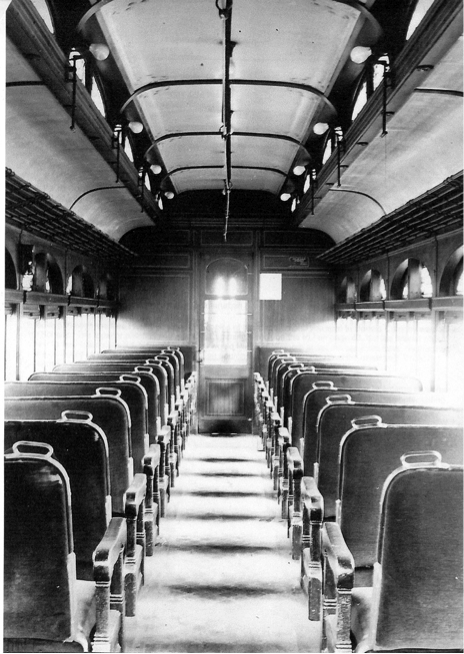
Interior of 1912, Laconia Car Company-built, Portland-Lewiston
Laconia built cars nos. 10, 12, 14, and 16. Wason built Nos. 18, 20, and 22. There are a few minor differences between the Laconia-built interurbans and the Wason-built interurbans. The position of the seat handles on the seat-back and the shape of the handles are two of the slight differences that help to identify which manufacturer built a particular car. This image shows the viewer peering down the aisle towards the number one end of the Arbutus. We know this because the walls on either side of the doorway have no windows, so the doorway leads passengers to the smoking compartment, which is located at the number one end of the interurbans.
Ever seek estimates for a major project at home or for work on your car/truck? What's your first thought when the contractor's opening statement is, "Perhaps you should have a seat first"...? Aaahhh, yes, you recall that feeling. Well, with a major restoration project like we have here with the Narcissus, there are some similar awkward moments of discovery throughout the process. Estimates have begun to come in, for foundry work alone....looking at the $10,000 and up range to make the cast pieces.... yes, I'm sitting down as I type this blog post :)
Today's blog post takes us through the opening segment of the Narcissus Seat Saga...
Even though the Narcissus is in the midst of exterior work, we are looking ahead towards the next phase of the restoration of this beautiful, classic, wooden interurban. One of the major tasks ahead is making all 20 of the 19" by 31" reversible transverse seats (for 40 riders) from scratch. We will also need to make the two 18" by 32" longitudinal seats. They are next to the wall that divides the smoking compartment from the main passenger compartment (for four riders). These seats were all upholstered with green plush. In addition, we will need to build the two 18"-wide, leather-covered longitudinal seats (for 8 riders) that belong in the smoking compartment. In total, the Narcissus will seat 52 riders.
This blog post will be the first in a series that follows the progress of making the 20 "walk-over" seats.
These first three images show details of the seats while in service on the PLI cars between Portland, Maine, and Lewiston, Maine, from 1914 through 1933. The captions will explain some differences between the seats in the Laconia-built cars and the Wason-built cars.


In the image above are wooden armrests and a Laconia-built PLI car. Similar to those on the BRB & L but uses ‘squared posts’ and plain armrests.

Interior of 1912, Portland-Lewiston Interurban No. 16,
Clematis. This image has the viewer peering down the aisle
towards the number two end of the Clematis. We know this
because the adjoining walls, on either side of the doorway
where the conductor/motorman is standing, have windows.
This doorway will lead the passengers to the vestibule and the
exit from the car on the number two end.
Image from Seashore Trolley Museum

Interior of 1912, Wason Manufacturing Company-built,
Portland-Lewiston Interurban, No. 20, Magnolia.
Image from Seashore Trolley Museum
Notice the difference when looking for handles at the corners of the seatbacks. Compared to the images
above, of the Laconia-built seat-backs. This viewer in the image is peering down the aisle toward the number one end of the Magnolia. We know this because the adjoining walls on either side of the doorway have no windows, so the doorway will lead the passenger to the smoking compartment, which is located at the number one end of the interurbans.

The 20 seats in the Narcissus were manufactured by the
Heywood Brothers and Wakefield Company in Wakefield, MA.
This advertisement features an image of a seat that resembles the seats we will be making from scratch for the Narcissus. There are some variations, but many similarities. Compare this seat to the seats in the first two images above. The pedestal outer "leg" seen here is not the style used in the Narcissus. From an ad in The Daily Railway Age, June 22, 1900, posted in Classic Trains Magazine, "Heywood-Wakefield Building"

This seat is not anything like the seats in the Narcissus,
but the pedestal is very similar to the ones used in Narcissus.
From an ad in the Electric Railway Journal, March 16, 1928
From an ad in the Electric Railway Journal, March 16, 1928
posted in Classic Trains Magazine, "Heywood-Wakefield Building"
So, where do you start? First, you take a look at what you have that may have been in the Narcissus originally. The Narcissus came out of service in 1933 from the PLI, and its whereabouts and purpose were a mixed bag of information until Mr. J. Henri Vallee purchased the body in 1939. The Narcissus was already in Sabattus, Maine, by that time, and Mr. Vallee made the Narcissus the family summer camp. There were some seats in the body, and he stored those seats in a shed in the backyard. Those seats made it to Seashore and were in storage. Those seats and others, either, were on the Museum campus in storage or installed in cars, and were examined. One seat back and one seat cushion from the Narcissus were dissected, and other parts assembled that would ultimately make a whole. The metal pieces would need to be taken to a couple of foundries to have estimates. Estimates would include the original cost for the original pattern and then the costs to produce each piece from each pattern.
Several components are used to make the seats from wood or from other materials.
The Mohair Plush is an example.
So, here is a series of images taking us through some of these early steps. Following the list of images will be the initial report by the lead restoration technician for the Narcissus, Donald Curry (slightly edited).
 |
| You make a parts list, write up observations, take measurements, perhaps sketch an image, and take pictures for documentation. PWM |
 |
| Seats may seem very similar on the outside, but the interior components may vary greatly. PWM |
 |
| The Mohair Plush is woven. Similar to how a carpet is made. PWM |
 |
| Mohair Plush. PWM |
 |
| This is the correct handle assembly for the Narcissus. PWM |
 |
| There are many different spring styles, shapes, and diameters of the wire, which may differ. How the springs attach to pieces inside. Catalog all these things and develop a list of parts. PWM |
 |
| You can see to the right the imprint of the original pedestal and the screw hole pattern for mounting the pedestal to the floor. We match up the correct pedestal to the pattern, style, height, etc. The pedestal in this image is not the correct one, by the way :) PWM |
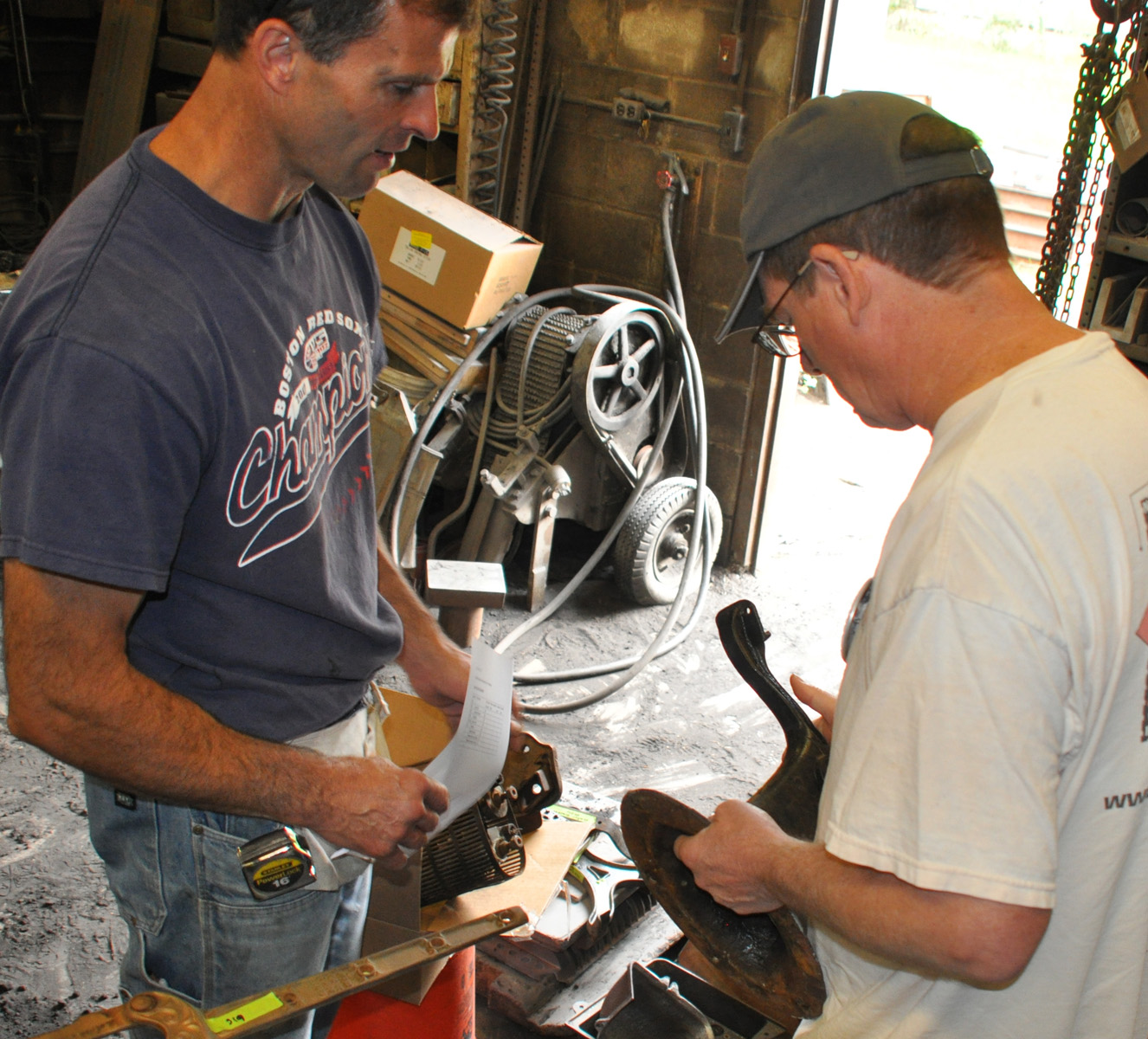 |
| Then it's off to a foundry with the parts so the foundry can access and develop a price to make a pattern, and also to make the individual pieces. This is Mike Blais on the left and Seashore Trolley Museum volunteer Ernie Eaton is on the right. Ernie is holding a correct pedestal for the Narcissus. Image by Donald Curry |
 |
| Detachable seat back-casting DGC |
Other components for the Narcissus will also need to be cast. Samples of those items were also dropped off or sent up via USPS.
 |
| Truss rod bracket DGC |
 |
| Front door step plate - DGC |
Here is the initial report for the Narcissus, Donald Curry (slightly edited).
24 October 2016
To: Those interested in the restoration of PLI Interurban 14, Narcissus
Re: Seating for the Narcissus
From: Donald G. Curry
Restoration Project Manager
All the details we have been able to find of 14’s seating.
Strategy:
Since the seats are a stand-alone phase of the restoration, a small number (2) of finished seats will be used as an example of what we can do. They could even be a remote presence where the body will never go. The foundries are aware of this, and their policy is to produce one of each part before making a complete run. Some items will require patterns, which will make the first piece expensive but, in the long run, may make the job less expensive and of higher quality. Some pieces may not require any pattern, except for the original, as only a minimal one.[1]
Depending on the size and complexity of each component (not necessarily a casting), it may be necessary to purchase the entire quantity. While for others, only what is necessary for the ‘display seats’ will be ok.[2] (We are also considering spreading the word to the trolley/RR ‘industry’ to see if other groups might be interested in joining in.)
We understand that the car body had been stripped of its seating when it was deaccessioned by the PLI or the Vallees when at the Sabbatus site.
Sometime after the replacement house was constructed, while I was there, Mrs. Vallee presented me with several seat components, some covered in mohair green plush (two different shades). She also gave me some white painted trim pieces (probably for the vestibules), which have since been intermingled with the other parts.
We took the seats, believing that they were from the Narcissus. But O. R. Cummings (and possibly someone else) said the ‘seats were from other trolleys in the area’. We have looked at these seats, and it does appear that some were from the Narcissus.
There are two types of seatbacks. One is forest green, with four other backs in a sort of ‘olive’ green.
There are also two types of seat cushions, in similar shades. (Some other seatbacks are in a greener shade and have heavier overall construction, much too big for 14.) At this point, we[3] have examined those components and studied cars with similar seating: BRB & L (?no.)[4], 38, 70, 610, 4175.
While we know the seats were manufactured by Heywood Bros. & Wakefield Co., they could have been made in a myriad of styles. The catalog examples we need to vary, in one way or another, from the three images we have of what must have been in car 14 while in service (or the other 3 Laconia-built cars).
14’s seats had an ornate wooden armrest [5] on the aisle side with the other side screwed against the wall (with a No. 523 seat end) ¾ in wainscoting. (20 seats) The catalog illustrations show a division of the backs into two or three sections. The 3 photos we do have of the PLI Laconia interiors show an undivided back of the walk-over style. The aisle sides are supported by heavy cast-iron pedestals, held to the floor by eight screws in an oval pattern[6]. 14’s seats had one armrest and likely two round footrests[7]. The catalog sheets show some of the seats with detachable backs that slip over the arms of the walkover seats. Initially, we couldn’t tell for certain that style was what was in 14. Some of the seatbacks we got from Mrs. Vallee were detachable, and the patent dates were 7 and 14 February 1901. There are traces on the floor of two longitudinal seats, with a separate pedestal and the end fastened to the No. 2 bulkheads.
What shall we use as our model? Manchester 38 (Laconia 1906) came with a complete set of seats, albeit very worn and dried out. The car was given a major rebuilding about 1965(?), which included reupholstering the seats with genuine mohair.[8] 38 has decorative aisle-side seat end castings and plain ones screwed to the wainscot side. Because the 14’s aisle-side is covered with a decorative wood armrest assembly, the wall-side casting can be reversed into an aisle-side one.
 |
| A close example of 14’s original seating |
 |
| 38’s cross-seat cushion and back. |
The cushions we fabricate for Narcissus will essentially be like this one, but the back will not have the ‘head roll’ division. The upholstery of the back will curve smoothly from the bottom, then be tacked over on the top, and will not be detachable except by removing the four wood screws on each side.
The search made possible styles; the most adaptable seats appear to be the Heywood Wakefield “Wheeler” seat style in Manchester car 38, particularly because we have a complete set. We determined that it could be easily disassembled. Its components are used as patterns (directly). Or patterns from which replacements could be cast[9]. However, as we study the photos of the interior of a Laconia-built car with those from Mrs. Vallee, we have found that the seatbacks were ‘quick detachable’ style. At this point, we are now studying the long, screwed-on, non-detachable arms on No. 38’s seats. They are more delicate and more attractive than the detachable style, in which the arms are ‘stubby’ and hidden by the hollow seat anchors. Because we are only at the estimating stage, we can get some idea of their cost. Looking very carefully at the illustration on p. 5, you can see the difference.
We also studied 4175’s seatbacks. They were refabricated from wider Illinois Central RR seats fitted only with arms. But not the detachable sockets on them originally. Looking at them with ‘fresh eyes, the sides look like something is missing; the wider socket would have filled the space better.
We contacted Auburn Stove Foundry (Mike Blais – New Gloucester) and Enterprise Foundry (Leo Ferland) in Lewiston. We disassembled two cross-seats and, on 20 October, took one set of castings to each of the two foundries for cost estimates. We told them that both would be asked to submit their estimates by our 1 November deadline. We were given a very interesting tour of Enterprise and had useful discussions with both.
 |
| 38’s – 521 Rocker assembly, back arm, links, hooks, and tubing, 522 seat end (not to be used--523 use instead) |
The “Wheeler” seat ends (523) will not be used. Instead, the one from the other end (wall side) will be duplicated. And then reversed the wood armrest covering the aisle side. The bronze grab handle on the back will be different from the angled one, using a Brill seat as a pattern.
 |
| Decorative seat end (523) – we will not use this style. |
 |
| Similar to the Heywood Brothers seats |
 |
| Heyward Bros and Wakefield seat Ad |

Old style Boston, Revere Beach & Lynn RR
seat with wood armrest, similar in style to those
in Narcissus. Use as an example. Rosettes?
How many seats were there? Initially, we counted 9 seatbacks on each side. But O. R. Cummings’ book says there are 10, plus the two longitudinal ones on the no. 2-end. Finally, we carefully cleared and swept the floor and found the requisite number of oval-shaped marks and screw holes opposite each of the 10 double sashes in the passenger compartment.
There appears to be a cushion, with square corners fixed to the bulkhead. We got a pair from Vallee’s, and they appear to be the right size, but there are no marks in the panels to show anything was ever fastened there.
The seat at the bulkhead appears to be located with the ‘point’ of the seat pedestal about 12 in. away. The proposed seat assemblies will fit very well in that space and probably never were ‘walked over’; only facing backward toward the no. 2-end.
But then, what about the extra wall cushions? They’re in excellent condition (except for the mohair, which has some moth damage).
Based on this, we revised our original estimate of castings required to what appears in this report.
|


 |
| Grab-handle with extended half-oval brass ends and socket for the detachable back. Note the rectangular hole for the arm. This is close to what was used in 14. The angled handle is what is in 38. |
 |
Two different sizes of detachable back sockets.
The upper one would work for 14. Note the upper,
more olive green mohair. Is that Pullman Green?
The lower green is Illinois Central green.
|
 |
| Above is a correct handle for 14. It is from STM Brill seats, of which there are about six in the “Butler” garage on the STM campus. |
 |
| The dark area ahead of the seat closest to the bulkhead could be the ‘mysterious’ cushion to be mounted on the bulkhead. There are two clips on the ones we have (from Mrs. Vallee), but no evidence of screw holes. There is another small clip on one side of the sample. |
 |
| Back support arms, links, hooks, and cross-tubes |

|
The arms in the image above are connected to the links by loose rivets, enabling them to move when the seat is "walked over". These can be drilled out. (Note that the heads are non-standard and may have to be turned on a lathe.) The hooks and links come together (two pairs per seat). It looks as if they are pressed or shrunk onto the connecting tubes, which were turned down on the ends to fit the bearing ‘cups’ on the seat ends. It looks like they can be heated and removed. There is no evidence of a pin holding them. |
Remnants of original seating: We have examined the remnants (evidence) of the original seating in Narcissus’ passenger compartment, still remaining:
· Impressions on the No. 2 bulkheads - 2
· In the impressions on the side wainscot panel seats
· Impressions on the floor in two oval configurations—one for each of the 20 cross seats in the passenger compartment and one in each of the two corner seats.
· Wall cushions (2) on the passenger side of the smoker bulkhead-still looking for traces. There may not be any.
The seats in car 38 are the closest we have that can be combined and modified to work with various components to create reasonable facsimiles for 14. Upholstered pieces also provide evidence of original techniques. They can be derived from ‘samples’ that came with Narcissus, which still may not have been original.
21 October 2016
Portland-Lewiston Interurban Car 14 – Narcissus
Cast Iron Seat Components (Revised after recounting the seats)
Casting
No.
|
Part name
|
No. Pieces
Required
|
Pattern required?
Price
|
Individual
price
|
Quantity
price
|
523
|
Seat End
|
44
|
|||
529
|
Footrest Bracket
|
40
|
|||
525
|
Pedestal
|
22
|
|||
519
|
Back arm – “A”
|
22
|
|||
520
|
Back arm – “B”
|
22
|
|||
519
|
Links & hooks –A
|
22
|
|||
520
|
Links & hooks – B
|
22
|
|||
521
|
Rockers
|
44
|
|||
Heater Bracket
|
44
|
||||
Heater end-round holes
|
22
|
||||
Heater end-square holes
|
22
|
||||
Proceeding from here:
Parts needed: Crosswise and longitudinal (totals 20 + 2)
Seat base and reversing mechanisms
“Colonial” armrest assemblies (wood) (20)
Wall side end casting (no. 523) (44) Use for both wall and aisle sides
Rocker casting (no. 529) (40)
Rocking casting ‘hooks’, links, and rods-Left & Right.
Back support arm castings (links) (probably left & rt.?)
Back support arms (No. 519 & 520)(left & right?)
Heater end castings-round holes (20)
Heater end castings-square holes (20)
Heater mounting bracket (40)
Pedestal casting (no. 525) (22) definitely needs a pattern and core
Footrest bracket (no. 529) (22)
Diamond-shaped side supports (ash) (44)
Possible isolated supporting bracket from Sabbatus-where is it?
Seat cushions (20 + 2 pcs.)
Wood frames (ash)
Coil springs (cone shape) (0.125 wire) 300 pcs.
Corrugated spring supports (0.015 spring steel)
Spring steel reinforcement strips (1 x 12 in.)
Horsehair or cotton batting
Burlap strips
Canvas under
Mohair upholstery
Perforated steel pin locating strips (44 pcs)
Seat backs (no ‘head roll’ for car 14) (22 pcs.)
Seatback handle (40) Bronze
Top protective strip
Wood frame
Coil springs (hourglass shape) (0.080 wire) (300 pcs.)
Horsehair padding
Cotton backing
Canvas under
Mohair upholstery
Non-reversing (2 pcs.) special back framing (may be able to use new cross seats, if we use them.
Major components required for seat restoration:
Iron castings –
Brass seat back handles
Wood (ash for all) air-dried
Springs (contract)
Coil
0.125
0.080
Significant steps in the fabrication
Machining castings
Wood frames – design, obtain ash for framing
Mill ash and cut what is needed for full sets
Springs – assemble
Install assemblies in framing
Upholstering - Include backing and padding
Assemble
Smoker seats (Because these are very different, we will treat them separately at some time in the future.)
Bench type longitudinal with leather upholstery and fixed back (2 pcs. 6 ft.)
Probably supported by wood posts?
May have lifted up
Coil springs, padding, etc.
Under-seat heaters
We removed and partially disassembled two seat assemblies because it was convenient to take them to the foundry. They are in good condition. But with poor auxiliary wiring, we feared there could be a fire because they were not connected. We will still have the information needed to have new ones cast.
[1] The shrinkage of cast iron is 1/8 in./ft. This may not be a significant number for most pieces.
[2] Examples – specially tinted mohair upholstery, custom coil springs, corrugated spring steel plates
[3] Ernie Eaton & Donald Curry
[4] Some of the B R B & L cars ended up on the East Broad Top RR. I contacted Joel Salomon, who’s active in the adjacent Railways to Yesteryear, asking for the probable date to confirm the seats.
[6] Many of the screw holes remain on the floor. Also, enough visible outlines of the oval-shaped pedestals to establish their locations.
[8] When 396 was being restored by Otto Preminger for The Cardinal, a large supply of mohair upholstery was purchased from the Maine Central RR (from their remaining passenger equipment supply). So, 38 was reupholstered, and there remains a significant role that is in store in my attic (after being rescued from the Bunkhouse attic). A lot of the work by Mae Minnich, including upholstering the half-oval seatback trim. We had no experience reupholstering seats. So we used what seemed to be the best available, foam rubber for padding. It is too soft, so the mohair is somewhat loose.
[9] Fortunately, the wiring and reassembling of 38 were still underway, so the car would not be used for service before next spring anyway.
~~~~~~~~~~~~~~~
We continue the restoration work on the 1912 Narcissus, the only surviving high-speed, luxury interurban coach of the Portland-Lewiston Interurban.
Click Here: Narcissus Restoration-Related Posts
More than a century old, the stately "Elegant Ride," Narcissus, is a gem. This shimmering precious stone of Maine transportation history is brilliantly resplendent as it emanates so many elements of history, including time, places, people, and events, that it was coupled to, that when just a smattering of its seemingly innumerable stories are shared, the contents captivate, fascinate, and then generate interest to learn more 🙋. The majestic Narcissus is listed in the National Register of Historic Places.
Please consider joining the epic journey to complete the Narcissus Project by donating today!
Click Here: Donation Options
The restoration of this majestic icon of Maine's electric railway history is but one in a series of captivating stories containing an abundance of incredible coalition narratives.
Click Here: History-Related Posts - Narcissus and Portland-Lewiston Interurban
The Narcissus is featured in the national Gold Award-winning novel, Teddy Roosevelt, Millie, and the Elegant Ride. The "Elegant Ride" is the Narcissus. Theodore Roosevelt was a passenger on the Narcissus on August 18, 1914, between Lewiston and Portland, Maine, while campaigning for the Progressive Party candidates.
Click Here: Bookstores and Businesses promoting the Narcissus Project

Independent book publisher Phil Morse, holding
Gold Book Award Winner plaque for
Middle Reader category for The Eric
Hoffer Book Award. Congratulations to
award-winning Maine author,
Jean M. Flahive
