Showing posts with label Portsmouth Kittery and York Street Railway. Show all posts

Saturday, January 22, 2022

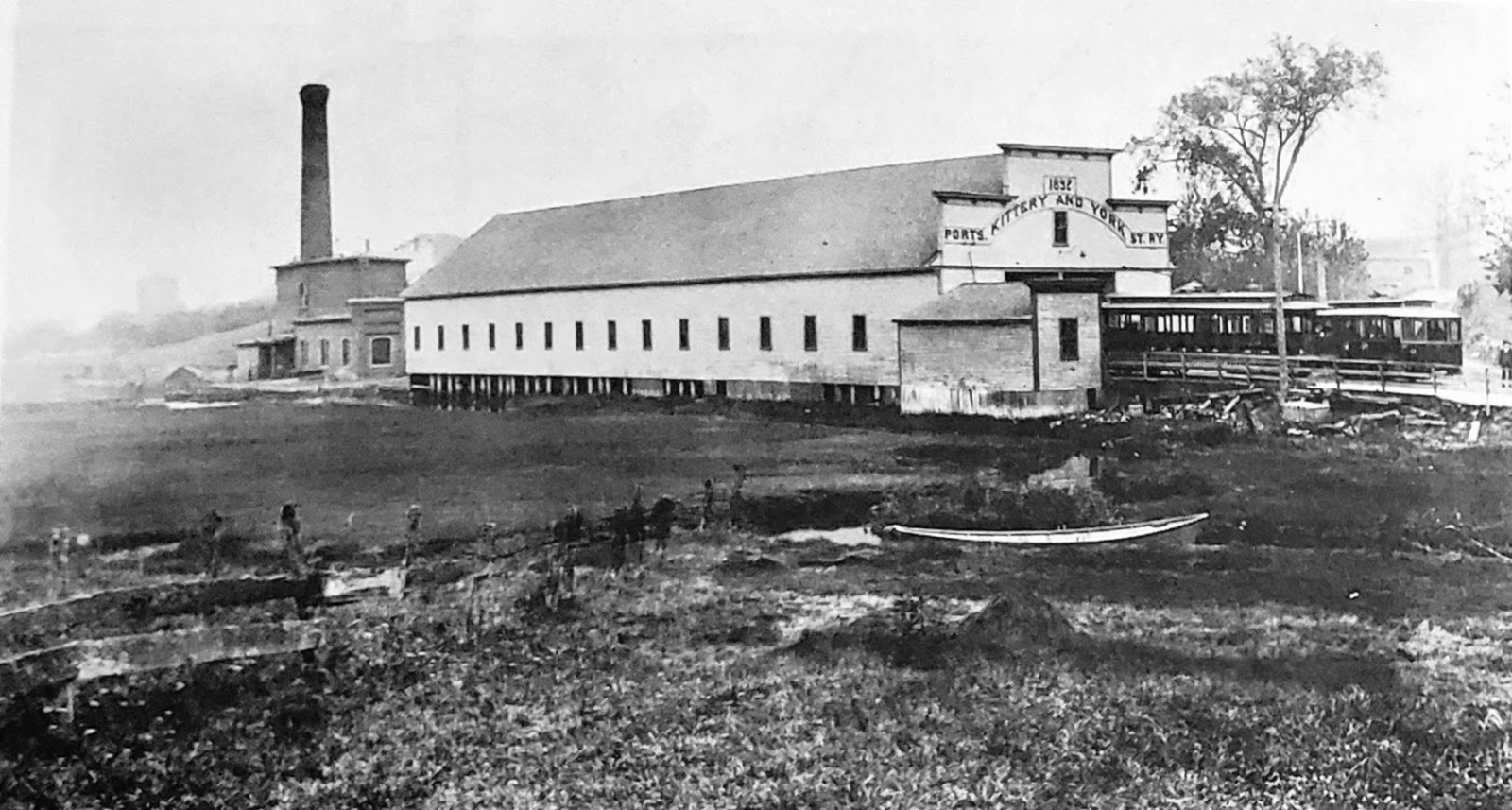
Portsmouth, Kittery & York Street Railway Carhouse and Steam Plant

The Kittery Point Carhouse shortly after the opening of
Portsmouth, Kittery, & York Street Railway 1897
O. R. Cummings Collection 2009_2_9_102

Though the Narcissus1912 Blog features the historical background and restoration work of the National Register of Historic Places member, the high-speed, luxury, 1912 Portland-Lewiston Interurban, No. 14, Narcissus, the blog does release other posts that relate to Maine electric railways, Theodore Roosevelt-related connections with Maine, and posts about the Seashore Trolley Museum in Kennebunkport, Maine.

This blog post features the Portsmouth, Kittery & York Street Railway's carhouse and power plant at Kittery Point, Maine. Summary/images from the book, "Atlantic Shore Line Railway" by O. R. Cummings, presented as Transportation Volume 4 by the Connecticut Electric Railway and the National Railway Historical Society-Connecticut Chapter - June 1950, re-issued January 1957. And text/images are also taken from an O. R. Cummings book, "Trolleys To York Beach: The Portsmouth Dover & York Street Railway", Bulletin No. 1, New England Electric Historical Society, December 30, 1964.  Additional images will be credited. Details on how the local community members felt about the introduction and approved construction of the new electric railway. Find a copy of John D. Bardwell's compilation of news events published in the local newspaper, "The Diary of the Portsmouth, Kittery, and York Electric Railroad," released in 1986 through the Portsmouth Marine Society in Portsmouth, NH.

Additional blog posts on related electric railways can be found through the links below:
  • 2.23.2020 - Maine Bicentennial Series - Portsmouth, Kittery & York St. Rwy 1897-1903
  • 3.11.2020 - Maine Bicentennial Series - Portsmouth, Dover & York St Rwy 1903-1906
  • 3.12.2020 - Maine Bicentennial Series - Atlantic Shore Line Railway 1900-1910
  • 3.14.2020 - Maine Bicentennial Series - Atlantic Shore Railway 1911-1923
  • 3.15.2020 - Maine Bicentennial Series - York Utilities Company 1923-1949

The first carhouse erected for the Portsmouth, Kittery, & York Street Railway in 1897 was located near Hutchins' Corner (at the intersection of Pepperall and Chauncey Creek Roads) in Kittery Point. The facility was a building 45 feet by 175 feet, wood-frame, erected on piles over a tidewater swamp. Two lead-in tracks were connected through a transfer table to the four tracks inside the rambling structure, which had a capacity of twelve cars. Some repair facilities were provided inside as well. 

The brick power station of the Portsmouth, Kittery, & York Street Railway was located directly behind the Kittery Point carhouse. This power plant would generate the direct-current electricity that the various electric railway vehicles would utilize for operating the fleet in the early years. The original equipment included three Dillon 125-hp vertical boilers and two Ball and Wood tandem compound engines, one of 250-hp and one of 150-hp, belted to General Electric 550-volt direct-current generators of 225 and 110 kilowatts, respectively.

Enlargement of the Kittery Point power station was undertaken between 1901 and 1902, with two Hodge 200-hp boilers, an Erie City 400-hp, four-valve, 21-inch x 21-inch engine, and a General Electric with 225 kilowatt, 550-volt direct-current generator being installed. 

The building was an active operating center until trolley service in Kittery and Kittery Point ended; it was then razed. As early as 1909, fears were expressed that the wood-frame structure would be blown down in any severe windstorm, but such a calamity did not occur. An attempt to burn the building on August 16, 1908, did not succeed. The carhouse was razed in 1926, while the powerplant remained several years thereafter.

The power station was situated directly behind the carhouse.
Coal for the boilers was hauled from Cutts Wharf near Kittery
Point bridge. Original equipment for the plant in 1897 included
three boilers, two engines, and two generators; two more boilers,
another engine, and a third generator were added in 1900. 
The by-then-obsolete station was placed on reserve status
 1915, after arrangements were made to purchase power from
Rockingham County Light and Power of Portsmouth.
Image from the collection of H. T. Moulton within 
O. R. Cummings Collection 2009_2_9_104 circa 1910

Coal for the power station reportedly was first landed from barges at the rear of the building, but later was received at the wharf adjacent to the Kittery Point bridge and carted to the plant. There was a coal pocket at the wharf, and later a siding was provided so that the fuel could be hauled to the power plant via rail.

Outside storage of soft coal can be seen as a pile on
the right in this photo above. Soft coal was the fuel for the
steam boilers. This pile of coal is on the east side
of the power plant. 
O. R. Cummings Collection 2009_2_9_107

February 1904 insurance company drawing of the steam
power station plant and the carhouse is seen off of
Pepperell Road in Kittery Point. Thanks to Ralph Littlefield
for pinpointing the current address to the entrance of the
former carhouse/power plant. 150 Pepperell Road,
the current site of the Kittery Point Citgo Gas Station.
O. R. Cummings Collection 2009_2_9_108

The rail that provided access to the power plant for
delivery of coal circa 1915
O. R. Cummings Collection 2009_2_9_105

circa 1906
O. R. Cummings Collection 2009_2_9_106

Kittery Point bridges across Spruce Creek.
York Harbor & Beach Railroad trestle and coal wharf,
the Portsmouth, Kittery, & York Street Railway
received fuel for its power plant.1898 view.
O. R. Cummings Collection 2009_2_8_50

Work car "B" of the Portsmouth, Kittery, & York Street Railway
was photographed at the Kittery Point
carhouse with many employees, c 1897.  These two tracks
led to a transfer table that accessed four tracks inside.
O. R. Cummings Collection 2009_2_7_105

The interior of the Kittery Point carhouse, where
the two entrance tracks led to the transfer table, seen here,
allowed access to four tracks inside the carhouse.
 c 1905 O. R. Cummings Collection 2009_2_9_103
~~~~~~~~~~~~~~~
Click Here: For the list of links to Theodore Roosevelt Maine Heritage Trail Posts in Easy Order to View

We continue the restoration work on the 1912 Narcissus, the only surviving high-speed, luxury interurban coach of the Portland-Lewiston Interurban. 

Click Here: Narcissus Restoration-Related Posts

Being more than a century old, the stately, "Elegant Ride," Narcissus, is a gem.  This shimmering precious stone of Maine transportation history is brilliantly resplendent as it emanates so many elements of history, including time, places, people, and events, that it was coupled to, that when just a smattering of its seemingly innumerable stories are shared, the contents first captivates, fascinates, then generates interest to learn more 🙋. The majestic Narcissus is listed in the National Register of Historic Places.

Please consider joining the epic journey to complete the Narcissus Project by making a donation today!

Click Here: Donation Options

The restoration of this majestic icon of Maine's electric railway history is but one in a series of captivating stories containing an abundance of incredible coalition of narratives.

Click Here: History-Related Posts - Narcissus and Portland-Lewiston Interurban

     The Narcissus is featured in the national Gold Award-winning novel, Teddy Roosevelt, Millie, and the Elegant Ride. The "Elegant Ride" is the Narcissus. Theodore Roosevelt was a passenger on the Narcissus on August 18, 1914, between Lewiston and Portland, Maine, while campaigning for the Progressive Party candidates.

Click Here: Bookstores and Businesses promoting the Narcissus Project

Independent book publisher, Phil Morse, holding
Gold Book Award Winner plaque for
 Middle Reader category for The Eric
Hoffer Book Award. Congratulations to
award-winning Maine author,
Jean M. Flahive

Sunday, February 23, 2020

Maine Bicentennial Series - Portsmouth, Kittery & York Street Railway - 1897-1903

Later converted to a line car (work car), Portsmouth,
Kittery and York Street Railway (PK&Y) No. 4 is shown
here on Government Street at Kittery Foreside in 1897.
O. R. Cummings Collection

     Here is the newest release in the Maine Bicentennial series of electric railways in Maine. This blog post features the Portsmouth, Kittery & York Street Railway summary/images from the book, "Atlantic Shore Line Railway" by O. R. Cummings, presented as Transportation Volume 4 by the Connecticut Electric Railway and the National Railway Historical Society-Connecticut Chapter - June 1950, Re-issued January 1957. And text/images are also taken from an O. R. Cummings book, "Trolleys To York Beach: The Portsmouth Dover & York Street Railway", Bulletin No. 1, New England Electric Historical Society, December 30, 1964. Some text/images may be from the NEERHS 2015 publication, "The Illustrated Atlas of Maine's Street & Electric Railways 1863-1946. Additional images will be credited.

To see the online version of the 1957 book, Atlantic Shore Line Railway at Bangor Public Library, click here 

Click Here for the post: Ninety Communities in Maine with Electric Railway Service!
Click Here for the post: 57 Million Passengers Carried on Electric Railways in Maine in 1915!
Click Here for the post: Maine Bicentennial series - History of the Portland Railroad 1860-1941
Click Here for the post: Maine Bicentennial series - History of the Calais Street Railway 1894-1929
Click Here for the post: Maine Bicentennial series - History of Aroostook Valley Railroad 1909-1946
Click Here for the post: Maine Bicentennial series - Fryeburg Horse Railroad 1887-1913
Click Here for the post: Maine Bicentennial series - The Norway and Paris Street Railway 1894-1918
Click Here for the post: Maine Bicentennial series - Skowhegan & Norridgewock Railway 1894-1903
Click Here for the post: Maine Bicentennial series - Benton and Fairfield Railway 1898-1928
Click Here for the post: Maine Bicentennial series - The Somerset Traction Company 1895-1928
Click Here for the post: Maine Bicentennial series - The Fairfield and Shawmut Railway 1903-1927
Click Here for the post: Maine Bicentennial series - Waterville, Fairfield, & Oakland Rwy 1887-1937
Click Here for the post: Maine Bicentennial series - Trolleys to Augusta, Maine 1889-1932
Click Here for the post: Maine Bicentennial series - Rockland, South Thomaston, & St. George Rwy
Click Here for the post: Maine Bicentennial series - Biddeford and Saco Railroad Co. 1888-1939
Click Here for the post: Maine Bicentennial series - Mousam River Railroad - 1892-1899
Click Here for the post: Maine Bicentennial series - Sanford & Cape Porpoise Railway 1899-1904
Click Here for the post: Maine Bicentennial series - Bangor Street Railway 1889-1905
Click Here for the post: Maine Bicentennial series - Bangor Railway & Electric Company 1905-1925
Click Here for the post: Maine Bicentennial series - Bangor, Orono & Old Town Railway 1895-1905
Click Here for the post: Maine Bicentennial series - Bangor, Hampden & Winterport Rwy 1896-1905
Click Here for the post: Maine Bicentennial series - Penobscot Central Railway 1898-1906
Click Here for the post: Maine Bicentennial series - Bangor Hydro-Electric Company 1925-1945
Click Here for the post: Maine Bicentennial series - Lewiston, Brunswick & Bath St Rwy 1898-1907
Click Here for the post: Maine Bicentennial series - Lewiston, Augusta & Waterville St Rwy 1907-19
Click Here for the post: Maine Bicentennial series - Androscoggin & Kennebec Railway 1919-1941
Click Here for the post: Maine Bicentennial series - Portland & Brunswick Street Railway 1902-1911
Click Here for the post: Maine Bicentennial series - Auburn & Turner Railroad 1905-1928
Click Here for the post: Maine Bicentennial series - Auburn, Mechanic Falls & NorwayStRwy1902-7
Click Here for the post: Maine Bicentennial series - Portsmouth, Dover & York St Rwy 1903-1906
Click Here for the post: Maine Bicentennial series - Atlantic Shore Line Railway 1900-1910
Click Here for the post: Maine Bicentennial series - Atlantic Shore Railway 1911-1923
Click Here for the post: Maine Bicentennial series - York Utilities Company 1923-1949
Click Here for the post: Maine Bicentennial series - Portland-Lewiston Interurban - It Begins 1914
Click Here for the post: Maine Bicentennial series - Portland-Lewiston Interurban - The End 1933

Trestle of the Portsmouth, Kittery & York Street Railway
over the York Harbor & Beach Railroad at Seabury in York, ME.
The railway vehicle on the trestle is the single-truck flat car,
"B", which was built in 1898. O. R. Cummings Collection

Portsmouth, Kittery, and York Street Railway
     At the southeasterly corner of York County, the Kittery & York Electric Railroad was incorporated on March 27, 1893, to build from Kittery through Kittery Point to York Village, York Harbor, and York Beach, and to operate a ferry across the Piscataqua River between Kittery and Portsmouth, New Hampshire. On March 19, 1895, the charter was extended two years, and late in 1896, Amos F. Gerald of Fairfield, ME, was one of Maine's best-known street railway promoters. He acquired control, and on February 2, 1897, another two-year extension was granted, along with the name of the company being changed to the Portsmouth, Kittery & York Street Railway.

     Construction began in the spring of 1897, the route extending from Badger's Island, Kittery, where a ferry landing and waiting station were built, over locations named in the Kittery & York Electric Railroad's charter, a distance of 15.1 miles. Commenting on the PK&Y construction in 1897, the State Railroad Commissioners' report said of it, in part: "This is the longest electric railroad construction in Maine during the year."

Map by Charles D. Heseltine in the 2015 publication, "The
Illustrated Atlas of Maine's Street & Electric Railways 1863-1946.

     The first ferry was purchased second-hand in 1897. The used ferry was renamed the "New March". It turned out to be unsatisfactory, and a small steamer, the "Mystic", was leased and later purchased.  

     War hysteria gripped the nation after the sinking of the battleship "Maine" in Havana Harbor in Cuba on February 15, 1898, and on March 15, the PK&Y found it necessary to deny rumors that the "New March" would be converted into an armored cruiser for the defense of Portsmouth Harbor.

     The "New March" was destroyed by fire in 1899 and was replaced by the "Kittery" in 1900.

Crossing the Piscataqua River between Portsmouth, NH, and
Badger's Island, Kittery, ME, is the double-ended ferry,
"Kittery" was built at Kennebunkport, ME, in 1900.
In the 2015 book by NEERHS, "The Illustrated Atlas of
Maine's Street & Electric Railways 1863-1946

Water-side view of the terminal at Badger's Island, Kittery, ME,
shortly after the arrival of the new ferry, "Kittery" in 1900.
O. R. Cummings Collection

The station building and covered walkway, as well as wagon
lane, appear in this view of Badger's Island landing in Kittery.
O. R. Cummings Collection

After crossing the Piscataqua River, passengers disembarked
from the ferry and boarded a trolley car at this waiting station
on Badger's Island. This depot had a waiting room and a
refreshment stand. Postcard from O. R. Cummings
Collection in the 2015 book by the NEERHS. "The Illustrated
Atlas of Maine's Street & Electric Railways 1863-1946

This drawing is of the Ferry Terminal at Badger's
Island. The tracks and terminal in the sketch can
be matched to the color postcard above. The trolleys serving York Beach used the shorter track siding next to the main track that was used by the trolleys that served Dover, NH.
Sketch from O. R Cummings' 1964 publication, Trolleys To York Beach: The Portsmouth Dover & York Railway.

Ceres Street ferry landing in Portsmouth, NH, seen here as
the Atlantic Shore Line Railway (ASLRy) Ferry Landing,
originally was built by the Portsmouth, Kittery & York
Electric Railway (PK&Y) in 1897. The PK&Y would be
absorbed by the Portsmouth, Dover & York Street Railway
(PD&Y), starting in 1903 and in 1906, the PD&Y merged with and
lost its identity to the ASLRy. O. R. Cummings Collection

     The road, as a whole, was a very crooked one, both horizontally and vertically, and because of its following the shore, some 13 pile trestles totaling nearly 1.3 miles in length were required to cross the numerous creeks, coves, and harbors along the route. Ten waiting stations of wood frame construction were erected at different points along the line in 1897. All being of tasteful design, they resembled the summer houses or gazebos popular at the turn of the century, and most were open to the breezes during the summer months, being enclosed with shutters or windows during the other seasons.

     A wooden frame carhouse and a brick power station were built at Kittery Point, with another car barn at York Beach. Rolling stock of four single-truck closed cars, two 10-bench, 4-wheel opens, and seven 14-bench, double-truck opens was purchased from the Briggs Carriage Company in Newburyport, MA.

The rambling Kittery Point carhouse was built by the  PK&Y
in 1897. Located near Hutchins' Corner (at the intersection
of Pepperell and Chauncey Creek Roads), 45 feet by
175 feet, and erected on piles over a tidewater swamp. It had a
capacity of 12 cars and included some repair facilities.
The power station is at the rear. O. R. Cummings Coll.

A drawing showing the layout of the PK&Y carhouse.
O. R. Cummings Collection

Click Here: for the P,K&Y St.Rwy Powerhouse and car barn


     Operations began on August 12, 1897, when the first car traversed the entire line. However, until the 27th of that month, only limited service was given, with two cars running over the 4 miles of line between Badger's Island and the Kittery Point carhouse. Regular service to York Village commenced on October 6th, and to York Harbor and York Beach on June 30th of 1898.

PK&Y No. 4 near the intersection of Chauncey Creek and
Tenney Hill Roads, Kittery Point, in 1897.
O. R. Cummings Collection

One of the original Briggs Carriage Company (Amesbury,
MA), 14-bench open cars of the Portsmouth, Kittery & York
Street Railway in Kittery, Maine. Here you see the typical
side-of-road construction and winding track. When these
cars were first in use, they bore no numbers. Image
from Howard T. Moulton within the O. R. Cummings Coll.


Turning from New March Street into Government Street,
Kittery, one of seven 14-bench open cars purchased in 1897
by the PK&Y from the Briggs Carriage Company,
Newburyport, MA. O. R. Cummings Collection

Trolley car crossing Locke's Cove trestle, near what later
became the main entrance to Portsmouth Naval Shipyard,
Kittery, Maine. O. R. Cummings Collection


Crossing Calls' trestle between Kittery Point and Cutt's
Island en route to York Beach. O. R. Cummings Collection

The longest trestle between Kittery and York was across
Brave Boat Harbor. The view is taken from Kittery's end of the span.
O. R. Cummings Collection

The very first pile, drawbridge in America, Sewall's Bridge,
across the York River in York, was built in 1761. It had to be
strengthened to permit the use of electric cars.
O. R. Cummings Collection

Negotiating the sharp curve at The Willows, York Beach.
O. R. Cummings Collection

An enthusiastic crowd greets the first trolley to York Beach
on the afternoon of August 27, 1897
O. R. Cummings Collection

     Late in 1899, the railway purchased St. Aspinquid Park, a pleasure resort on the north end of York Beach, near the mouth of the Cape Neddick River. The park contained a casino, restaurant, and menagerie and was attractively landscaped with walks, carriage drives, and rustic arbors. On June 27, 1900, the PK&Y opened a short extension from its original terminus at York Beach northerly to St. Aspinquid Park, a distance of .43 mile, and installed a 220-cell storage battery at York Beach carbarn.

 
Kittery Point Bridge across Spruce Creek, York Harbor &
Beach Railroad trestle and coal wharf, where the PK&Y
received fuel for its power plant, appear in this 1898 view.
O. R. Cummings Collection

     The Portsmouth, Kittery & York Street Railway was one of the first street railways in New England to operate a railway post office car, being given a 4-year contract in 1897 to carry the mail between Portsmouth and York Harbor.

Original mail car "A" of the PK&Y at York Beach, circa 1899.
O. R. Cummings Collection

     During the summer of 1901, Maine Governor John F. Hill attempted to secure the necessary charters to construct an electric railway from York Center through his native town of Eliot to the New Hampshire state line at the Eliot bridge across the Salmon Falls River, and over the bridge to Franklin Square in Dover. In pursuance of that purpose, in 1902, he organized the Berwick, Eliot & York Street Railway in Maine and the Dover & Eliot Street Railway in New Hampshire.

     Governor Hill acquired a large interest in the Portsmouth, Kittery & York Street Railway. In 1903, the Berwick, Eliot & York Street Railway was given additional powers by the state legislature, including permission to purchase or lease the Portsmouth, Kittery & York Street Railway, and other local railways. Subsequently, the Berwick, Eliot & York Street Railway changed its name to the Portsmouth, Dover & York Street Railway (PD&Y), and on November 1, 1903, the PD&Y took over the Portsmouth, Kittery & York Street Railway. Though "officially" still an operating railway entity within the corporate structure of the PD&Y until 1917, the merger truly ended the PK&Y.

     The total cost of the Portsmouth, Kittery & York Street Railway as of June 30, 1903, was $511,837, covered in part by $221,700 in common capital stock (2,217 shares at $100 par) and $200,000 in 6 percent 20-year gold bonds, issued as of March 1, 1897, and maturing on March 1, 1917. There were 108 stockholders, 28 of whom were Maine residents, with a total of 706 shares.
~~~~~~~~~~~~~~~
Click Here: For the list of links to Theodore Roosevelt Maine Heritage Trail Posts in Easy Order to View

We continue the restoration work on the 1912 Narcissus, the only surviving high-speed, luxury interurban coach of the Portland-Lewiston Interurban. 

Click Here: Narcissus Restoration-Related Posts

Being more than a century old, the stately, "Elegant Ride," Narcissus, is a gem.  This shimmering precious stone of Maine transportation history is brilliantly resplendent as it emanates so many elements of history, including time, places, people, and events, that it was coupled to, that when just a smattering of its seemingly innumerable stories are shared, the contents first captivates, fascinates, then generates interest to learn more 🙋. The majestic Narcissus is listed in the National Register of Historic Places.

Please consider joining the epic journey to complete the Narcissus Project by making a donation today!

Click Here: Donation Options

The restoration of this majestic icon of Maine's electric railway history is but one in a series of captivating stories containing an abundance of incredible coalition of narratives.

Click Here: History-Related Posts - Narcissus and Portland-Lewiston Interurban

     The Narcissus is featured in the national Gold Award-winning novel, Teddy Roosevelt, Millie, and the Elegant Ride. The "Elegant Ride" is the Narcissus. Theodore Roosevelt was a passenger on the Narcissus on August 18, 1914, between Lewiston and Portland, Maine, while campaigning for the Progressive Party candidates.

Click Here: Bookstores and Businesses promoting the Narcissus Project

Independent book publisher, Phil Morse, holding
the Gold Book Award Winner plaque for
 Middle Reader category for The Eric
Hoffer Book Award. Congratulations to
award-winning Maine author,
Jean M. Flahive