2024 is the 85th Anniversary year of the founding of what we know as the Seashore Trolley Museum in Kennebunkport, Maine. Today, I was looking through some of Ed Dooks' transcripts of his interviews with some of the early members. One interview was done in 1988 as Ed collected stories from John Amlaw and Henry Brainerd.
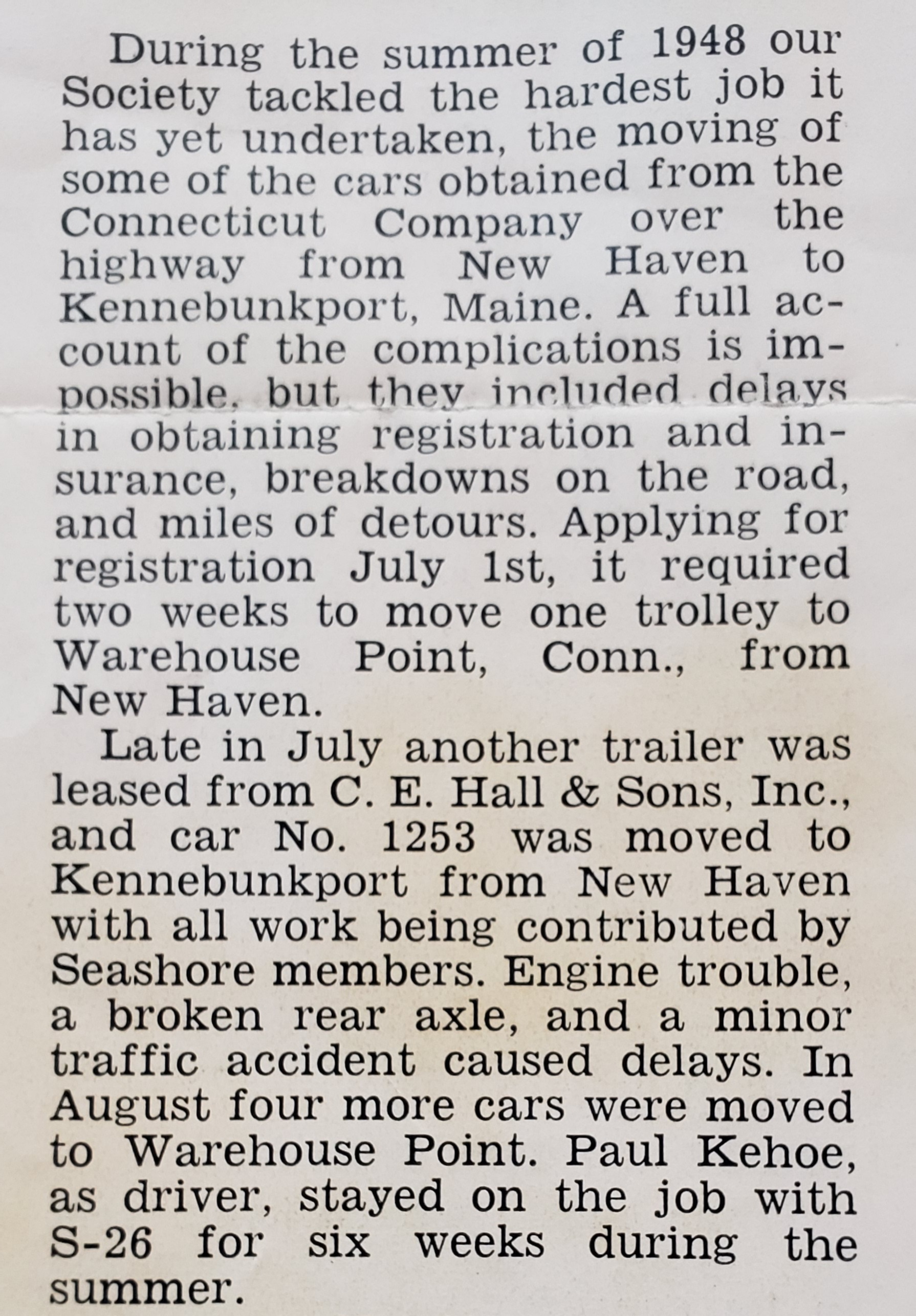
The topic was about acquiring the Connecticut Company open cars in the late 1940s. One of those open cars was No. 1253. Sadly, shortly after arriving at Seashore, 1253 caught on fire and was badly damaged. In the 1948 Annual Report, a paragraph or two talks about the acquisition and transportation.
John Amlaw and Henry Brainerd mention a little more about 1253 in their interview.
Brainerd: "Well, maybe it was '47 that was the last year they ran. I guess '48 was when we got them. That is, they were still there in the barn until spring, and we got 4 of them, one of which was 1253 that caught on fire, mysteriously."
"The best we could figure was the cardboard carton with a big glass headlight lens broke open from the rain and the weather, and acted as a burning glass, and the car was burned beyond the point of salvage. Well, we thought so then. Today, I think we'd know how to rebuild it..."
Amlaw: "We did go through a couple of side roads with it, and when we did, there was no room for anybody coming the other way. Fortunately, we didn't meet anyone because we only went down a short road on a detour, probably 2 miles long. But we backed that trailer into James Street Carhouse in New Haven, and operator Hamilton, who's the one we usually ask for, came out. He looked at it and said, "You'll never do it." So we backed the trailer in. Hooked up the rails. He said, "Well, if you're going to try it, I'll be willing to try it for you." So, he got into the car and very carefully ran it up the ramp and onto the trailer while we watched from both sides. He got on top of the trailer and went forward as far as it would go until the front truck touched the gooseneck of the trailer, looked down, and said, "I knew you could do it."
"So, this was the point at which we fastened the car down and brought it up to Seashore. One of the things that amused me was that in this short detour, I was mentioning, we stopped to let an automobile get by. We had to come to a dead stop so that he could very carefully maneuver the automobile by the trailer in the other direction. Now, there were something like 30 cows in a field, and the 30 cows lined up on one side along the fence, and they all carefully watched while we moved that car away."
Brainerd: "I guess somebody got a photo of it while it was stopped there, and they were trying to figure out what to do. The Christian Science Monitor got the photo, and I was, by then, working at MIT and was reachable by phone, so they called me. They knew I was the man they could get information from and asked me about it. Of course, this was a black-and-white photo, and they asked me what color it was. I said, "It's yellow", and they said, "Well, what shade of yellow?" I knew the boys called it butter yellow. "Well, that doesn't sound quite right. Doesn't it have a real name?" "Well," I said, "I think the caption on the photo was the butter-yellow trolley car going from New Haven to the Seashore Trolley Museum, or something like that. (The color is actually DuPont's Armour Yellow, no. 3421--DGC)
"Altogether, we had our fun. We got some publicity."
Henry mentions that during 1253's move from New Haven, CT, to Kennebunkport, the tractor-trailer with 1253 was aboard and pulled over to the side of the road. Someone took a photo, and it was published in the Christian Science Monitor. I did an online search and ta-da!...found the newspaper with the photo and story.
Friday, August 6, 1948 issue.
Page 2 - ibid
Each paragraph in the page 2 story below is shown separately below...fyi
ibid
No. 1253 is listed in the 1948 and 1949 Annual Reports as a passenger car in the "Rolling Stock" collection. However, in the 1950 and 1951 Annual Reports, 1253 is listed among the "Additional Work Equipment" in small print below the Work Cars collection list and is mentioned as "No. 1253, Open Car Body. 1253 is not listed after 1951.
~~~~~~~~~~~~~~~
Click Here: For the list of links to Theodore Roosevelt Maine Heritage Trail Posts in Easy Order to View
We continue the restoration work on the 1912 Narcissus, the only surviving high-speed, luxury interurban coach of the Portland-Lewiston Interurban.
Being more than a century old, the stately, "Elegant Ride," Narcissus, is a gem. This shimmering precious stone of Maine transportation history is brilliantly resplendent as it emanates so many elements of history, including time, places, people, and events, that it was coupled to, that when just a smattering of its seemingly innumerable stories are shared, the contents first captivates, fascinates, then generates interest to learn more 🙋. The majestic Narcissus is listed in the National Register of Historic Places.
Please consider joining the epic journey to complete the Narcissus Project by making a donation today!
The restoration of this majestic icon of Maine's electric railway history is but one in a series of captivating stories containing an abundance of incredible coalition of narratives.
Click Here: History-Related Posts - Narcissus and Portland-Lewiston Interurban
The Narcissus is featured in the national Gold Award-winning novel, Teddy Roosevelt, Millie, and the Elegant Ride. The "Elegant Ride" is the Narcissus. Theodore Roosevelt was a passenger on the Narcissus on August 18, 1914, between Lewiston and Portland, Maine, while campaigning for the Progressive Party candidates.
Click Here: Bookstores and Businesses promoting the Narcissus Project
The Laconia Car Company was located in the center of
Laconia, NH. Over the years, it expanded and took up 7 acres
of land. There were woodworking shops, foundries, set-up
shops, storehouses, and paint shops. The extensive four-story brick
building was dedicated to the iron foundry, which was
connected with the car fabrication business.
Laconia Car Company was one of the important electric railway streetcar manufacturing companies at the turn of the 20th century. This builder was the only industry in the New Hampshire town of the same name. The community problems faced by the townspeople following the company's collapse in 1928 have been the subject of several important economic studies. (1) Seashore Trolley Museum has ten accessioned electric railway representatives from the Laconia Car Company among its collections. The Laconia collection at Seashore Trolley Museum is diverse. Starting with two early single-truck models from 1895, with monitor roofs and a seating capacity of 26 passengers, up to a 1918 semi-convertible, with a seating capacity of 44. The collection includes a 1904, double-truck, 15-bench, open car with a railroad roof, wooden interurbans, a postal service car, and a wooden steeple cab locomotive.
(1) p. 6, 1954 "Historic Cars of the Seashore Electric Railway, 1st edition
1918 - No. 4387 - Eastern Massachusetts Street Railway
Semi-Convertible - Double/Air
Laconia Car Company - Seats: 44 L: 43' 3" W: 8' 10" H: 12' " Wt: 44,880 Acquired on August 29, 1946
No. 4387 in the Talbott Park loop at Seashore Trolley Museum
August 28, 2004. PWM
No. 4387, a somewhat improved version of Bay State Street Railway semi-convertible No. 4175, is one of 200 cars built for the Bay State Street Railway by the Laconia Car Co. in 1918. It has large platforms and extremely large three-sash windows, of which the lowermost drop into pockets in the sides. The frame is of composite steel and wood construction and the car is equipped with both transverse and longitudinal seats, having been designed for operation on both city and suburban lines. They were widely used throughout the vast Bay State system.
No. 4387 at Franklin Square, Melrose, MA 1925.
From the 1946 annual report of the N.E.E.R.H.S.
Including those sold to the Boston Elevated in 1936, along with the Chelsea and Revere car lines, many of this fleet survived until the late 1940s. Car 4387 last was used on an Eastern Mass. line running between the Sullivan Square elevated terminal in Charlestown and the town of Stoneham. It was acquired by the museum in 1946. Although No. 4387 was in fairly good condition when acquired, a poorly executed roof repair of the 1938 Hurricane damage had failed to hold up. There were numerous electrical problems, and general fraying over the years, but a total restoration has made 4387 another particular jewel of the Seashore fleet. Historic Cars: The National Collection at the Seashore Trolley Museum by Ben Minnich
The video below has No. 4387 in operation during the July 5, 2014, Seashore Trolley Museum 75th Anniversary Trolley Parade. Thanks go to Andy Dolph for giving his permission to draw the 4387 clip from his full video.
Edward Dooks, a long-time Seashore Trolley Museum member/volunteer, conducted, recorded, and transcribed, recollections of Seashore Trolley Museum members' experiences involving the Museum. In addition, Ed recorded, collected, and transcribed recollections of local neighbors for the Seashore Trolley Museum. Here are some of those transcriptions, as they relate to 4387.
Transcripts from 1988 interviews conducted by Ed Dooks. Interviewees:
A = John Amlaw, one of Seashore's original members
B = Henry Brainerd, one of Seashore's earliest members
A: They quit in August 1946. The last car ran then, so what they told me in Boston was that the reason for it was that the cars were getting old and that they had wanted to modernize the line and put the seven-thousands up there instead of selling them but people up there objected to it and they wanted buses. So they said, "All right if you want buses, we'll give them to you." And that's what they did.
B: They had a farewell ride about midnight the night before (abandonment) and then sort of a ceremony where the Selectmen rode a car up to Stoneham Square and then rode back again to the town line in a bus. The car that did the farewell with the Selectmen was 4387 and the motorman was Les Stephenson (Sr.) Is that right?
A: Right. They had the 4387 all fixed up. It was taken to the shops and they checked all the mechanical portions of it. They gave it a good wash job and inside they cleaned it all up and it looked as though it had just come out of the builder's shops.
B: I believe Les commented he picked that because it was the one that was in the best condition of the surviving Eastern Massachusetts 4300s.
Mr. and Mrs. Lester Stephenson, Sr., on July 28, 1946, with
Les's favorite car, No. 4387. Les was the individual who brokered the
deal to have 4387 become the property of the fledgling
Seashore Trolley Museum the very next month.
From the 1946 annual report of the N.E.E.R.H.S.
A: I know that the 4300 was originally a much faster car than it is today. It had a 17:61 gear ratio with 31-inch wheels and they were later changed over to a 15:63 gear ratio, still 31-inch wheel, and slowed down from 42 mph to 35.
A: 4387 is another car I ran off the property. I ran it at Salem Street Carhouse (Medford, MA ed.). Wally Goddard and I went out there one day to take some pictures and, at the time, I had a Chrysler. So, we pulled into the yard and there's the office building out front. It was in the summertime. The windows were open so I stopped and blew the horn in the car and a fellow came to the window. Wally said, "Uh-oh, that was a bad mistake you just made." I said, "No, no, Wally." So, the fellow looked out and I waved to him, didn't say anything, and started up again, so then I got in the yard, went over to the yard office and there were two cars in the way. We wanted to take one of the 4300s.
We wanted a nice picture of 4387 for use for the heading of the publicity we were putting out to raise funds to move it. But it was in the yard that day and there were two type 5's in front of it so we couldn't get a picture of it. I went to the yard office and asked, "Is the head shifter on duty?" He said, "Yes, Mike Shea." So, he came out and I said, "Mike, I'm here with a photographer to take pictures of 4387. We came out from Boston." I didn't say we were sent out. I said, "So, I wonder if you could move Type 5's out of the way?" "Oh, sure." so, he pulled them up and I said, " That's fine. I'll let you know when we're through so you can move them back again." so, Wally took the pictures and I went back to the office and said, "Will you tell Mike Shea that we're all set now?" And he said, "Yes, he's right here." So, he came out and I said, "Mike, we got the pictures. We're all set. Thanks a lot now, and if you want to move the 5's back, go ahead." So, I got up to the front office, blew the horn again and the fellow came to the window again and waved. "Okay?" I said, "Yes. everything is fine. Thanks for your cooperation." and off we went. Wally said, "Boy, what nerve you've got." I said, "Look, if I had driven in there without stopping to call that fellow in the office, they would have sent out someone to know who I was and what I was doing. that's why they didn't dare ask me who I was because I was driving a big car like all their executives and they don't want to admit they don't know me." That's exactly right.
A: Another place where they had a lot of fun was when they first bought the 7000s. Five of them were assigned to Fall River for use on the Taunton run and the track was pretty rough down there. The 7000s have swing-link bolsters, which means that the car body just sways back and forth and the motormen were afraid to run them at full speed because they were jumping around so much. So they used to joke about it that when they got up to Taunton, some of the passengers would get out and lie on the grass to recover their balance again, which is a story. I don't know how much truth there is to it but the 7000s were only on that run for a couple of weeks. The 4100's went back. The 41 of course, had Bay State trucks under them (as does 4387, ed) so they used to bang over those ends of the rail joints and such things, but they'd bang over them but they didn't sway. So, nobody got sick riding them.
July 1, 2004. PWM
September 13, 2003. PWM
The video below is the full video of Andy Dolph's recording of the July 5, 2014, Seashore Trolley Museum 75th Anniversary Trolley Parade
Click Here: Video of Theodore Santarelli de Brasch explaining the "Birth" of Seashore Trolley - 1939
Additional blog posts on Seashore Trolley Museum's Laconia Car Company-built collection:
Click Here: No. 14 - 1912 Laconia Car Company-built Collection
Click Here: No. 38 - 1907 Laconia Car Company-built Collection
Click Here: No. 60 - 1895 Laconia Car Company-built Collection
Click Here: No. 100 - 1906 Laconia Car Company-built Collection
Click Here: No. 108 - 1904 Laconia Car Company-built Collection
Being more than a century old, the stately, "Elegant Ride," Narcissus, is a gem. This shimmering precious stone of Maine transportation history is brilliantly resplendent as it emanates so many elements of history, including; time, places, people, and events, that it was coupled to, that when just a smattering of its seemingly innumerable stories are shared, the contents captivates, fascinates, then generates, interest to learn more 🙋. The majestic Narcissus is listed in the National Register of Historic Places.
Please consider joining the epic journey to complete the Narcissus Project by making a donation today!
The restoration of this majestic icon of Maine's electric railway history is but one in a series of captivating stories containing an abundance of incredible coalition of narratives.
Click Here: History-Related Posts - Narcissus and Portland-Lewiston Interurban
The Narcissus is featured in the national Gold Award-winning novel, Teddy Roosevelt, Millie, and the Elegant Ride. The "Elegant Ride" is the Narcissus. Theodore Roosevelt was a passenger on the Narcissus on August 18, 1914, between Lewiston and Portland, Maine, while campaigning for the Progressive Party candidates.
Click Here: Bookstores and Businesses promoting the Narcissus Project
The Laconia Car Company was located in the center of
Laconia, NH. Over the years, it expanded and took up 7 acres
of land. There were woodworking shops, foundries, and set-up
shops, storehouses, and paint shops. The extensive
four-story brick building was dedicated to the iron foundry,
which was connected with the car fabrication business
This blog is all about the Portland-Lewiston Interurban, No. 14, Narcissus, which was built in 1912 by the Laconia Car Company. From time to time, a blog post will extend its coverage of related information to include electric railway topics that enhance understanding of the collection of the Seashore Trolley Museum. This post will be one in a series that digs deeper into the Museum's collection of Laconia Car Company-built vehicles.
Laconia Car Company was one of the important electric railway streetcar manufacturing companies at the turn of the 20th century. Seashore Trolley Museum has ten accessioned electric railway representatives from the Laconia Car Company among its collections. The Laconia collection at Seashore Trolley Museum is diverse. Starting with two early single-truck models from 1895, with a 1902 double-truck streetcar, a 1904 double-truck 15-bench open car, a 1904 postal service/express car, a 1906 wooden interurban, a 1906 wooden steeple cab locomotive, a 1912 wooden interurban, a 1914 semi-convertible, and a 1918 semi-convertible. Not all of these vehicles have been restored yet.
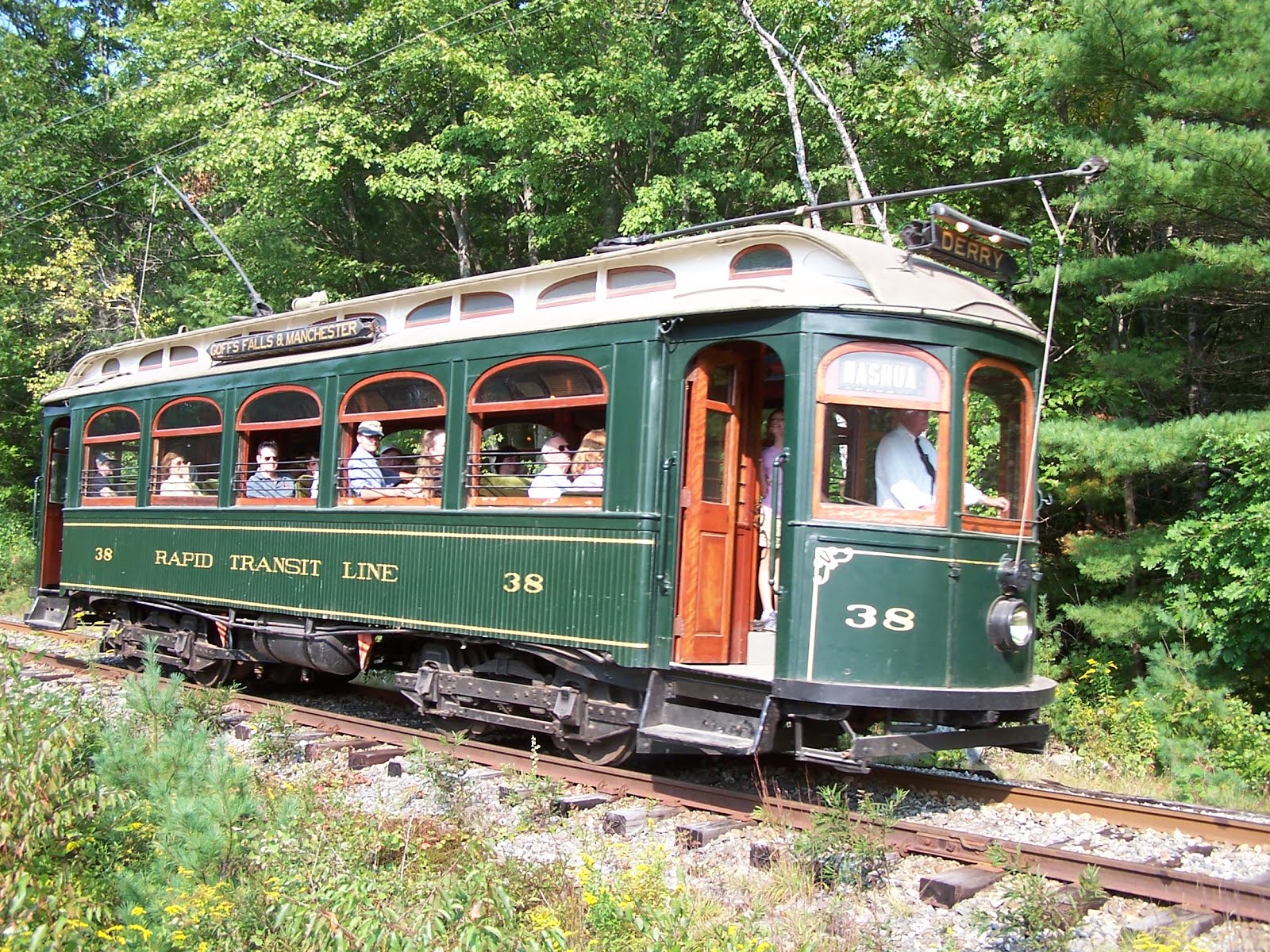
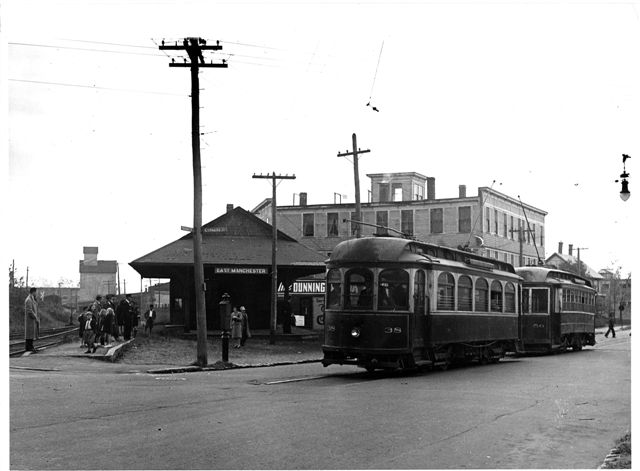
The second car ever acquired by Seashore was No. 38, built by the Laconia Car Company in 1906 for the 18-mile run between the Merrimack Valley cities of Manchester and Nashua, New Hampshire. It also saw considerable service between Manchester and Derry, and later was operated on the suburban run from Manchester to Goffstown. Car 38 has a railroad roof and double-width windows, an early forerunner of today's picture windows, and seats with green plush upholstery.
Acquired by Seashore when the rail lines in the Queen City were motorized in 1940, No. 38 has been thoroughly restored with polished cherry woodwork and new upholstery. The rather poorly designed and desperately battered Laconia 9B trucks have been extensively rebuilt, thanks to a generous grant from the Norcross Wildlife Foundation, which also supports historic preservation. Worn surfaces were built up, oval bolt holes were filled in and redrilled, and new bolts and other fasteners were installed, though most of the original fabric was faithfully retained.Historic Cars: The National Collection at the Seashore Trolley Museum by Ben Minnich. The video below is a short clip of No. 38 operating on Seashore Trolley Museum's mainline on September 25, 2009.
From a 1987 interview conducted by Edward Dooks, see and hear the founder of Seashore Trolley Museum, Theodore Santarelli de Brasch, talk about how No. 38 was acquired and brought to Seashore Trolley Museum in 1940. The first minute of the video below is an intro, then he tells the story of acquiring No. 38. To watch the full interview of the beginning of Seashore Trolley Museum by Theodore Santarelli de Brasch - Click Here
Edward Dooks, a long-time Seashore Trolley Museum member/volunteer, conducted, recorded, and transcribed recollections of Seashore Trolley Museum members' experiences involving the Museum. In addition, Ed recorded, collected, and transcribed recollections of local neighbors to the Seashore Trolley Museum. Here are some of those transcriptions, as they relate to the acquisition of No. 38 in 1940.
Transcripts from 1988 interviews conducted by Ed Dooks. Interviewees:
A = John Amlaw, one of Seashore's original members
B = Henry Brainerd, one of Seashore's earliest members
A: We were on a fan trip over to Manchester, and everybody liked those "rapid cars". There were 2 sets of them. There were 12 altogether: 6 long ones and 6 short ones, and the long ones had been retired. They were up at Lake Massabesic as summer camps.
38 was originally numbered No. 4. It was renumbered in the '30s as 32. 38 had had a bad accident. The newspaper up in Manchester came out with quite an editorial about the miserable conditions of the cars and the terrific damage that had been done to this car. The MSR had 32 in the shops at the time being overhauled. They renumbered it to 38 and put it out in the street and said, "Now the newspaper is telling about all the damage that was done. How come it was the car out in the street today?" It was a different car, and if you opened the inside panel on the left side of the doors on 38, in the body itself (bulkhead), you'll see the old number 4, the new number 32, and nothing about 38.
No. 32 disguised as No. 38
Fan trip 1939 - Seashore Trolley Museum Collection
Dooks: How did you get 38?
There was another trolley fan trip, and several people had seen what we had done with 31, and they said, "Well, suppose we buy 38. Can you take it over with 31?" And we said, "Sure." That originally started as a separate group led by Gordon Pilkington (from Danbury, CT, and Roger Borrup, who came to us and said, "It hardly seems worthwhile to have two competing groups when we could pool our assets and thereby have twice as much track and wire and other supplies for the same amount of money instead of having two separate locations." (They also found how much was entailed in paying for it, moving it, and finding a place to keep it and all the details involved.) Some of his people were members of Seashore, so everyone agreed it was a much better idea if we made it a cooperative effort and just had one group. (The other group was mostly from NH and CT)
Gordon Pilkington had not at that time even gone to the Manchester people to buy the car or to arrange for buying it, so we took over that end of it and went up to see Roger Moscroft, who was the Executive Assistant of the Manchester Street Railway, or the Power Company which owned the Street Railway.
Dooks: To get to Manchester Public Service, my understanding from Ted (Santarelli de Brasch) was that you had a big problem trying to get the people to talk to you. They kept putting you off, and he mentioned a way that they were able to get to the President of the company.
A: All I remember is that Roger Moscroft was sympathetic to us, and I think he was the one who interceded. Their offices were up at (I think) 1000 Elm Street and they were in the same building, the same set of offices and a different floor as the power company up there, and the manager, as I recall was probably 70 years old at the time, wouldn't see anybody, but as I said, Roger Moscroft saw him for us and arranged for an interview for us to go up and talk to him.
We agreed we would buy one of the cars. The only drawback was that they were afraid that if there were a bad accident or fire and the car was destroyed, we would then hold them liable and want them to replace the car. So I told them that we would take in order either car No. 38, or 36, or 42, or 44, or if by any
ill fortune, none of them were available, simply return our deposit. Under those conditions, the company gave us the contract, and the price was $75 for the car body plus trucks and $50 for each of the (4) motors. We were not able to raise enough money to buy the motors, so we agreed to buy the car itself and the two trucks.
(When questioned about some difference in figures for the cost of 38 he said, "That was 48 years ago, and the original books I think were lost when Eliot Sterling took them out to his house because we had a nice dairy. It was a beautiful book, about 'that thick" and about 'so big' with plush covers on it and leather bindings, but he lost that completely and that gave all the story of the first days of Seashore; who went up there and what they did on those trips. It would have been worth its weight in gold today.")
At the time, the company went out of the streetcar business and went to buses. Goodman, the junkman (later A said he ran a second-hand place and junk shop in Manchester), who bought the cars (to break them up), was at the car barn. Roger Moscroft came down and said, "You've got everything in this building and the ones across the street except car 38." And Goodman asked him, "Now, how about this car? Isn't this the one I don't get?" And Moscroft said, "That's right, this car and everything in it was bought by these people, and they're going to take it over to Maine to preserve it, so don't touch anything on it." (Later, A says Moscroft said, "That car is theirs, everything just the way it stands." So he gave us the motors.) There were 3 or 4 of us there at the time, looking over 38 to see what needed doing to it.
A: Incidentally, he offered us car 18 for nothing if we wanted to take it. It was a work car, and he was just saying that it was so well built and maintained that he hated to burn it up, but we couldn't afford to move it at that time.
We used to go over there occasionally and work on the car even before they did away with the streetcars. They put the car on the track at the back of the barn where we could get to it and wouldn't interfere with anything, and we would clean it, paint it, and repair it. At the time, 36 was going to be scrapped, so we transferred the better stuff from it over to 38, such as cracked windows we replaced, torn seat cushions, broken panes of glass, and things like this, and afterward, someone bought 36 and took it down to Bedford, NH.
B: I think I heard he wanted to buy all three of them and make them into one long dinner or something, and he was a bit unhappy that we got one of them.
Dooks: When 38 was moved, we turned on the power, and you say whoever was the operating man or power man when he threw the switch in to energize the trolley wire, he hoped that people that might be stealing the trolley wire would be on it and get the jolt. (His name was McFarland)
A: Yes, they had stolen quite a bit of the wire, apparently for 5 or 6 nights, and the police were unable to catch them, at least they didn't, and they didn't want to leave the power on. I remember there was a big switch-up on the pole, and that switch was off. McFarland came over to us and said, "We'll turn the power on so you can run 38 down to the railroad station." So on this particular occasion, he said, "I just hope they're up there right now!!" They weren't, and we didn't read anything about a fellow being hit by electricity and killed. Dan Twomey and Ted Santarelli were on board.
38 on the siding in Manchester 1940
Seashore Trolley Museum Collection
B: He ran the car down from the barn, down to the railroad crossing in the freight yards, derailed it, then rerail it on the railroad. In other words, rode down the pavement and derailed it and rerailed it on the railroad, ran it about a few hundred feet to where he had the flatcar, and then jacked it up and ran the flatcar under it/ It was unloaded in Kennebunk on a siding. (The body was moved to Seashore but) The trucks remained in Manchester. Chase Transfer supplied a little bit of a trailer and moved it from the railroad to Seashore and set it on blocks more or less over the end of the track, but partly blocking the road on the ASL roadbed. As it went by the Kennebunk Inn, two ladies from Manchester were sitting on the front porch, and one of them said to the other, "Oh, there's one of our Manchester trolley cars coming by.
38 being jacked up for placement on the flat car in Manchester,
1940 - Seashore Trolley Museum Collection
No. 38 on the rails - destination Kennebunk, Maine train station.
Then a trip to the Seashore Trolley Museum in Kennebunkport.
1940 image from the collection of Seashore Trolley Museum
Loaded at the Kennebunk railroad station siding, 38 traveling
to its new home, the Seashore Trolley Museum, 1940
Seashore Trolley Museum Collection
We got to the Log Cabin Crossing. (It was called Biddeford Road but was renamed Log Cabin Road later because there were one or two other streets called Biddeford Road or Old Biddeford Road, and it was confusing. There was a tourist cabin with fake log cabins that was called "The Log Cabin," and so the road was named for that."
(I wasn't there) And then we got to the railroad crossing. At the time, the only protection was the train's whistling, and someone had checked with the B & M dispatcher and found no trains were expected, and we got over the crossing. It barely cleared the crossing when a freight train came by, and then I think they had to use something to lift the telephone cable to get the car under it.
The next time I got back to Seashore, the car was standing on blocks, lined up over the end of the track, and it stayed there a year too. I think it was the 4th of July weekend of '41. I remember I found sleeping in that was much more comfortable than sleeping on the bench of 31, and I found you could take a seat cushion and prop it up in the aisle on a wooden soapbox. It was much more comfortable sleeping than out in the chill of 31.
That summer of '40, there was a forest fire, and I think the fire engines cut slightly, having to detour around where 38 stuck out over the roadway. The right-of-way belonged to the power company, then Cumberland County Power and Light, before it became part of Central Maine Power. Sometime in '41, they said, "We damn well had to stop blocking the roadway any longer."
I think I remember that I was in on negotiating the trucks brought over, and we had to make a deal with somebody and had to enroll him temporarily as a member to make it legal for him to bring them. We got them over there, and they were placed right way round, lined up at either end, one on the track out on the roadway. I was there. Well, the day we actually did it, we had barely enough blocking (materials), and we first jacked up the end that was over the track, and we had to get it damn high, and we didn't really have enough blocking to follow up the jack, so we had it way up in the air and just on the jack with no protective blocking. The jack was pretty well extended, and we could just about get the truck under the low platforms. (They stepped lower than the main body.) We got it under and let it down and put the kingpin in.....We got it down on July 4, 1941. I remember I was crawling under the car and the car not actually swaying but up pretty precariously on an extended jack, and I remember sort of thinking, "Well, if anything happens, I'm a goner." Nothing happened, thank goodness...We got it up on the permanent track and took up the temporary rail that we laid, then we had it on our land, clear of the roadway.
No. 38 at Seashore Electric Railway (Seashore Trolley Museum)
- top image circa 1946. lower image-probably
earlier. Images from the collection of Seashore Trolley Museum
No. 38 outside of Shop #1. Circa 1956
Collection of the Seashore Trolley Museum
No. 38 on the Town House Restoration shop lead at Seashore Trolley
Museum 3-29-2003 - Donald Curry image
Click Here: Video of Theodore Santarelli de Brasch explaining the "Birth" of Seashore Trolley - 1939
Additional blog posts on Seashore Trolley Museum's Laconia Car Company-built Collection: Click Here: No. 14 - Laconia Car Company-built Collection Click Here: No. 38 - 1907 Laconia Car Company-built Collection
Click Here: No. 60 - 1895 Laconia Car Company-built Collection Click Here: No. 100 - 1906 Laconia Car Company-built Collection
Being more than a century old, the stately "Elegant Ride," Narcissus, is a gem. This shimmering precious stone of Maine transportation history is brilliantly resplendent as it emanates so many elements of history, including time, places, people, and events that it was coupled to, that when just a smattering of its seemingly innumerable stories are shared, the contents captivate, fascinate, and then generate interest to learn more 🙋. The majestic Narcissus is listed in the National Register of Historic Places.
Please consider joining the epic journey to complete the Narcissus Project by making a donation today!
The restoration of this majestic icon of Maine's electric railway history is but one in a series of captivating stories containing an abundance of incredible coalition narratives.
Click Here: History-Related Posts - Narcissus and Portland-Lewiston Interurban
The Narcissus is featured in the national Gold Award-winning novel, Teddy Roosevelt, Millie, and the Elegant Ride. The "Elegant Ride" is the Narcissus. Theodore Roosevelt was a passenger on the Narcissus on August 18, 1914, between Lewiston and Portland, Maine, while campaigning for the Progressive Party candidates.
Click Here: Bookstores and Businesses promoting the Narcissus Project