Showing posts with label John Amlaw. Show all posts

Monday, July 15, 2024

85 Years Ago Today - July 15, 1939 - Biddeford and Saco Railroad Open Car 31 Arrived in Kennebunkport, ME

Thank you to Reece Saunders for recreating this colorful digital version from
the original photo taken on July 15, 1939, of the "Parade" of Car 31
chained-together vehicles. The length of the combined pieces is said to
have been 90-100 feet long. Left to right: Old rear end from a junked
Mack dump truck with two rails from the end of Car 31 attached for
use as the rear wheels. Car 31's other end is held up by a chain held
by the crane of the Mack Truck wrecker. To keep the front wheels of
the wrecker on the ground, the front end of the wrecker is chained to the
back end of the truck to the far right - "Designs by Reece" Reece Saunders

Description of the "Parade" of chained-together vehicles as told by
one of the original eight founders of what we know now as the
Seashore Trolley Museum, John Amlaw. From his write-up in the September
1960 issue of The Trolley Museum Dispatch. Car 31's two truck assemblies
had been removed to transport the body to Kennebunkport. The last sentence
mentions ..."two rails sticking out beyond it...," - two rails were attached to
the underneath end of 31 so that the extended ends could be secured to the
top of a separate rear end from a junked old Mack dump truck. The overall
height of Car 31 had to be such that it could safely pass underneath a 
railroad overpass in Saco. 

A difficult-to-acquire, brass model of a Brill, 12-bench open car, and
a pair of Brill 22-E trucks. The car, and separately, the two trucks, were
acquired from England. Found by Tom Tello, with help from Tony Tieuli,
both are longtime members of the Seashore Trolley Museum. Working
together, they accepted my request to consider the possibility of creating
a model diorama reproduction of the incredible "Parade of Car 31" and
the chained vehicles that transported Car 31 to Kennebunkport on
July 15, 1939. - Photo courtesy of Tom Tello

A "teaser" for the work that Tom has done. Stay tuned for the 
announcement of the completed "Parade of Car 31" diorama creation!
Edited photo courtesy of Tom Tello

A copy of the original photo taken on  July 15, 1939 - The "parade" is pulled over
to the side of the Biddeford Road as it approaches what is now the main entrance
to the Seashore Trolley Museum. The crew needed to take a look at the 
entrance to the former right-of-way (ROW) of the Atlantic Shore Railway and 
plan the approach to backing this 90- to 100-foot-long parade into the ROW
to access the property where Car 31 was to be unloaded. It was challenging!
The story is below.
 Image courtesy of the Seashore Trolley Museum.

Happy 85th Anniversary!!

Eighty-five years ago today, on July 15, 1939, open car No. 31 of the Biddeford and Saco Railroad was delivered to the original ten-acre property in Kennebunkport that is now close to the main entrance to the Seashore Trolley Museum in Kennebunkport, Maine. 

There will be many special events at the Seashore Trolley Museum during this 85th Anniversary season.
Click Here: The Seashore Trolley Museum's website home page.

This blog post will focus on the activities of the founding members of the Seashore Trolley Museum following their Farewell Fan Trip at the Biddeford and Saco Railroad on June 18, 1939.

Click HereRead about Car 31 and the Biddeford and Saco Railroad during the year that Car 31 arrived in
 the Biddeford-Saco area, 124 years ago, on June 6, 1900.

Car 31 has the unique distinction of being the first trolley car (anywhere in the world) to be saved by a group of individuals to start a trolley museum. Seashore Trolley Museum in Kennebunkport, ME, was founded in 1939 with the acquisition of Car 31. Car 31 is recognized as the "Mother Car" of all trolley museums worldwide. Car 31 is listed in the National Register of Historic Places and is also a member of Save America's Treasures.

Click Here: Ted Santarelli tells the story of how Car 31 was saved. Santarelli was one of the young men who saved Car 31 in 1939, and in doing so, became one of the founders of the Seashore Trolley Museum. Think about this...Ted was twenty years old and was the leader of the group. Amazing...

Click Here: to read and view many photos of Car 31 when it returned home to Biddeford, Saco, and OOB in 1999 - 60th Anniversary Home Tour

    Theodore "Ted" Santarelli, John Amlaw, and Gerald "Gerry" Cunningham were electric railway fans living in the Boston area in 1939. Ted in Boston, John in Somerville, and Gerry from Haverhill. During their trip to the electric railway fan trip in Lewiston, Maine, on May 30, 1939, they discussed the announcement that buses would replace trolleys on the Biddeford and Saco Railroad by about June 20, 1939.

    After returning to MA, they each wrote letters to friends to invite them to join a group that would try to save a trolley from the Biddeford and Saco Railroad (B&S). Gerry, with his family, had spent several summers in Ocean Park in Maine. Ocean Park is a village in Old Orchard Beach. The trolleys of the B&S
operated into Old Orchard Beach. Over the years, Gerry rode the B&S trolley often and got to know many of the motormen, conductors, shop personnel, and the general manager/president of B&S, J. Burton Stride. Gerry wrote a letter to Mr. Stride that this new group would like to save one of the trolleys by purchasing a complete car. 

    Ted had sent a letter off to Charles "Charlie" Brown in Hyde Park, MA. With Charlie joining the group, they decided to create a "Farewell" Fan Trip event.  Hopefully, to raise money and interest to fund the purchase of a trolley. Charlie organized the trip for June 18, 1939, a day or two before the buses were scheduled to replace the trolleys.     

    Gerry didn't receive a reply from Mr. Stride. So, the day before the June 18 fan trip, Gerry stopped by Mr. Stride's office at the B&S carbarn on Beach Street in Saco. Mr. Stride happened to be in his office and welcomed Gerry in. Gerry listened to Mr. Stride's response to the request he had mentioned in the letter, saying the group was attempting a task that wasn't really doable. Stride went on to say he already had a contract to scrap all the trolley cars. In addition, as a member of the local Rotary Club, he promised not to sell any trolley bodies that would be relocated to any property in the Biddeford, Saco, or Old Orchard Beach communities. Gerry replied on behalf of the new group that he could promise that if they purchased a complete car, they would relocate it outside of the three communities. Gerry continued by stating the group was to save a complete car for future operations. Mr. Stride replied with a price of $300.
The Biddeford and Saco Carbarn on Beach Street in Saco.
The entrance to the office of the general manager/president,
 J. Burton Stride is to the right of the automotive vehicle.
 O. R. Cummings Collection 2009_2_14_161
Courtesy Seashore Trolley Museum

    Gerry communicated the price to Ted, John, and others in the new group. They were initially struck by how challenging it would be to raise that amount of money. So little time to do so. In addition, there would be funds needed to relocate the car. The costs associated with prepping it for transportation. The costs of transporting the car. It was during an economic downturn that one might have a job for $15 to $20 a week. After a day or two, they decided to approach Mr. Stride again to see if he would reduce the price.

    This time, Ted and John went to the Beach Street car barn to see Mr. Stride. They were told Mr. Stride was at his home at Graham Street in Biddeford. They went to Mr. Stride's home. Mr. Stride was mowing his lawn. He mentioned he was busy and couldn't chat with them at that time. Ted offered to take over mowing the lawn so he could chat with them. Mr. Stride agreed. John thanked Mr. Stride for offering to sell the group a trolley. John then restated the group's desire to save a trolley and that they would comply with Mr. Stride's promise to the Rotary Club to have the trolley be located outside of the three communities; however, they were struggling with the price. They asked Mr. Stride to consider a lower price. This approach must have made a positive impression on Mr. Stride. He took a moment, then he replied that the price would be $150. 

(Reading the transcripts from various interviews of many early members/founders of Seashore, conducted by longtime member, Edward "Ed" Dooks, during the late 1980s, it's unclear whether Ted and John began the search for a location and transportation sources, before the June 18 fan trip, or after the June 18 fan trip. For this post, I'll write the process that took place before the June 18 fan trip occurred)

    Once the group felt they could acquire a trolley, they next had to find and secure a location outside of the Biddeford, Saco, and OOB communities, and sources provided transportation of the trolley and its trucks to the location.

    
The former car barn of the Atlantic Shore Line/York Utilities Railway
was located at Town House Junction in Kennebunkport. After the YUCo
ended service, the building and some of its vehicles had been sold to 
Everett Greenleaf of Kennebunk.
No. 104, built in 1907, is at the Atlantic Shore Line Carbarn.
This photo was taken c. 1915. The car barn was one of the stops
the ERA members made and found some nuggets to keep.
Courtesy Seashore Trolley Museum Library:
 O. R. Cummings Collection 2009_2_7_099

    When asked for suggestions, a source to talk to about a location outside of the three communities, one of the Beach Street car barn staff members suggested that Ted and John seek Everett Greenleaf. He was the owner of the former car barn of the York Utilities/Atlantic Shore Line Railways in Kennebunkport.

    Ted and John traveled to the former car barn and met up with Mr. Greenleaf. Upon hearing the story
of the need for a location for a saved trolley in the coming weeks, Mr. Greenleaf suggested to Ted and John to seek a piece of property owned by a local farmer up the road. Mr. Greenleaf also offered to help with the transportation. He also referred Ted and John to a fella who had a wrecker.

    To keep the story short, through Mr. Greenleaf, Ted and John met Fred and Mabel Clough. They owned a farm near the former right-of-way of the Atlantic Shore Railway. Mr. Clough was a former motorman for the railway. Mr. Clough told Ted and John that there was a neighbor farmer, George Hill, who owned a ten-acre strip of landlocked property that ran parallel between the Clough farm and the former right-of-way of the electric railway. 

   Ted and  John next visited George Hill. Mr. Hill was interested in hearing the plan for saving a trolley, and yes, he would lease/sell the ten acres to the group.

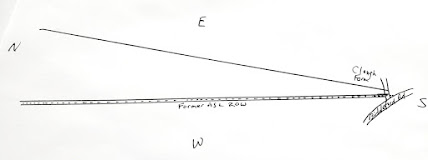
The original ten acres where Car 31 would be placed,
July 15, 1939. Shaped like a 22-degree acute triangle,
due to the length of Car 31, it would need to be unloaded
where the width of the property was wide enough
 for the complete car. That meant backing into the
right-of-way a few hundred feet before reaching a
wide enough piece for 31.

     Next up was following up on Mr. Greenleaf's referral for a wrecker. Bob Smart had owned a wrecker, but he had sold it to Tom Scott. Mr. Smart wanted to help transport the trolley. Ted and John visited Mr. Scott, and he, too, wanted to help. He and his wrecker were available to move the trolley when needed.

    The group started thinking that more friends were needed to achieve the goal of raising $150, plus dollars for the transportation-related costs. But, first things first. $150 to secure the purchase of a trolley. Ten people at $15 each was the goal for the June 18th Farewell Fan Trip.

Copy of a ticket for the Farewell fan trip
on June 18, 1939.

    It was during the Farewell Fan Trip, while riding on Car 31, that Car 31 would be the one to save.

The fan trip was noted in the newspaper.
Biddeford Daily Journal - June 18, 1939

    With only about 35 attending the Farewell FanTrip and the need to pay the B&SRR for the trip, the group didn't gain much from the Farewell trip event. They did have a handful of friends pledge, or commit to helping financially, but more money was needed.

     Fortunately, the delivery of the buses was delayed. That led to a date change for buses replacing the trolleys to July 6.

    July 5 was the final day of trolley operations on the B&SRR before buses took over on July 6. It was also the day that the $150 payment was due for purchasing Car 31. The group only had $108. 

    On July 5, Ted had the $108 and tracked down Mr. Stride to negotiate for a $108 deposit to save Car 31. Ted waited at the Old Orchard Beach train station, where the train with Mr. Stride, a passenger who would disembark at OOB. The train arrived. Ted met Mr. Stride, Ted talked about the finances, Mr. Stride accepted the $108 as a deposit, and required the balance of $42 to be paid by July 14 to the representative of the Salzberg Company that was under contract to scrap all the trolleys of the B&S. Mr. Stride and Ted shook hands on the negotiated deal. 

Postcard of the Old Orchard Beach train station PWM

    During the next few days, the group raised the remaining $42 for purchasing Car 31, as well as a few more dollars to pay for the wrecker and secure the rental of a used rear end from a junked Mack dump truck. The rear end would be used to secure one end of Car 31 during transportation to Kennebunkport. 

    On Friday morning, July 14, Ted was in Biddeford. He didn't have the $42 with him. John Amlaw sent it to Ted via Western Union shortly after lunchtime. Ted met up with the rep from Salzberg Company and paid the balance due for Car 31. Ted then went to the Beach Street Carbarn to start prepping Car 31 for transporting to Kennebunkport.

The backyard of Beach Street Carbarn. Car 31 would use one
of those two tracks extending from the center bays to rest on a track
while awaiting being prepped for leaving.
Courtesy Seashore Trolley Museum Library:
 O. R. Cummings Collection 

    Car 31 was waiting in the backyard of the Beach Street car barn. It was on a piece of track that extended through one of the bays into the backyard. Ted, with no experience in removing trucks from under a trolley car, borrowed a jack and the many, many wooden blocks from the Beach Street car barn to jack up one end of Car 31 and remove each truck. 

Ready for the wrecker to arrive and hook up.
Car 31 with both of its trucks removed. The body is resting
on wooden saw horses. The end of Car 31, opposite the
carbarn, has two rails secured to the underside of the body.
Those two rails extend out from the body and are secured
to the top of the rear end of a Mack dump truck. 
Courtesy Seashore Trolley Museum

    John Amlaw arrived after Ted got started, and he helped with the process. Each end of 31 was jacked up 6 feet or higher so the trucks could be rolled out from underneath the body. The first end was lowered back down onto wooden sawhorses. Before the back end was lowered all the way down, to the used rear end of a junked Mack dump truck, a pair of rails had to be secured to the underside of the body and to the top of the rear axle of the Mack dump truck. This was like a trailer for the rear end of Car 31 during the transportation to Kennebunkport.

    The next morning, July 15, Ted was the only one from the group who was at the Beach Street car barn when Bob Smart and Tom Scott arrived with the wrecker, and Everett Greenleaf arrived with his truck to transport each truck separately to Kennebunkport. In addition to transporting Car 31, the wrecker would be used to load/unload each of Car 31's trucks into and out of Everett's truck.

     With how Car 31 was positioned behind the carbarn, it was going to be challenging to hook up the front end of Car 31 to the wrecker and have the wrecker drive through the carbarn, exit through the front of the bay doorway, out to Beach Street, en route to Kennebunkport.

    The car barn was going to be totally razed within a couple of weeks. The process had already begun with some sections. A new storage and repair shop for the buses was going to be built.

    The wrecker backed up to the end of Car 31, held up by the wrecker's crane. After the sawhorses were removed and the full weight of Car 31 was on the crane, the front wheels of the wrecker lifted up, then away from the ground level. Of course, the driver was not able to steer the wrecker with the front wheels in the air. The team reset 31 so that the front tires returned to the ground.

    Ted came up with an idea. Chain the end of Mr. Greenleaf's truck to the front end of the wrecker. Thinking that the added weight of the truck on the front end of the wrecker would keep the wheels on the ground when Car 31 was lifted by the crane. It worked. 

    However, now they had the 90-100-foot-long parade of chained-together vehicles to try and maneuver through the car barn bay. In Ted's transcript of his interview, he mentions that crew members from the company dismantled part of the car barn, stepped in, and removed portions of the building that were blocking the parade from exiting. Then the long parade maneuvered through and exited the car barn. Then it was off to Kennebunkport.
     
This is an early '70s aerial view of the area where the entrance is to the
Seashore Trolley Museum. The roads you see at the entrance to the museum were
not there in 1939. You can still see where the old right-of-way extended
from the top right of the photo, heading south, passing over the Clough 
Farm driveway, and continuing just in front of their son, Carl's, house, and
on running parallel with the east side of Biddeford Road (now Log Cabin Road).

    Using the photo above as a reference. You can get a sense of the challenge the drivers of the wrecker and lead truck chained to the wrecker were presented with as they contemplated the approach needed to back the 90-100-foot-long Car 31 parade up the right-of-way several hundred feet before they could reach the property where it was wide enough to place Car 31. Where they needed to place Car 31 is further up along the right-of-way than is visible in this photo. 

    They had to drive toward Kennebunkport until the very end of Car 31, resting on the rails, where the rear end of the Mack dump truck was in line with backing straight into the right-of-way. Coordinating the backing up of these chained-together vehicles must have been very tough.

    Ted mentions in his transcript that the Clough Farm driveway was torn up and damaged by the vehicles backing over it. This was the first direct experience of Car 31 being next door to the Cloughs. They were not happy about the damage done to their driveway. Ted, being Ted, apologized to the Cloughs and told them he would return to repair the damaged gravel driveway. Ted was staying with friends on Peaks Island, off the coast of Portland. The next morning, Ted took the ferry from Peaks Island to Portland. Walked to the Customs House. Took a trolley to Monument Square. Boarded a Portland bus to Old Orchard Beach. Board a Biddeford-Saco bus to Five Points. Walked to Granite Street Extension. Entered the old right-of-way of the YUCo/ASL Railway and walked the four miles to the Clough Farm. Borrowed the shovel needed to repair the gravel driveway. Fixed the driveway. Ted thanks the
Clough family, and he returned to Peaks Island later in the day. 

    The Cloughs were impressed and became longtime, dear, caring volunteers, overseeing the collection of cars over many years while the early members were serving during WWII and on the weekdays, were not able to be with the collection on the property. Mr. Clough, as a former ASL motorman, with help from his three sons, all of whom were very helpful in providing guidance as to track work, pole placement, overhead wire, working on the cars, etc.

   
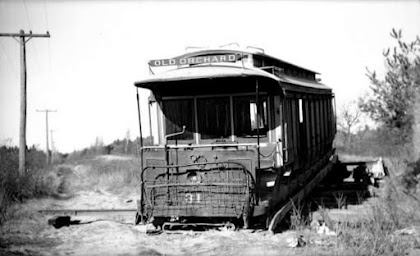
Car 31 as it looked when it was first unloaded at its new home.
You can see the right-of-way parallel with the electric poles.
You see the end of Car 31 is resting on a portion
of the right-of-way. That was a problem. The Electric
Company: Cumberland County Power and Electric began to
complain about this predicament. They required that Car 31
be totally removed from the right-of-way before winter fell.
On November 11, Armistice Day, the task was accomplished!
    
    Below is a link to an interview with Ted Santarelli and his first-hand accounting of how things unfolded and how the first couple of streetcars were acquired (1900 open car No. 31 from the Biddeford 
Saco Railroad and 1906 interurban No. 38 from Manchester & Nashua Street Railway.) 

Thank you to Ed Dooks for recording the interview and digitizing the original VHS tape. 
"This is the way we started, with one car, with no great thought that we were going to have more cars or that we would develop into a museum of this size."

Ted Santarelli, October 10, 1987


Click Here for the post - "The Birth of Seashore Trolley Museum - An Interview with the Founder".
Click Here for the post - "80th Anniversary Year-Seashore Trolley Museum - A Look Back at the 50s
Click Here for the post - "80th Anniversary Year-Seashore Trolley Museum-A Look Back at the 60s
Click Here for the post - "80th Anniversary Year-Seashore Trolley Museum-A Look Back at the 70s
Click Here for the post - "1901 Tower C Boston Elevated Railway to STM 1975"
Click Here for the post - The Saga of Northampton Station Coming to Maine 1990
Click Here for the post - 50 Years Ago on Halloween - Narcissus Arrived at Seashore Trolley Museum
~~~~~~~~~~~~~~~
Click Here: For the list of links to Theodore Roosevelt Maine Heritage Trail Posts in Easy Order to View

We continue the restoration work on the 1912 Narcissus, the only surviving high-speed, luxury interurban coach of the Portland-Lewiston Interurban. 

Click Here: Narcissus Restoration-Related Posts

More than a century old, the stately "Elegant Ride," Narcissus, is a gem.  This shimmering precious stone of Maine transportation history is brilliantly resplendent as it emanates so many elements of history, including time, places, people, and events, that it was coupled to, that when just a smattering of its seemingly innumerable stories are shared, the contents first captivate, fascinate, then generate interest to learn more 🙋. The majestic Narcissus is listed in the National Register of Historic Places.

Please consider joining the epic journey to complete the Narcissus Project by donating today!

Click Here: Donation Options

The restoration of this majestic icon of Maine's electric railway history is but one in a series of captivating stories containing an abundance of incredible coalition narratives.

Click Here: History-Related Posts - Narcissus and Portland-Lewiston Interurban

     The Narcissus is featured in the national Gold Award-winning novel, Teddy Roosevelt, Millie, and the Elegant Ride. The "Elegant Ride" is the Narcissus. Theodore Roosevelt was a passenger on the Narcissus on August 18, 1914, between Lewiston and Portland, Maine, while campaigning for the Progressive Party candidates.

Click Here: Bookstores and Businesses promoting the Narcissus Project

Independent book publisher, Phil Morse, holding
Gold Book Award Winner plaque for
 Middle Reader category for The Eric
Hoffer Book Award. Congratulations to
award-winning Maine author,
Jean M. Flahive

Tuesday, June 18, 2024

85 Years Ago Today - June 18, 1939 - "Farewell to the Biddeford and Saco" Fan Trip - Car 31 on Track to be Saved

At the age of 104 years old, one of these fans is still with us today!
85 years ago today, on June 18, 1939, open car No. 31 of the Biddeford
and Saco Railroad Co. is seen making the curve from Alfred Street to enter
Elm Street, at Five Points, in Biddeford, ME. The passengers were all riding
Car 31 during a fan trip organized by a few young men who would become
known as the founders of what is now known as the Seashore Trolley Museum
in  Kennebunkport, Maine. It was during this trip on Car 31 that the decision
was made that Car 31 should be the car they try to save from being scrapped.
Image 2009_2_14_032 from the O R Cummings Collection at
Seashore Trolley Museum

    Eighty-five years ago today, on June 18, 1939, a small group of young men made the choice to try and save open car No. 31 of the Biddeford and Saco Railroad from being scrapped. While overcoming several challenges, they were successful. On July 15, 1939, Car 31 was transported to what is now the main entrance to the Seashore Trolley Museum in Kennebunkport, Maine. This series of activities led to the beginning of what is now the Seashore Trolley Museum.

There will be many special events at the Seashore Trolley Museum during this 85th Anniversary season.
Click Here: The Seashore Trolley Museum's website home page.

This blog post is going to focus on the activities that occurred to create the June 18, 1939, fan trip that led to saving Car 31. The eight men who were able to contribute some money towards the expenses needed to save, transport, and provide property for Car 31's "new home" would become known as the founders of the Seashore Trolley Museum

Click Here: Read about Car 31 and the Biddeford and Saco Railroad during the year that Car 31 arrived in the Biddeford-Saco area, 124 years ago, on June 6, 1900.

Car 31 has the unique distinction of being the first trolley car (anywhere in the world) to be saved by a group of individuals to start a trolley museum. The Seashore Trolley Museum in Kennebunkport, ME, was founded in 1939 with the acquisition of Car 31. Car 31 is recognized as the "Mother Car" of all trolley museums worldwide. Car 31 is listed in the National Register of Historic Places and is also a member of Save America's Treasures.

Click Here: Ted Santarelli tells the story of how Car 31 was saved. Santarelli was one of the young men who saved Car 31 in 1939, and in doing so, became one of the founders of the Seashore Trolley Museum.

Click Here: Car 31 Returned Home to Biddeford, Saco, and OOB in 1999 - 60th Anniversary Home Tour

    Theodore F. Santarelli de Brash (Ted) of Boston (Sophomore at Harvard University, John E. Amlaw (John) of Somerville (South Postal Annex-Boston), and Gerald (Gerry) F. Cunningham of Haverhill (Northeastern Undergraduate) were three members of the Boston Division of the Electric Railroaders Association (ERA) when they learned about an April 19, 1939, fan trip, for visiting and riding two trolley cars on the Androscoggin and Kennebec Railway (A&KRy) out of the Auburn-Lewiston area in Maine. They made plans to travel together and attend the fan trip.

Portland Press Herald - March 5, 1939

    The schedule of the fan trip is explained in the newspaper article below.
Sun Journal - March 13, 1939

    To promote the fan trip, the Portland Division of the ERA talked about the fan trip in the group's newsletter, The Maine Electric Transiteer. Below is the page from the Feb/Mar 1939 issue explaining the trip.
Article in the Feb/Mar issue of the Maine Electric Transiteer, the newsletter
from the Portland Division of the Electric Railroaders Association, promoting
friends/fans to attend the April 19, 1939, fan trip to ride car No. 190 of the
Androscoggin and Kennebec Railway. The trip was hosted by the Portland
(Maine) Division of Electric Railroaders Association - PWM

    Over the years of collecting information on the April 19, 1939, fan trip, there were occasionally individuals who made the statement that the fan trip was on May 30, 1939. That has caused some uneasiness when it comes to feeling confident to state what the date was when the fan trip actually happened. Hopefully, as more research is conducted, the evidence will help make it clear.

    In mid-April, this newspaper article below mentions that the date of the A&K Ry fan trip was changed from April 19 to May 30, 1939. One piece of evidence...

Evening Journal - April 15, 1939 

Another piece of evidence that the April 19, 1939, fan trip took 
place on May 30, 1939
Kennebec Journal - June 1, 1939 

    The Biddeford and Saco Railroad announced that modern buses would replace the trolley cars serving the Biddeford, Saco, and Old Orchard Beach communities (on) about June 20th (1939). 

Biddeford Saco Journal - May 25, 1939 - page 2

   The transportation plans for Ted, John, and Gerry to travel together to Maine (now on May 30, 1939) to attend the fan trip had Ted traveling by electric railway to Somerville, MA, where John, driving his car, would pick Ted up. Then, they would drive to Haverhill to pick up Gerry. Together, the three of them would travel north to Maine to join the other electric rail fans and enjoy the fan trip of the A&KRy. When John, with Ted on board, stopped the car to pick up Gerry, as he entered the car, Gerry stated, "Fellas, they've ordered the buses!"

    Gerry had heard through his connections with the Biddeford and Saco Railroad, based in Saco, Maine, that the company had announced that modern buses were to arrive and replace the trolleys beginning on June 20, 1939. Ted, John, and Gerry were all very fond of the Biddeford and Saco electric railway line, in particular, the open cars that were still being operated during the tourist season. At the time, the Biddeford and Saco Railroad was the only electric railway in all of New England to still be using open cars during regular daily operations of a line during spring, summer, and fall (one or two lines in New England would still use open cars for special events, but not for regular daily operations).

    Gerry spent time in Maine at Ocean Park during the summer. Ocean Park is a small village within the town of Old Orchard Beach. The Biddeford and Saco Railroad (B&SRR) electric streetcars served Old Orchard Beach. Gerry spent many days during his summer visits in Ocean Park riding and photographing the trolley cars of the B&S and getting to know many of the motormen, conductors, car barn workers, and even the general manager, J. Burton Stride. 

    Based on previous newspaper clippings and the Feb/Mar 1939 issue of the Maine Electric Transiteer newsletter, the photos below, taken during the A&KRy fan trip, will now have the date of May 30, 1939, associated with them.
No. 120 of the Androscoggin and Kennebec Railway with a banner on
the dasher. Passengers inside the car are a group on a fan trip
hosted by the Portland Division of the Electric Railroaders Association.
May 30, 1939 - O. R. Cummings Collection 2009_2_21a_030

No. 190 of the Androscoggin and Kennebec Railway with its destination sign
showing "EXTRA" and a sign on its dasher. It reads "SPECIAL."
Those signify the passengers and friends inside the car as the group on the fan
trip hosted by the Portland Division of the Electric Railroaders Association.
 May 30, 1939 - O. R. Cummings Collection 2009_2_10_002

    While on their fan trip, traveling on the trolley cars, they discussed how they might be able to make a plan to try and save one of the B&S trolleys. They came up with a plan to write to their friends about the idea, and the short timeframe to try and pull it off. Because Gerry knew Mr. Stride, the general manager of the B&S, he was the one to write a letter to Mr. Stride to introduce their idea to him, wanting to save one of the trolleys. Meanwhile, one of the friends they contacted, Charles A. Brown of Hyde Park, MA, took on the task of planning a separate fan trip at the B&S on June 18, 1939. That day was meant to be close to the final day of trolley operations before the buses were to take over public transportation in Biddeford, Saco, and Old Orchard Beach.

    This handful of young men was hoping that the June 18 fan trip would generate interest in saving one of the B&S trolley cars, and that some individuals would contribute money towards the purchase price.

    Members of the Portland Division of the ERA joined in with members of the Boston Division of the ERA to promote the June 18, 1939, "Farewell" Fan trip on the Biddeford and Saco Railroad system
Evening Express - June 16, 1939

A reproduction of the June 18, 1939 fan trip announcement,
 "Farewell To The Biddeford & Saco"
From the Jan/Feb 1964 Seashore Trolley Museum newsletter,
"The Dispatch." PWM

    Mr. Stride, the general manager of the B&S, did not reply to the letter that was sent to him from Gerry. Gerry paid Mr. Sride a visit at his office at the B&S car barn on Beach Street in Saco. Mr. Stide did receive Gerry, and they discussed the topic of the letter. Gerry, representing the group, would like to save one of the B&S cars. As a complete car, not simply a body. Mr. Stride responded, saying he had already arranged for all the cars to be scrapped. Besides, he had made a commitment to his friends who were members of the Biddeford Rotary Club that he would not sell any more cars/car bodies to anyone that were planning on relocating the piece on the property in the Biddeford, Saco, or Old Orchard Beach communities. And if he did consider selling one, the price would be $300.

    Gerry left and met up with Ted and John to discuss the meeting with Mr. Stride. $300 in 1939 was a massive amount of money for the average person. The average worker might make somewhere in the $15 to $18 and week. They discussed plans and made a choice to visit with Mr. Stride again to try and negotiate a better offer. 

    In addition, they needed to find a place to transport the potential trolley to a location outside of the three communities that were off limits to the home of the car. Having a location in mind might help.

    One day, soon after the original meeting with Mr. Stride, they were able to meet with him once again. This time, the meeting was at Mr. Stide's home at Graham Street in Biddeford. Mr. Stride was mowing his lawn and told the visitors he was busy now. They offered to have one of the group take over mowing the lawn for Mr. Stide. Mr. Stride agreed. The visitors discussed their honest commitment to save one of the cars from being scrapped. They would transport it to a location outside of the three banned communities. Mr. Stride acknowledged that he recognized the challenges the group faced and also respected their commitment to the task. He agreed to sell a car to them for $150. The money needed to be paid by the final day of trolley operations on the B&S. Fortunately, for the group, the date that the buses were to take over had now been delayed until July 5, 1939. 

    With the success in negotiating the purchase of one of the trolleys, along with the reduced price, the group had to focus on securing a location for the placement of the acquisition. In addition, make arrangements for removing the vehicle and transporting the chosen candidate to the location. All of which would be meaningless if they were not able to raise the money needed to pay for the trolley car by July 5.

    The June 18, 1939, "Farewell to the Biddeford and Saco" fan trip. Would it generate what was needed?

The summary of the fan trip was noted in the newspaper.
Biddeford Daily Journal - June 18, 1939

    Here are photos. All taken during the fan trip that took place on June 18, 1939.


Map of the 8 miles of the Biddeford and Saco Railroad system. 
The company office was located in the car barn on Beach Avenue in Saco.
Five Points in Biddeford is seen on the map on the far left. The end of the
line at Old Orchard Beach can be seen on the far right.

    No. 10, a single-truck, 18-foot, box, closed car, was purchased new from the J. G. Brill Company in 1899.
No. 10 was one of the two "new" cars that the above newspaper
talks about. No. 10 was the vintage car used by the June 18, 1939,
The Farewell Fan Trip passengers.
Biddeford Daily Journal - January 29, 1900

After passing under the B & M RR overpass, No. 10 is heading toward
the Half-Way. It's traveling on Orchard Street (now Old Orchard Road)
on its way to Old Orchard Beach.
Courtesy of Saco Museum - the Foster Leavitt, Sr. Collection
Photo by C. D. Duncan

At the Half-Way intersection, turning out from Orchard Street
(now Old Orchard Road) to Saco Avenue, heading toward Old Orchard
O. R. Cummings Collection 2009_2_15_035

At the Tabernacle Turnout on Union Avenue, Old Orchard Beach.
No. 10 with the Farewell fans and the Birney car, No. 607, that the fans would
be riding next. O. R. Cummings Collection 2009_2_15_051

Turning from Union Avenue, OOB, onto Washington
Avenue, en route to Old Orchard Beach
 O. R. Cummings Collection 2009_2_15_060

At the Tabernacle Turnout on Union Avenue, Old Orchard Beach, waiting
to turn onto Washington Avenue heading towards Old Orchard Beach
O. R. Cummings Collection 2009_2_15_050

On Saco Avenue, Old Orchard Beach, with the Old Orchard House
 - O. R. Cummings Collection 2009_2_15_073

On Old Orchard Street, after turning from Saco Avenue, heading
to the end of the line at the B & M RR crossing at Old Orchard Beach
O. R. Cummings Collection 2009_2_15_084

The operator for No. 10 during the trip was
E. I. Hill. Here he is at Kelley's Turnout, on
Orchard Street (now Old Orchard Road),
No. 10 in the background. He is using
the B&S phone to talk with the dispatcher
back at the carbarn.
Photo by Gerry Cunningham

Turning out from Orchard Street (now Old Orchard Road) onto Beach
Street as the Farewell fans return to the car barn. There they will board
Birney car No. 607 and travel the Saco-Biddeford route as the second
portion of the fan trip.
O. R. Cummings Collection 2009_2_15_002


    No. 607, a one-man, single-truck, Birney Safety Car, was originally a Portland Railroad (PRR) car purchased from the Wason Company in 1919. The B&S bought No. 607 and several other Birney cars from the PRR in 1937.

No. 607 with the Farewell fans on board after leaving the Beach Street
car barn on Main Street in downtown Saco. Heading to Biddeford.
O. R. Cummings Collection 2009_2_14_096

Elm Street, Biddeford, heading to Main Street
O. R. Cummings Collection 2009_2_14_045

Elm Street, Biddeford, heading back to Main Street
O. R. Cummings Collection 2009_2_14_042

Main Street, Saco, Nourse's Crossing, heading to Beach Street
O. R. Cummings Collection 2009_2_14_109

Main Street, Saco, Nourse's Crossing, heading to Beach Street
O. R. Cummings Collection 2009_2_14_107


    No. 31 is a double-truck, 12-bench, open car that, like No. 10, was purchased from the J. G. Brill Company. It arrived, with three other 12-bench open cars, on June 6, 1900.
Click Here: Read about Car 31 and the Biddeford and Saco Railroad during the year that Car 31 arrived in the Biddeford-Saco area, 124 years ago, on June 6, 1900.
Biddeford Daily - June 7, 1900

As Car 31, with all the Farewell fans on board, was leaving the Beach
Street, car barn, it derailed. Fans were actually interested to see and 
participated in getting Car 31 back on track.
O. R. Cummings Collection 2009_2_14_130

Open Car No. 49, 12-bench (1903), waiting for Car 31 to be back on track. 
Across the street from the Beach Street Carbarn, Saco
O. R. Cummings Collection 2009_2_14_132

Across the street from the Beach Street Carbarn, Saco. Once Car 31
was back on the tracks, it would head out for Old Orchard Beach
O. R. Cummings Collection 2009_2_14_131

    H. Lincoln "Linc" Harrison was on the Farewell trip, and he actually did help the crew to put Car 31 back on track.
Click Here: Linc was featured in the Worcester, MA, Sunday Telegram newspaper in August 1961

At Kelly's Turnout (siding) Orchard Street on (now Old Orchard Road)
towards Old Orchard Beach
O. R. Cummings Collection 2009_2_15_044

At Kelly's Turnout (siding) Orchard Street (now Old Orchard Road)
towards Old Orchard Beach
O. R. Cummings Collection 2009_2_15_011

At Kelly's Turnout (siding), Orchard Street (now Old Orchard Road)
towards Old Orchard Beach
Foster Leavitt, Sr. Collection

End the line in Old Orchard Beach at the B & M Railroad Crossing
O. R. Cummings Collection 2009_2_15_097

Here is Car 31 in place in June 1999, during one of its stops during its
Home Tour to celebrate the 60th anniversary of it being saved.
The railroad tracks and the building on the right in the background
are in the photo taken 60 years earlier during the Farewell Fan Trip.
PWM photo

Click Here: Car 31 Returned Home to Biddeford, Saco, and OOB in 1999 - 60th Anniversary Home Tour

End the line in Old Orchard Beach at the B & M Railroad Crossing
O. R. Cummings Collection 2009_2_15_113

End the line in Old Orchard Beach at the B & M Railroad Crossing
O. R. Cummings Collection 2009_2_14_114

Returning from Old Orchard Beach. On Orchard Street (now Old Orchard Road).
Just about to pass underneath the B & M RR overpass.
O. R. Cummings Collection 2009_2_15_033

After returning from Old Orchard Beach, Car 31 passed by the Saco
car barn on Beach Street. A very short distance after the car barn is
another B & M RR overpass. Car 31 is seen here passing under it.
O. R. Cummings Collection 2009_2_14_114

    A story told by John Amlaw about his being onboard Car 31 during the Farewell Fan Trip,
he talks about one of the fans, George King, and how, for an extended time, George constantly pulled the rope that made the conductor's bell ring. And ring very loudly. John was in the seat located underneath where the conductor's bell was. Bing! Bing! Bing, Bing! It was a nuisance! So, I stood up and disconnected the rope from the bell. 
From Saco, on to Biddeford, up Alfred Street to Five Points. Here is
Car 31 at Five Points, leaving Alfred Street and turning towards Elm Street.
O. R. Cummings Collection 2009_2_14_131

    Another Car 31 story at the Five Points, it was decided by the handful of the group that put the trip together, that Car 31 would be the B&S car that they would save.

Main Street, Biddeford, faces City Hall while Car 31 heads towards Elm Street
O. R. Cummings Collection 2009_2_14_131

    In the opening photo of Car 31 at Five Points, I mentioned, one fan from the Farewell Fan Trip that was made on June 18, 1939, is now 104 years old. That is Arthur Ellis, from Pennsylvania. Art was also one of the founders of the Pennsylvania Trolley Museum in Washington, PA. 


Screenshot of Art Ellis operating No. 78 on June 8, 2024, at the Pennsylvania Trolley Museum

    The Farewell Fan Trip came to an end...Ted, John, and Gerry knew the cost to be $150 for the car they chose (Car 31). They had a goal to have ten friends each contribute $15. Once things settled down after the fan trip. They did not have a commitment from ten friends. The $150 was due on July 5, 1939. In addition, they needed money to cover the costs associated with the equipment, etc., needed for loading and transporting Car 31 to its new location. 

    To Be Continued...Click Here: to go to the next post "The Last Day of Trolley Operation, July 5, 1939"
~~~~~~~~~~~~~~~
We continue the restoration work on the 1912 Narcissus, the only surviving high-speed, luxury interurban coach of the Portland-Lewiston Interurban. 

Click Here: Narcissus Restoration-Related Posts

Being more than a century old, the stately, "Elegant Ride," Narcissus, is a gem.  This shimmering precious stone of Maine transportation history is brilliantly resplendent as it emanates so many elements of history, including; time, places, people, and events, that it was coupled to, that when just a smattering of its seemingly innumerable stories are shared, the contents captivates, fascinates, then generates, interest to learn more 🙋. The majestic Narcissus is listed in the National Register of Historic Places.

Please consider joining the epic journey to complete the Narcissus Project by making a donation today!

Click Here: Donation Options

The restoration of this majestic icon of Maine's electric railway history is but one in a series of captivating stories containing an abundance of incredible coalition of narratives.

Click Here: History-Related Posts - Narcissus and Portland-Lewiston Interurban

     The Narcissus is featured in the national Gold Award-winning novel, Teddy Roosevelt, Millie, and the Elegant Ride. The "Elegant Ride" is the Narcissus. Theodore Roosevelt was a passenger on the Narcissus on August 18, 1914, between Lewiston and Portland, Maine, while campaigning for the Progressive Party candidates.

Click Here: Bookstores and Businesses promoting the Narcissus Project

Independent book publisher Phil Morse, holding
Gold Book Award Winner plaque for
 Middle Reader category for The Eric
Hoffer Book Award. Congratulations to
award-winning Maine author,
Jean M. Flahive