Monday, December 19, 2022

Substations and Terminals of the Portland-Lewiston Interurban

The combination carhouse and terminal at Middle Street,
Lewiston, when it first opened to public operations in
 June/July 1914. This is a single photo, from one page,
within the 88 pages of the incredible
Portland-Lewiston Interurban
(PLI) Employees Scrapbook. The Scrapbook
includes contents from the four reunions held
in Gray, Maine, at the Newbegin Hall,
in 1938, '39, 40, and '41.

This is one of several posts that will include materials and related stories connected to the contents of the PLI employees' reunion scrapbook. This post includes materials related to the preparation and opening of the electric railroad from 1911 to 1914. 

Below is the video taken on April 8, 2014, as I first looked through the scrapbook. If needed, you may Click Here to access the YouTube video

My first view of the scrapbook in 2014, as seen in
a video, I took using my phone.

    Great Thanks to the staff at Northeast Document Conservation Center (NEDCC) in Andover, MA, for the amazing work they did in cleaning, repairing, and photographing the contents of the scrapbook during the conservation process in 2022.

Lewiston Terminal/Carhouse/Dispatcher

Car No. 12 was named Gladiolus. W. Scott Libbey, the builder of
Portland, Gray, and Lewiston Railroad was encouraged by his two daughters,
Gertrude and Alla, to name the original six high-speed, luxury interurban coaches
after his favorite flowers. PLI reunion scrapbook in the O. R. Cummings Collection

Car No. 10, Arbutus, exiting the Lewiston carhouse at Middle Street.
PLI reunion scrapbook in the O. R. Cummings Collection

The doorway on the left of the above photo is the entrance
to the ticket counter. PLI reunion scrapbook in
the O. R. Cummings Collection

A photo of the only known surviving porcelain
signage promoting ticket sales. This particular signage was
at the ticket counter at the Lewiston terminal.
 O. R. Cummings Collection

The ticket window at the Lewiston terminal.
PLI reunion scrapbook in the O. R. Cummings Collection

The dispatcher's office was upstairs over the ticket counter area.
PLI reunion scrapbook in the O. R. Cummings Collection

    The dispatcher communicated with the operators of the electric railroad equipment utilizing a private phone line with portable phones in each vehicle, a phone at each substation, and a phone booth at each end of the 30-mile right-of-way entrance/exit.

Click Here - to view the post on the portable "cell phone" of the PLI.

Here are excerpts of phone use and descriptions of phone use from Portland to Lewiston on the Arbutus during the summer of 1921, from O. R. Cummings's 1967 book, Maine's Fast Electric Railroad, speaking to the use of the telephones.

pg. 41
 "When necessary, train crews were given orders at the substations, the operators of which displayed flags to notify the conductors to call the dispatcher. These operators also noted the time of train arrivals and departures and forwarded the information to the dispatcher for entry on the train sheet. For emergencies, each car was equipped with a Western Electric portable telephone set and a jointed contact rod so conductors could tap the telephone wire running alongside the track and call the dispatcher."

Albert C. Clement uses the portable telephone to call orders as
No. 34 augments the snow-fighting force along Hotel Road,
Auburn, in March 1920.
Photo from O. R. Cummings' 1967 publication;
Maine's Fast Electric Railroad: Portland-Lewiston Interurban

Inside the Lewiston terminal carhouse. On the far left is
No. 90, the electric locomotive.  We then see the number two
end of the Wason-built interurban, No. 20, Magnolia. Its
number one end is facing the open doorway to Middle Street.
Then the next open doorway entrance is another of
the early interurbans (unknown #). On the right, we see
one of the Laconia-built interurbans. It might be No. 16
Clematis, with its number one end also facing Middle Street.
If not No. 16, it could be No.10, Arbutus, No. 12, Gladiolus,
or No. 14, Narcissus.
2009_2_27_125 from the O. R. Cummings Collection -
Seashore Trolley Museum

No. 90, the electric locomotive that is inside
the Lewiston carhouse in the above photo.
PLI reunion scrapbook in the O. R. Cummings Collection

    The passenger windows are one way you can tell which builder constructed any of the PLI high-speed luxury coaches, and also, which end of the interurban coach you are looking at.

    If the leaded stained glass design, above each of the passenger windows, is a series of vertical plumes, Wason is the builder. Wason is the builder of No. 20, Magnolia, in the image below.

    If the first passenger window on the end of the passenger compartment is a single-sash, this is the Number two end. In the image below, No. 20, Magnolia, a single-sash passenger window is on the far left, making that the number two end of the luxury, high-speed coach.

Wason built No. 20, Magnolia, in 1912, for
Portland, Gray, and Lewiston Railroad. 
Shortly after opening in 1914, the name would
be changed to the Portland-Lewiston Interurban
Railroad.

    If the design of the stained glass over each of the passenger windows has a center circle with a couple of extending "stems" with "leaves," the builder is Laconia. In the image below of a Laconia-built interurban, you see the stained glass windows with a design that resembles a flower blossom with stems and leaves.

    If the first passenger window in the passenger compartment is part of a pair with a large stained glass "eyebrow" over the double sash windows (which indicates where the smoking compartment is located) this also indicates it is the number one end. These interurbans tended to travel forward with the motorman at the controls in the vestibule of the number one end.

    The image below of a Laconia-built interurban has the first windows in the passenger compartment at the far end on the left. It is a double-sash pair with a large stained glass window eyebrow over the pair. This is the number one end.

    To the far right is the first passenger window on the number two end, which is a single sash with a small stained glass window above the single window.

The name/number of this Laconia-built, interurban
 is a challenge to read, but it looks like
it might be No. 16. 

No. 16, Clematis at the Laconia Car Company (Laconia, NH)
 being prepared for shipping to Maine in 1912.

PLI reunion scrapbook in the O. R. Cummings Collection


The above photos have a closeup of the stained glass "eyebrow" windows over pairs of passenger windows on a PLI Wason-built interurban on the left (vertical blooms) and Laconia-built interurban on the right (center circle with branches extending out from the circle)

The former PLI carhouse/terminal entrance
on Middle Street in Lewiston. 2017 PWM

The former PLI carhouse/terminal building on Middle Street
in Lewiston. 2017 PWM

Sub-stations 

    The substations erected at Danville, Gray, and West Falmouth were neat red brick buildings, the first two being approximately 25' by 40.' All three buildings still exist today (2022), though Gray and West Falmouth have been converted to private residences with various additions/changes made over the years.

    The Gray substation doubled as a passenger station, with wood-framed waiting stations initially being provided at Danville and West Falmouth. In 1924, Danville and West Falmouth brick substations had modifications to include the passenger waiting rooms (there were also passenger shelters with frame construction at Upper Gloucester, New Gloucester, South Gray, West Cumberland, and at other more important stops along the line).

    Three-phase 60-cycle alternating current from the Deer Rips hydroelectric station (supplemented in 1915 by a steam turbine plant in Lewiston) was transmitted at 10,000 volts, at Danville, where it boosted up to 33,000 volts for the stations at Gray and West Falmouth. The high-tension line poles were separate from those used for the trolley overhead and were 40 feet high. No. 1 copper was used between Deer Rips and Danville, and No. 2 copper wire the rest of the way. The poles also carried the wire for the private phone system.
The Portland, Gray, and Lewiston right-of-way through
Chandler's Woods, New Gloucester, shows evidence of
the early electric railroad construction. Poles on the right
carried 600 volts of direct current to power the 
railroad's equipment, and the poles on the left carried
high-tension lines.  2009_2_27_068 A Gerald
Cunningham photo in the O. R. Cummings Collection

    In 1920, CMP bought Androscoggin Electric Company, which included the ownership of
the Portland-Lewiston Interurban. In about 1925, CMP extended the transmission line from West Falmouth to Portland.

    Each of the substations initially had one General Electric 300 K rotary converter, with an output of 600-650 volts direct current, and three 100 K step-down transformers. The Danville station also had three 200 KVA 10,000/33,000-volt step-up transformers.

    The operators at the substations doubled as company agents, and there were two men at each station, one working from early morning until mid-afternoon and the other being on duty from mid-afternoon until the last car completed the runs at night.

Danville
Maine Lidar map shows the PLI heading south
over Moose Brook and then becomes what is now,
Oras Lane, where the interurban would stop at the
Danville sub-station/passenger station (corner of
Oras Lane and Poland Spring Road) before
crossing Poland Spring Road to then run parallel
with Eastman Lane.

The rotary converter and transformer equipment, located inside,
on the left of the substation's double doors.
 PLI reunion scrapbook in 
O. R. Cummings Collection
 
The rotary converter and transformer equipment, located inside,
on the left of the substation's double doors
 PLI reunion scrapbook in
O. R. Cummings Collection

Danville substation is on the right.
M. Clyde Grover worked the early shift at the 
Danville substation for several years.
PLI reunion scrapbook in O. R. Cummings Collection

The large rotary converter wheel is on the left, with other
electrical transformer-related equipment on the right in this
 photo of the inside of the substation in Danville. The double
doors to the outside are to the left of the rotary converter.
PLI reunion scrapbook in O. R. Cummings Collection

No. 22, Maine, departing the Danville substation and
heading north to Auburn/Lewiston along what is now
Oras Lane. PLI reunion scrapbook in
O. R. Cummings Collection

Leroy Libby worked the second shift
at the Danville substation in the later
years of PLI operations.
PLI reunion scrapbook in
O. R. Cummings Collection

The large rotary converter wheel is on the left, with other
electrical transformer-related equipment on the right in this
 photo of the inside of the substation in Danville. The double
doors to the outside are to the left of the rotary converter.
PLI reunion scrapbook in the O. R. Cummings Collection

Oras Lane, when looking north towards Auburn/Lewiston with
the former Danville substation on the right.  PWM 2017

PLI reunion scrapbook in
O. R. Cummings Collection

The former Danville substation at the corner of Oras Lane
and Poland Spring Road in 2017 PWM

Double doors that once opened
to access the rotary converter and
other electrical equipment at
Danville substation.
2017 PWM

Doorway to where passengers 
could buy a ticket inside the
Danville substation. 2017 PWM
Gray Sub-station

Maine Lidar map shows the PLI heads south
from Colley Hill Road, through what are
the baseball diamonds behind
Pennell and New Begin Hall in Gray,
and then a stop at the Gray
sub-station/passenger station before
crossing Yarmouth Road, then continuing
south through Gray Meadows.

Photo from the PLI reunion scrapbook in
O. R. Cummings Collection

August 18, 1914 - Theodore Roosevelt aboard the Narcissus, waving to
the gathered townspeople in Gray, Maine. The Narcissus has been listed
on the National Register of Historic Places since 1980. It is currently under
restoration at the Seashore Trolley Museum in Kennebunkport, Maine.
Image courtesy of Gray Historical Society

Photo from the PLI reunion scrapbook in
O. R. Cummings Collection

The former substation building in Gray is a private
residence. T. Blake image 2020

West Falmouth Sub-station

Maine Lidar map shows the PLI right-of-way
as it exits the West Falmouth
sub-station/passenger station and heads
 a little southwest between Gray Road and
I-95 towards Portland.

Photo from the PLI reunion scrapbook in
O. R. Cummings Collection

Photo from the PLI reunion scrapbook in
O. R. Cummings Collection

Photo from the PLI reunion scrapbook in
O. R. Cummings Collection

Photo from the PLI reunion scrapbook in
O. R. Cummings Collection

Photo from the PLI reunion scrapbook in
O. R. Cummings Collection

Photo from the PLI reunion scrapbook in
O. R. Cummings Collection

No. 16, Clematis, at the West Falmouth substation.
Former POTUS, Theodore Roosevelt, was a passenger
on the Clematis from Portland to Lewiston on 
August 31, 1916.
Photo from the PLI reunion scrapbook in
O. R. Cummings Collection

The former substation in Wets Falmouth is a private
residence. T. Blake photo 2020

The former substation in West Falmouth is a private
residence. T. Blake photo 2020

Portland Terminal

    The Portland terminal was an irregularly shaped two-story structure. Because of the descending grade between Cumberland Avenue and Portland Street, only one story was at street level on Cumberland, while both stories were above ground on Portland Street. The track entrance was on Portland Street, along which the Portland Railroad had a double iron running in an east-west direction. 

    Original plans called for all interurban cars leaving Portland to start from the terminal, and the upper floor, with its entrance on Cumberland Avenue, was to contain a waiting room and toilet facilities. However, instead, cars were routed through Monument Square, and the Interurban used the Portland Railroad's waiting room at Congress and Elm Streets. Consequently, the upper floor of the terminal was leased to various business concerns over the years.

Photo from the PLI reunion scrapbook in
O. R. Cummings Collection

Photo from the PLI reunion scrapbook in
O. R. Cummings Collection

Photo from the PLI reunion scrapbook in
O. R. Cummings Collection

The former Portland terminal on Portland Street.
Donald Curry photo 

The former Portland terminal on Cumberland Avenue.
Donald Curry photo

The former Portland terminal on Cumberland Avenue.
PWM

Photo from the PLI reunion scrapbook in
O. R. Cummings Collection
~~~~~~~~~~~~~~~
Click Here: For the list of links to Theodore Roosevelt Maine Heritage Trail Posts in Easy Order to View

We continue the restoration work on the 1912 Narcissus, the only surviving high-speed, luxury interurban coach of the Portland-Lewiston Interurban. 

Click Here: Narcissus Restoration-Related Posts

Being more than a century old, the stately, "Elegant Ride," Narcissus, is a gem.  This shimmering precious stone of Maine transportation history is brilliantly resplendent as it emanates so many elements of history, including time, places, people, and events, that it was coupled to, that when just a smattering of its seemingly innumerable stories are shared, the contents first captivates, fascinates, then generates interest to learn more 🙋. The majestic Narcissus is listed in the National Register of Historic Places.

Please consider joining the epic journey to complete the Narcissus Project by making a donation today!

Click Here: Donation Options

The restoration of this majestic icon of Maine's electric railway history is but one in a series of captivating stories containing an abundance of incredible coalition of narratives.

Click Here: History-Related Posts - Narcissus and Portland-Lewiston Interurban

     The Narcissus is featured in the national Gold Award-winning novel, Teddy Roosevelt, Millie, and the Elegant Ride. The "Elegant Ride" is the Narcissus. Theodore Roosevelt was a passenger on the Narcissus on August 18, 1914, between Lewiston and Portland, Maine, while campaigning for the Progressive Party candidates.

Click Here: Bookstores and Businesses promoting the Narcissus Project

Independent book publisher, Phil Morse, holding
Gold Book Award Winner plaque for
 Middle Reader category for The Eric
Hoffer Book Award. Congratulations to
award-winning Maine author,
Jean M. Flahive

Wednesday, December 7, 2022

Newspaper Clipping, Reunion scrapbook, and family journals provide details on past history of PLI

A single page, within the 88-pages of
the incredible Portland-Lewiston Interurban
(PLI) Employees Scrapbook. The Scrapbook
includes contents from the four reunions held
in Gray, Maine at the New Begin Hall
in 1938, '39, 40, and '41.

The PLI Employees Reunion Scrapbook was made by
Charles Heseltine. He worked with Oscar Adkins, leader
of the PLI Reunion Committee. Charles was thanked accordingly.
Heseltine gave the Scrapbook to his friend and electric railway
history colleague, O. R. Cummings. O. R. Cummings, is the
well-known and prolific publisher of dozens of books on the
histories of various electric railway companies. O. R. passed
the Scrapbook on to Seashore Trolley Museum's Library.

    As you looked at the above photo of the PLI Employees' Reunion Scrapbook, you may have noticed that the photo of the open scrapbook was each labeled at the bottom with the word; BEFORE
That is because, on November 11, 2022, I was able to pick up the newly conserved Scrapbook and the memory stick full of its professionally digitized contents!

    This is one of several posts that will include materials and related stories connected to the contents of the PLI employees' reunion scrapbook. This post includes materials related to the preparation and opening of the electric railroad from 1911 to 1914. 

Below is the video taken on April 8, 2014. If needed, you may Click Here to access the YouTube video

My first view of the scrapbook in 2014, as seen in
in a video, I took using my phone.

    Great Thanks to the staff at Northeast Document Conservation Center (NEDCC) in Andover, MA for the amazing work they did in cleaning, repairing, and photographing the contents during the conservation process.

    Shortly, I will be putting together and releasing a blog post that will describe the work and steps in the conservation and digitizing process. Today's post will be one of several that will highlight how items such as the PLI Reunion Scrapbook, family diaries/journals, and newspaper clippings that are held by family members, historical societies, and museums, can be utilized to bring local history to life through the personal descriptions and recollections of activities/events that were noted in the various ephemera.  The contents of those various items that relate to the PLI will be useful for us to learn more about the history and the people involved in the building and operation of the "Finest and Fastest Electric Railroad in All-New England."

A newspaper clipping taped into the
PLI Reunion Scrapbook (seen on the page
in the first photo above) The hand-written
description next to the clipping reads;
Lewiston Journal, July 2, 1909. 

The above clipping is actually on the front page of the
Lewiston Saturday Journal edition dated July 3, 1909.
This newspaper is available online through Google News Search.

Click Here  - July 3, 1909, Lewiston Saturday Journal - Through Google News Search - The online edition of the article on the Portland, Gray, and Lewiston Railroad Company meeting is on the front page. The link takes you to the July 2nd edition of the Lewiston Evening Journal...which also includes the July 3rd edition of the Lewiston Saturday Journal. You will need to scroll through all the pages of the 2nd and onto the front page of the 3rd. 

Screenshot of the online article in the
July 3, 1909 issue of the Lewiston Saturday Journal.

Click Here to view the post on deed research of the properties acquired for building the 30-mile private right-of-way for the Portland, Gray, and Lewiston Railroad.
Click Here to view the post on the conservation of the original 1910 surveyors' map (28.5 feet long) of the 30-mile-long right-of-way between Auburn and Portland.
Click Here to view the post on the recent comparison of where the original 30-mile right-of-way was with what remnants of the Portland-Lewiston Interurban exist today.

Diary entries

The PLI Scrapbook has hundreds of items attached to its 88 pages; newspaper clippings, poetry, schedules, memorial materials, cards, photos, etc. Many names of former PLI employees, their addresses, and phone numbers, along with names of local community residents are included. As information from the scrapbook is used to further research the PLI activities in the various communities the high-speed electric railroad operated, local historical societies and community members have become interested in locating PLI-related materials they may have within their collections.

    Personal diaries and journals were created by many local community residents during the years the PLI was being constructed or while it operated in those communities. As these local accountings are uncovered, they add interesting personal stories to the history of the PLI.

    Nancy Wilson Latham and Kathy Allen MacDonald grew up in West Cumberland and have deep family roots in the community. They worked together in reading through family diaries and found some very interesting entries involving connections to the electric railway.

    The 1912 Diary of Henry Wilson (Henry Wilson had the farm on Mill Road in West Cumberland that Nancy Wilson Latham lived in as she was growing up during her youth.  Henry's 1912 diary has several entries concerning activities relating to the Portland, Gray, and Lewiston Railroad (shortly after the public operations began, the name was changed to the Portland-Lewiston Interurban).

    * July 23, 1912 - Today the poles were set in place through the fields of Wilson Farm for the electric road.
    * September 5, 1912 - Sam Fergerson came here and hired the shop (this was a small building on the Wilson Farm). The shop was cleared out over the next few days and the railroad men put their tables into the shop and put their cookhouse into the dooryard. Then the stable was made ready and the stable cellar for the railroad horses.
    * September 10, 1912 - Charles Cummings and another fellow came here this afternoon and slept in my room.
    * September 12, 1912 - Laying of track through the Wilson Farm fields commenced. 
    * September 18, 1912 - Took them to the junction. The electric locomotive came up through our field and stayed overnight. 

They worked on the line until October 17 (1912) and the railroad men went away with all the horses.

Photos of construction and other early days of
the electric road on one of the 88 pages in the reunion 
scrapbook of the former employees of the
Portland-Lewiston Interurban (1938. '39, '40, & '41).

A photo from the above page in the scrapbook with Harry
Ferguson c 1913. Harry Ferguson photo

The "messengers" trolley wire mentioned in the image above
is for the phone system that the electric road uses. We have
one of the "cell" phones that are identical to the ones used in
the PLI vehicles. Harry Ferguson photo

Spiking the rail to the ties as mentioned in Henry Wilson's
diary entries above. Harry Ferguson photo

The electric locomotive that was mentioned in Henry Wilson's
diary entries is shown above. Harry Ferguson photo

Harry Ferguson is seated 4th in the front row on the left. 
This is a group photo from the 1941 reunion. This was the
last reunion of the former PLI employees.

1913 Diary of Henry Wilson - 
    * April 22 & 23, 1913 - W. Scott Libbey stayed and got dinner.

Photo of W. Scott Libbey in his very rare Stanley Steamer.
is considered by some to be the most valuable
Stanley Steamer in the world. It is among the
collections at Seal Cove Auto Museum on Mount
Desert Island.

Various entries of Henry hauling lots of boards for use by the electric roadmen. And lots of entries about hauling water for the steam shovel used at the Morrison Hill gravel pit. A man named Ashley (unsure if that is his first or last name(?) and his wife. Henry hauled ice for them. Henry hauled (probably meaning he used his horse-drawn wagon) Ashley on Monday evenings to the station to get the money box.

    * December 1, 1913, seems to be the last day of work on the rail.
    * December 14, 1913 - Henry went out and looked over the railroad company things.

The steam shovel in the above photo taken at
Morrison Hill in West Cumberland is the one mentioned
in Henry Wilson's diary entries above.

Dated October 18, 1913, an entry in the diary
of New Gloucester resident Andrew C. Chandler
Image courtesy of Tom Blake, the curator 
at the New Gloucester Historical Society

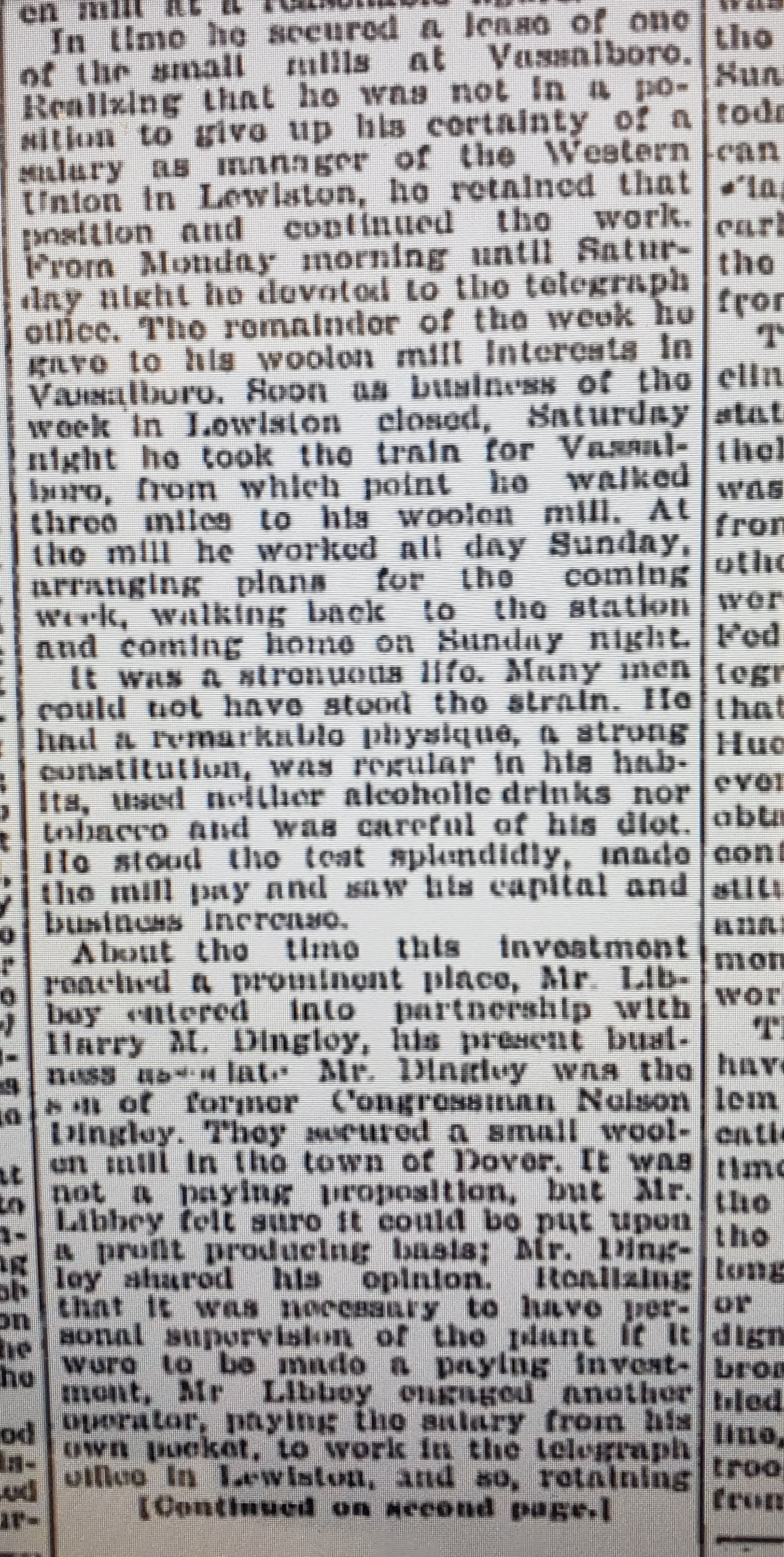
    On Sunday, May 17, 1914, just six weeks before the official public opening of the electric railroad, W. Scott Libbey died. This would cause the restructuring of Libbey's businesses later that year and lead to the name of the electric railroad being changed from the Portland, Gray, and Lewiston Railroad to the Portland-Lewiston Interurban Railroad.

Click Here - May 18, 1914, Lewiston Evening Journal - Through Google News Search - The online edition of the article on the death of W. Scott Libbey is on the front page.

Front page article in the Lewiston Evening Journal -
May 18, 1914.
Click Here to view the Libbey family biography 
of W. Scott Libbey.

Ibid

Ibid

Ibid

Ibid

Ibid

Ibid

Ibid

Ibid

Ibid

Ibid

Ibid

Ibid

Ibid

Click Here to view more background information about W. Scott Libbey, including materials from the  Biographical section of History of Maine.

May 18, 1914 entry of the death of
W. Scott Libbey who had stayed with
Henry Wilson at his farm in West
Cumberland for two
days/nights in April 1913.
Also, on July 2 and July 3, 1914, entries
in the diary of New Gloucester resident
Andrew C. Chandler
Image courtesy of Tom Blake, the curator

Page in the PLI Employees' Scrapbook

The hand-written note above this image reads Lewiston
Journal July 1, 1914

Click Here - July 1, 1914, Lewiston Evening Journal - Through Google News Search - The online edition of the article on the opening of Portland, Gray, and Lewiston Railroad is on page 12.

Ibid

Ibid

Ibid

Ibid


Click Here - July 3, 1914, Lewiston Daily Sun - Through Google News Search - The online edition of the article on the Portland, Gray, and Lewiston Railroad opening is on page 12. The link takes you to the July 2nd edition of the Lewiston Daily Sun...which also includes the July 3rd edition of the Lewiston Daily Sun. You will need to scroll through all the pages of the 2nd and onto July 3rd to page 12. 

July 3, 1914, Lewiston Daily Sun
article on the opening day of the
Electric Railroad.

Passenger tickets from the first day of public operation of 
the Portland, Gray, and Lewiston Railroad on July 2, 1914.

Click Here to view the post that summarizes the opening of the Portland, Gray, and Lewiston Railroad

1914 Diary of Henry Wilson -
    * July 2, 1914 - The Electric road began to carry passengers and collect fares. Willis came out on the 8 am car.
    * July 8, 1914 - Went to Portland on the Gladiolus car at 9:12 and came out on the car that gets to school house at 12:48. 
    * July 16, 1914 - The railroad team went away from here to Lewiston.
    * October 28, 1914 - Carried a switch point down to West Falmouth for the R.R. Co. in pm.
    * November 11, 1914 - George Davis called and paid for hauling the switch point to West Falmouth. A man called here for the R. R. Co. and looked over the things the cook needed.
    * November 12, 1914 - A railroad man called and gave cook supplies that Co. left
    * December 17, 1914 - Willis and I burnt the brush that the railroad men put over onto our land.

George Davis is mentioned in Henry Wilson's diary entry
above. George is seated 2nd in the front row on the right. 
This is a group photo from the 1941 reunion. This was the
last reunion of the former PLI employees.

    Two other former PLi employees who attended the 1941 reunion in Gray at the New Begin Hall were Forest Greenwood and Joseph Levigne. Forest Greenwood is standing near the middle, between two fellas wearing white shirts and ties. Joseph Levigne is seated second from the left. There are four reunions specifically cataloged in the 88-page PLI Employee Scrapbook; June 29, 1938, June 29, 1939,
June 30, 1940, and June 28, 1941. All four of the reunions were held in Gray, ME at the Newbegin Hall. It is noted in newspaper articles of the times, that combined, the total of former PLI employees and their
family members that attended each of the reunions well exceeded 100 in attendance. The PLI operated a very short distance behind the Newbegin Hall seen behind the group in this image. Forest Greenwood donated several items to the Gray Historical Society that were related to his employment at the PLI. Forest also donated a few PLI-related items that belonged to his friend and fellow PLI employee, Joseph Levigne. Click here to open the post about the items donated to the Gray Historical Society. The image of the former PLI employees attending the 1941 reunion is from the PLI employees' Scrapbook in the O.R. Cummings Collection at the Library of Seashore Trolley Museum.

Page in the PLI Employees' Scrapbook

Newspaper clipping from November 27, 1914, Lewiston
Evening Journal with the testimony of the experience
of Mrs. French being a passenger during the early
months of the operation of the electric railroad.

Click Here - November 27, 1914, Lewiston Evening Journal - Through Google News Search - The online edition of the article has a Mrs. French from Portland, while making her opening remarks on parliamentary law, at the Central Maine Hospital, referred to her ride to Lewiston on one of the Portland, Gray, and Lewiston Railroad interurbans. The story is on page 7, in the far left column, under the title "Of Local Interest." The link takes you to the November 25th edition of the Lewiston Evening Journal...which also includes the November 26th and 27th editions of the Lewiston Evening Journal. You will need to scroll through all the pages of the 25th, and 26th, and then onto November 27th to page 7. 

Ibid

    Local residents, along the electric railroad in 1914, that did not live in Lewiston and or in Portland or one of the limited number of stops in between, were not happy that they did not have easier access to riding the high-speed luxury electric railroad interurbans. Complaints won over and in 1915, several more stops were added to the line. There would be a "local" schedule added to the "limited" schedule. 

Beginning in the late spring of 1915, there were several
local stops added to the schedule. Two larger double-truck
cars, No. 40 and 42 were added to the fleet to be the
main sources of local passenger service. These two cars were
not interurban and were not assigned names. 

A 2018 photo of the 1915 Portland-Lewiston waiting station
from Morrison Hill in West Cumberland has been 
at Seashore Trolley Museum in Kennebunkport, Maine,
for more than 30 years. PWM photo
Click Here for a short history of the waiting station.

The last passenger car added to the PLI fleet was No 22,
Maine, in 1920. The large interurban was named Maine
to commemorate Maine's Bicentennial in 1920.
Photo from  G. F. Cunningham within the
O. R. Cummings Collection

Click Here to view the post on the seven high-seed luxury interurbans of the PLI and their fate following the end of operations in 1933.
~~~~~~~~~~~~~~~
Click Here: For the list of links to Theodore Roosevelt Maine Heritage Trail Posts in Easy Order to View

We continue the restoration work on the 1912 Narcissus, the only surviving high-speed, luxury interurban coach of the Portland-Lewiston Interurban. 

Click Here: Narcissus Restoration-Related Posts

Being more than a century old, the stately, "Elegant Ride," Narcissus, is a gem.  This shimmering precious stone of Maine transportation history is brilliantly resplendent as it emanates so many elements of history, including time, places, people, and events, that it was coupled to, that when just a smattering of its seemingly innumerable stories are shared, the contents first captivates, fascinates, then generates interest to learn more 🙋. The majestic Narcissus is listed in the National Register of Historic Places.

Please consider joining the epic journey to complete the Narcissus Project by making a donation today!

Click Here: Donation Options

The restoration of this majestic icon of Maine's electric railway history is but one in a series of captivating stories containing an abundance of incredible coalition of narratives.

Click Here: History-Related Posts - Narcissus and Portland-Lewiston Interurban

     The Narcissus is featured in the national Gold Award-winning novel, Teddy Roosevelt, Millie, and the Elegant Ride. The "Elegant Ride" is the Narcissus. Theodore Roosevelt was a passenger on the Narcissus on August 18, 1914, between Lewiston and Portland, Maine, while campaigning for the Progressive Party candidates.

Click Here: Bookstores and Businesses promoting the Narcissus Project

Independent book publisher, Phil Morse, holding
Gold Book Award Winner plaque for
 Middle Reader category for The Eric
Hoffer Book Award. Congratulations to
award-winning Maine author,
Jean M. Flahive